A serious brain injury can change far more than your physical health.
It can change your career, your relationships, your confidence, your sense of identity—and sometimes the entire direction of your life.
For Dr. Ash Jalli, that turning point came in 1996.
At 20 years old, Jalli was preparing to sign a full soccer scholarship in the United States when he was struck by a car while working in Toronto. The collision left him with multiple orthopedic injuries, and while hospitalized, he experienced a seizure.
But some of the most difficult problems came afterward.
Persistent dizziness, headaches, fainting, fear, and a feeling that the ground was moving beneath him became part of everyday life.
His search for answers would eventually introduce him to chiropractic care, functional neurology, neuroplasticity, and a completely different understanding of the brain.
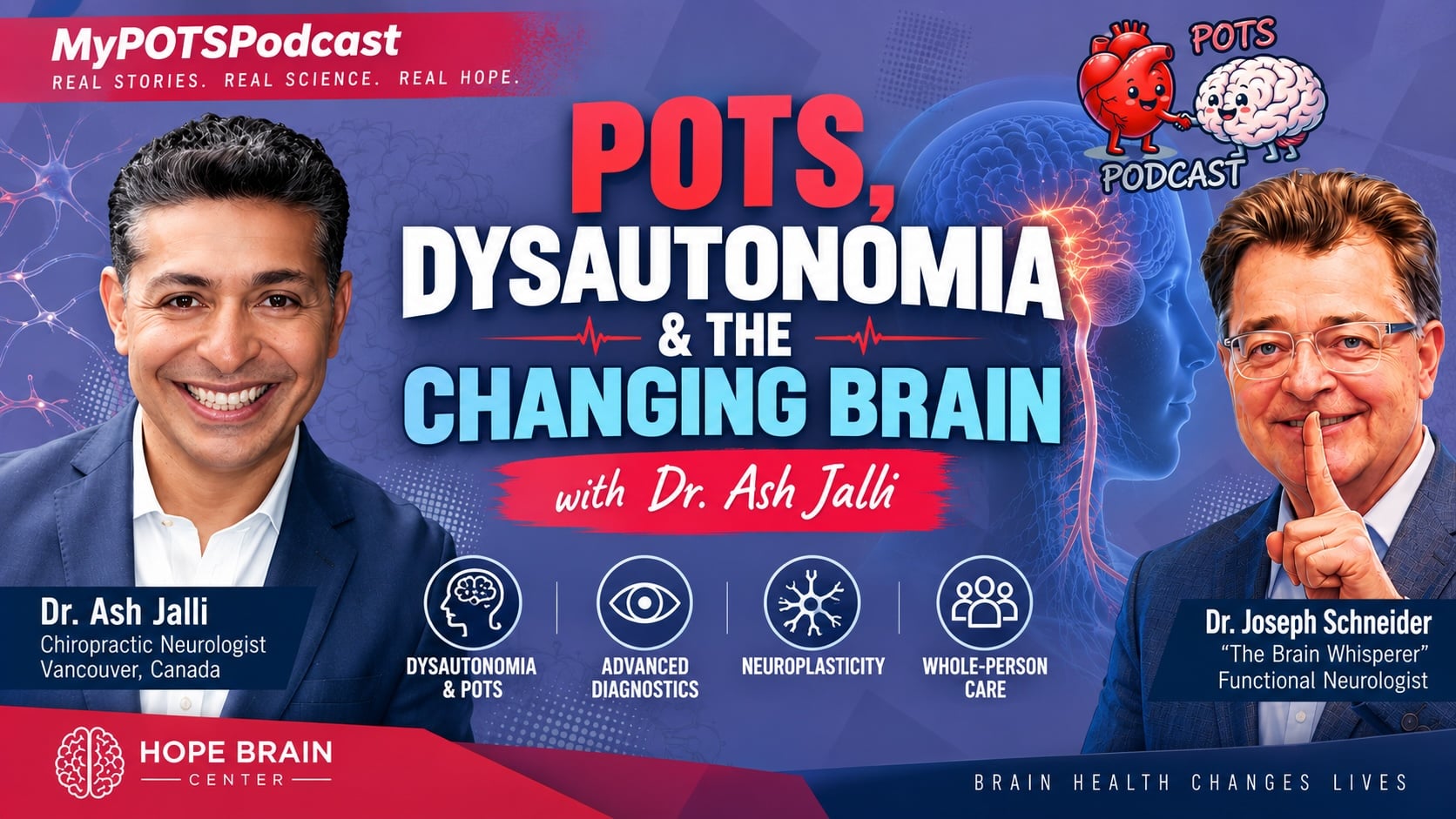
In this episode, Dr. Joseph Schneider sits down with Dr. Ash Jalli of Vancouver, Canada, for a deeply personal conversation about brain injury, recovery, functional neurology, advanced neurological diagnostics, dysautonomia, concussion rehabilitation, and the importance of treating the person—not simply the diagnosis.
Podcast Episode
When One Accident Changes Everything
Before the accident, Jalli’s life revolved around soccer.
He had dreams of becoming both a professional soccer player and a medical doctor. A full athletic scholarship appeared to provide the path forward.
Then everything changed.
After being struck as a pedestrian, Jalli woke up approximately three hours later in the hospital. He describes suffering a fibular head fracture, spinal injury, a dislocated shoulder and other trauma.
A few days later, he experienced a seizure.
Brain imaging at the time did not provide an obvious explanation for what had happened.
After leaving the hospital, however, Jalli realized his problems were far from over.
He experienced persistent dizziness. The floor felt “watery and floaty.” He developed headaches and episodes of fainting.
For a young athlete accustomed to trusting his body, suddenly being unable to trust his own balance and neurological function was devastating.
The Symptoms That Don’t Always Show Up on a Scan
Jalli’s experience illustrates an important challenge familiar to many people living with persistent post-concussion symptoms:
A scan doesn’t always tell the entire story of how someone is functioning.
A patient can continue experiencing dizziness, headaches, cognitive problems, exercise intolerance, balance disturbances or autonomic symptoms even when conventional imaging does not provide a complete explanation for those symptoms.
That distinction between structure and function is central to functional neurology.
Instead of asking only whether structural damage can be seen, clinicians may also investigate questions such as:
- How are the eyes moving?
- How is the vestibular system functioning?
- How does the brain respond to changes in position?
- How is the autonomic nervous system regulating heart rate and blood pressure?
- How well are different neurological systems communicating?
- What changes when the patient is challenged?
- Can those responses be objectively measured and retested?
That last question—can we measure it?—becomes a major theme throughout this conversation.
Four Weeks That Changed the Direction of His Life
After approximately two years of struggling, Jalli was encouraged by his soccer coach at McMaster University to visit a chiropractor near campus.
That introduction became a pivotal moment.
Jalli describes undergoing upper cervical chiropractic care and experiencing a dramatic improvement in the dizziness and fainting symptoms that had affected him for years.
His experience was so profound that it changed what he wanted to do with his life.
But it wasn’t simply the treatment that affected him.
It was the way his doctor approached him.
Jalli explains that he felt seen as a whole human being rather than a collection of symptoms.
That philosophy remains central to how he approaches patients today.
Rediscovering Hope After Brain Injury
One of the most powerful parts of Jalli’s story isn’t technological at all.
It’s about hope.
After losing soccer and struggling with persistent symptoms, he reached a point where he questioned what his future could possibly look like.
His chiropractor challenged him to think differently about his life and his passion.
Jalli ultimately returned to training. Six months later, he tried out for the soccer team and made it.
But something else had changed.
He had discovered what he wanted to spend his life doing.
He eventually attended chiropractic school in Los Angeles, where another important encounter shaped his future: meeting Dr. Ted Carrick and being introduced more deeply to clinical neuroscience and functional neurology.
The concept of **neuroplasticity—the brain’s ability to adapt and reorganize—**resonated with Jalli because he had already experienced recovery personally.
His injury had become the catalyst for his career.
When the Doctor Has Been the Patient
Dr. Schneider and Dr. Jalli share something significant.
Both understand neurological recovery from the patient’s side of the table.
Dr. Schneider has frequently discussed his own recovery following a stroke. Jalli describes years of neurological symptoms following his accident.
That shared experience shapes an important part of their conversation.
Neurological illness doesn’t affect a laboratory result.
It affects a person.
It can affect whether someone can work, exercise, drive, study, play sports, care for children or participate in relationships.
Jalli explains that when his clinic reviewed its patient feedback, one word repeatedly appeared:
Compassionate.
For him, that was deeply meaningful.
His own experience of being injured and searching for answers had shaped the way he wanted other patients to be treated.
Why Concussion Care Has Changed
The tools available to clinicians today are significantly different from those available when Jalli was injured in 1996.
Both doctors discuss the evolution from relatively simple concussion screening toward more sophisticated ways of measuring neurological function.
One important example is video oculography.
Eye movements provide clinicians with valuable information about neurological pathways involved in vision, balance, vestibular processing and brainstem function.
Instead of relying solely on bedside observation, modern systems can record eye movements and create objective data that can later be compared.
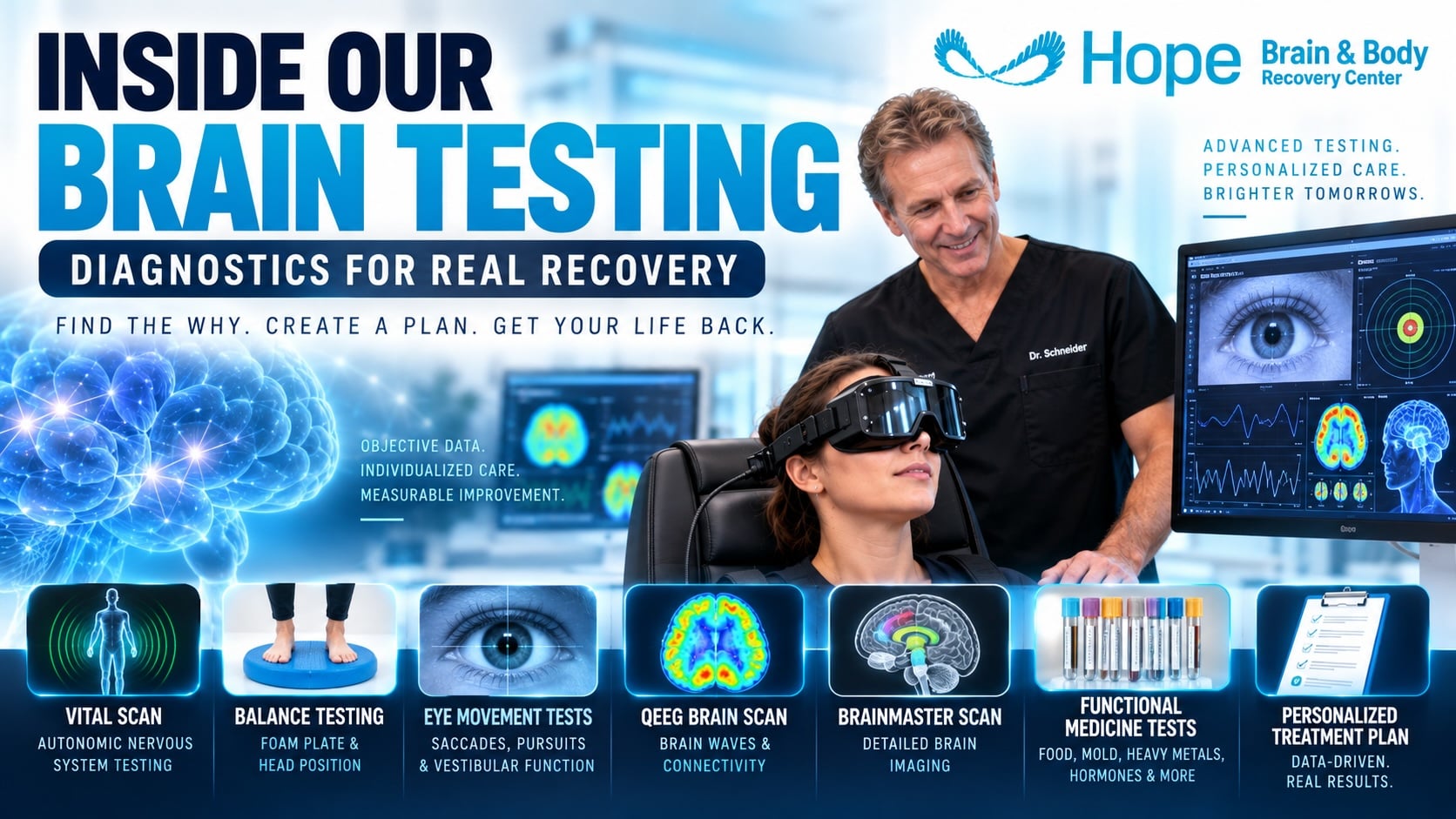
The conversation also discusses technologies and testing approaches such as:
- Video oculography
- VNG testing
- Tilt table testing
- Autonomic testing
- Electrodiagnostic testing
- Visual and auditory evoked potentials
- Motion imaging
- Vestibular assessments
The goal isn’t technology for technology’s sake.
The goal is measurement.
Test. Treat. Retest.
One of the clearest principles discussed in this episode is remarkably simple:
Test, intervene, and retest.
If clinicians establish an objective neurological baseline, they can later determine whether the nervous system is actually changing.
This becomes particularly important in complex neurological cases because every patient is different.
Two people can both be diagnosed with concussion yet have very different combinations of:
- Vestibular dysfunction
- Eye-movement abnormalities
- Autonomic problems
- Cognitive symptoms
- Headaches
- Fatigue
- Sleep disturbance
- Exercise intolerance
- Pain
- Metabolic issues
A diagnostic label is therefore only the beginning.
The neurological systems involved must still be identified.
The Rise of Dysautonomia and POTS
The conversation moves beyond traditional sports concussion into another increasingly important area: dysautonomia.
Jalli says his Vancouver clinic has experienced a substantial increase in patients presenting with autonomic problems and reports seeing more than 350 new dysautonomia patients over roughly the previous year.
Many of these patients present with complex symptoms rather than a straightforward traumatic brain injury.
Dysautonomia can involve disturbances in the systems responsible for regulating involuntary functions such as heart rate, blood pressure, temperature, digestion and responses to changes in posture.
POTS—Postural Orthostatic Tachycardia Syndrome—is one form of autonomic dysfunction.
The doctors discuss the importance of objective evaluation, including tools such as tilt table testing, when trying to understand these complicated presentations.
Why Brain Recovery Requires More Than One Tool
Complex neurological cases rarely exist in isolation.
A patient may arrive with a history of concussion but also struggle with sleep, inflammation, metabolic problems, pain, autonomic dysfunction or other health issues.
That’s why Jalli describes his Vancouver practice as a team.
His multidisciplinary model includes professionals from several areas, including functional medicine, naturopathic care, kinesiology, physiotherapy, chiropractic and acupuncture.
When appropriate, patients may also be referred for other medical or regenerative interventions.
His description is simple:
“It does take a village.”
No single practitioner needs to have every answer.
The strength comes from having professionals who can collaborate when a patient’s needs cross disciplines.
The Three Ingredients: Fuel, Stimulation and Neuroplasticity
Toward the end of the conversation, Dr. Schneider and Dr. Jalli distill brain rehabilitation into several foundational concepts.
The brain requires appropriate fuel.
It requires appropriate stimulation.
And then clinicians need to allow and guide neuroplasticity while continually measuring the patient’s response.
Nutrition and metabolic health may support the biological environment in which the nervous system functions.
Targeted neurological exercises provide stimulation.
Neuroplasticity allows the nervous system to adapt.
And retesting helps determine whether the approach is moving the patient in the desired direction.
Jalli summarizes the philosophy well: give the nervous system the appropriate fuel, provide the appropriate stimulus, and then test again to make sure the patient is actually progressing.
Sleep Is Part of Brain Recovery
Sleep also receives particular attention in the conversation.
As Dr. Schneider points out, it is extraordinarily difficult to rehabilitate a patient whose sleep remains severely disrupted.
Sleep is intertwined with cognition, energy, emotional regulation and neurological performance.
Jalli’s own interest in nutrition and metabolic medicine eventually led him to spend years developing a supplement formulation intended to support people dealing with post-concussion challenges.
He describes studying functional and metabolic medicine and working with a pharmacist to develop the formulation over many years.
He also reports that people using the finished product have described improvements in areas such as sleep, daytime energy and brain fog.
These observations should not be interpreted as proof that a supplement treats or cures concussion, but they reinforce a larger point made throughout the episode:
Brain rehabilitation extends beyond a single neurological exercise or therapy.
The Doctor’s Most Important Role May Be Teaching
Jalli makes another point that deserves attention.
The word “doctor,” he says, is rooted in the idea of being a teacher.
Patients need to understand what clinicians have found.
Why are they dizzy?
Why does standing trigger symptoms?
Why are certain eye movements abnormal?
Why are specific exercises being prescribed?
What are clinicians trying to change?
When patients understand their condition and the reasoning behind their rehabilitation, they can become active participants in the process rather than passive recipients of treatment.
But Jalli adds an equally important qualification:
Before you can teach patients, you have to listen to them.
Functional Neurology Is About the Individual Brain
Perhaps the biggest takeaway from this conversation is that neurological rehabilitation should not become a standardized assembly line.
Every injury is different.
Every nervous system is different.
Every patient’s lifestyle, history, physiology and goals are different.
That is why objective testing and retesting matter.
It’s also why technology alone isn’t enough.
Technology provides information.
Clinical experience helps interpret it.
Rehabilitation provides targeted stimulation.
Nutrition and metabolic support may help create an appropriate physiological environment.
And the patient provides the most important context of all: what it actually feels like to live inside that nervous system every day.
Two Doctors, Two Recovery Stories, One Mission
There is an obvious connection between Dr. Ash Jalli and Dr. Joseph Schneider.
Their stories are different, but both experienced neurological events that profoundly changed their lives.
Rather than moving away from those experiences, they ultimately built their clinical careers around them.
For Jalli, the accident that took away his original dream eventually created another one.
Today, his goal is helping patients find the same thing he once desperately needed himself:
Hope that improvement may still be possible.
Looking for Answers After a Concussion or Neurological Injury?
Persistent dizziness, brain fog, balance problems, headaches, exercise intolerance or autonomic symptoms can dramatically affect everyday life.
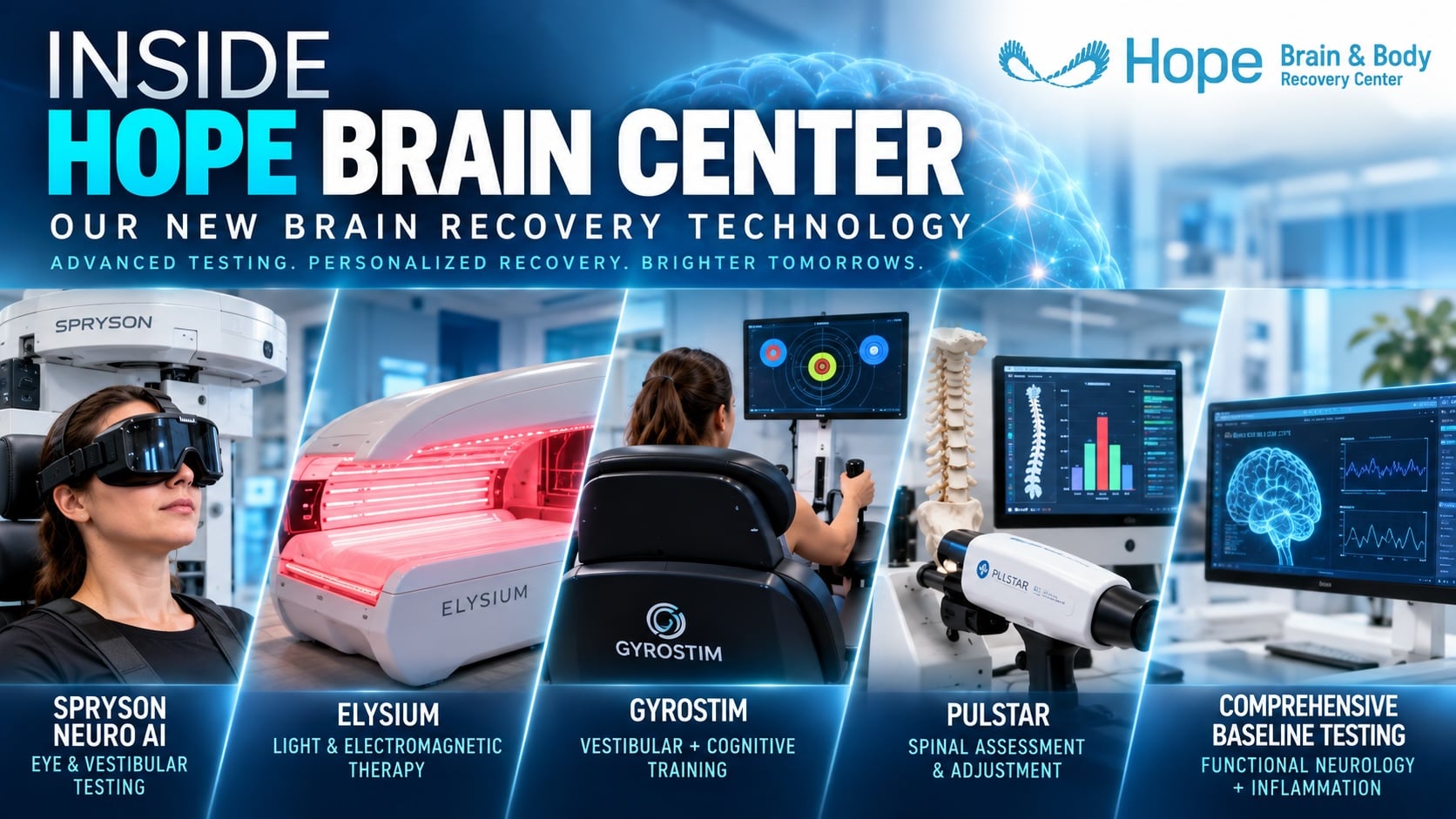
At Hope Brain Center, Dr. Joseph Schneider, Dr. Adam Klotzek and the clinical team use comprehensive neurological assessment and individualized rehabilitation strategies to investigate how the brain, vestibular system, autonomic nervous system and body are functioning together.
Rather than relying solely on a diagnosis, the goal is to identify dysfunctional neurological systems, establish measurable baselines and build an individualized rehabilitation program around the patient’s findings.
Ready to Take the Next Step?
Book a consultation with Hope Brain Center to learn more about our approach to concussion, traumatic brain injury, POTS, dysautonomia and complex neurological rehabilitation.
Our Location:
6 Dickinson Dr, Suite 310, Building 300
Chadds Ford, PA 19317
Frequently Asked Questions
What is functional neurology?
Functional neurology is a clinical approach that evaluates neurological function and uses targeted interventions intended to influence nervous-system performance and neuroplasticity.
Can concussion symptoms continue after imaging appears normal?
Yes. Structural imaging and neurological function measure different things. Persistent symptoms can warrant further clinical evaluation even when conventional imaging does not explain them.
What symptoms can occur after a concussion?
Symptoms can include headaches, dizziness, balance difficulties, brain fog, fatigue, sleep disruption, visual problems, exercise intolerance, mood changes and cognitive difficulties.
What is neuroplasticity?
Neuroplasticity describes the nervous system’s ability to adapt and reorganize in response to experience, learning, injury and targeted stimulation.
Why are eye movements tested after a brain injury?
Eye movements depend on complex networks involving the brainstem, cerebellum, vestibular system and higher brain regions. Measuring eye movements can therefore provide useful information about neurological function.
What is video oculography?
Video oculography uses specialized cameras to record and measure eye movements. The resulting data can help clinicians objectively assess aspects of visual and vestibular function.
What is dysautonomia?
Dysautonomia is a broad term describing dysfunction of the autonomic nervous system, which helps regulate involuntary functions including heart rate, blood pressure, digestion and temperature.
What is POTS?
POTS stands for Postural Orthostatic Tachycardia Syndrome. It is a form of orthostatic intolerance involving an excessive increase in heart rate after standing, along with associated symptoms.
Why is retesting important in neurological rehabilitation?
Retesting allows clinicians to compare objective findings over time and determine whether the nervous system is responding as intended. It can also help guide modifications to a rehabilitation program.
Why is multidisciplinary care useful for complex brain injuries?
Neurological injuries can affect many systems simultaneously. Collaboration between practitioners with different areas of expertise can help address neurological, vestibular, physical, metabolic and other contributing factors as part of a broader care plan.
How can I schedule a consultation?
Contact Hope Brain Center in Chadds Ford, Pennsylvania to schedule a consultation and learn whether comprehensive neurological evaluation and rehabilitation may be appropriate for your symptoms.
📞 Call Hope Brain Center: +1 (610) 652-4732
📅 Book Your Free Discovery Call: Book Your Consultation
Hope Brain & Body Recovery Center
6 Dickinson Dr, Suite 310, Chadds Ford, PA 19317
Visit https://hopebraincenter.com/book/ to learn more about comprehensive neurological rehabilitation and request a personalized consultation.
Transcript
Dr. Joseph Schneider (00:00): Great. Yeah.
Dr Ash Jalli (00:01): How are you? How are things?
Dr. Joseph Schneider (00:03): Good. Yeah, we’re doing really good.
Dr Ash Jalli (00:05): Looking great.
Dr. Joseph Schneider (00:07): Thank you. So do you.
Dr Ash Jalli (00:08): Thanks.
Dr. Joseph Schneider (00:10): We rarely get to really see each other, you know, finally. Exactly.
Dr Ash Jalli (00:16): Good for you that you’re doing this podcast. This is really good.
Dr. Joseph Schneider (00:19): Oh, you’re welcome. But, you know, I’ve been wanting to have you on for a while, you know. You know, like, you know, we keep watching each other on social media. I know, right? And, I mean, I gotta hand it to you. You’re all over the place.
Dr Ash Jalli (00:33): All over the place. My God.
Dr. Joseph Schneider (00:36): Yeah. Yeah. So, you know, Spain. You’ve been teaching in Spain, and. Yes, you got a great practice going on and doing nutritional work. And then the AI program that you have, the app is. It’s really cool. I like it. Yeah, I really like it. I appreciate it.
Dr Ash Jalli (00:55): It’s gonna help a lot of people. It’s gonna help, especially our group, to cut through the noise and figure out exactly why we’re doing what we’re doing. And, you know, if you don’t have, I don’t know, Dr. Carrick available next to you, or you don’t have some of the awesome guys like Azzolino or Shad Groves or Michaelopoulos, Zielinski and the gang, if you don’t have them around.
Dr. Joseph Schneider (01:21): Right.
Dr Ash Jalli (01:22): Let’s go to Cortex iq. It will tell you why you’re doing what you’re doing. What is this reference based on? How did it come about and what could it do? And so it kind of like, it’s a good. Good educational support for us to cut down, you know.
Dr. Joseph Schneider (01:37): Yes. To really filter through all the information. Yeah, yeah. There’s too much sometimes. But you know, what? The. The. As you stick in there and you keep looking at it and reviewing it over and over and over again, it. It does come to some completion for you, you know, certain aspects.
Dr Ash Jalli (01:54): Right, Definitely.
Dr. Joseph Schneider (01:55): And it’s always a learning experience. It never, never stops that way.
Dr Ash Jalli (01:58): You never stop. You’re absolutely right about that. There’s. It’s just not. There’s. It’s not possible. It’s not possible to stop. In this. In this industry of. Of brain health and brain longevity and the things that we do as a group, it’s just incredible. Incredible what we can do.
Dr. Joseph Schneider (02:14): Well, you know, the, you know, functional neurology really hasn’t gotten its place in the marketplace like it should. Right. And, you know, we’ve been trying to do that, you know, since I had a stroke. You know, I had a stroke and, yeah, it kind of really took me out and struggling Back has taught me a lot about neurology just so I can apply to myself and apply to my patients. But no, it’s, it’s, it’s a hard process. And then you know, you, you fight with the medical profession about is plasticity. You know, it really comes down to plasticity. Is plasticity true? Does it happen? Is there a way back?
Dr. Joseph Schneider (02:59): You know, especially like today, I want to get into your story because I know you’ve had concussions and you know, I’ve had my health issues so forth. And I mean for me coming back from illness of any kind is, takes a lot of courage and it takes a lot of persistence for it. So why don’t we go back to that, to your injury, if you don’t mind, you know, sharing.
Dr Ash Jalli (03:25): Absolutely. Not a problem. But, but I remember when I, when I met you a few years back when we were doing the brain dissection in, in Orlando, Florida and you and I were talking about your stroke and then the way you came back from it, it was pretty inspiring to be honest with you, as like we need stories like yours to be told and to be listened to because it’s important for not only our practitioners, the new practitioners, but also our patients. They need to know that the people who are treating them, they’ve had the challenges and they had to overcome the challenges by believing and then applying the neuroscience and neuroplasticity and you know, bring changes back to the brain and then hopefully you can move on with your life and live a better life than before. My story.
Dr Ash Jalli (04:19): 30 Years ago to be exact, I was about to sign a full ride scholarship with a very reputable university in, in the States. I was still in Canada at the time. I was 20 years old finishing high school because I lost a couple of years learning Spanish first in Spain and then coming to Canada learning English. So I was like a late bloomer as a high school graduate. And then I had few months to to kill and save up some money. So when I get the scholarship I can go easily to, to the US and then hopefully.
Dr Ash Jalli (04:56): But it was a full ride, full ride for four years scholarship which unfortunately flew away from me because I got hit by a car as a pedestrian when I was working as a walker career in, in Toronto, Canada and I woke up three hours later in the hospital and I had no idea what happened. All I know, I remember I, you know, the first car that hit me on my left shin, I flew with my head, went to the guy’s windshield and I just, he stopped and I bounced off and that was it. That was the end of it.
Dr Ash Jalli (05:33): So I woke up, this happened on a Tuesday in 1996, and I was supposed to sign this full ride scholarship after a game, a soccer game that I was playing in Toronto indoors, and sign it there with a, with a coach and the scout that wanted to do this in front of tv because we were making also a documentary about refugees coming to Canada and then getting to the next level in their lives because they were integrated, etc. And I was supposed to be part of that as well, too. So I was supposed to sign this full ride scholarship in soccer and then, plus none of it happened.
Dr Ash Jalli (06:12): I lost my role in the documentary and then also didn’t make it to the game because I had a fibular head fracture, I had a broken transfer process on the left, L5 dislocated shoulder, and you name it. But the most important thing, to be honest with you, doc, is it wasn’t really the fractures and the pain that I was in. It’s like third day I, I’ve had a seizure and I didn’t know I had a seizure, so I just didn’t know what happened was happening to my body. I was just, suddenly, everything just spasmed and for I don’t know how many seconds until I was given a medication later on.
Dr Ash Jalli (06:51): And then the doctor said, well, I don’t, I don’t know what happened because we did a CT scan of your brain and there was nothing for us to be suspicious of. So I don’t know what that is, but we’re going to have to give you medication for seizure. So I was on medication, a couple of pain meds and Dilantin and then many other things. And they sent me home after about a week because I just couldn’t handle it anymore. I was in the body. You know, it was a spongebob cast, air cast for the body, holding the TP off and then also the leg. And so I went home. And then the struggle begun when the pain went down because I was dizzy all the time.
Dr. Joseph Schneider (07:35): All the time?
Dr Ash Jalli (07:35): Yeah, all the time. I had no idea why the floor was, was watery and floaty under my feet. I’ve never had anything like that before. I mean, I probably have been concussed before that in soccer because I always, I was one of the players that I, as a striker, I would go head on to the ball and somebody’s foot would just hit me in the face. And, you know, it got your, your bells rang a little bit. And you get up and you start, you shake it off, you move on.
Dr. Joseph Schneider (08:03): Yeah, exactly.
Dr Ash Jalli (08:04): But this was very different, and it just didn’t make sense. Why was I fainting? Why did I suddenly would feel super dizzy and then faint? Or why would I wake up every single day with a headache and not knowing why the medication didn’t help the headaches? And then why was I fainting in the middle of the street when I was with my crutches crossing over the. Crossing the street amongst many other people? Because, by the way, for two years, I had such a fear of crossing the street. So I would wait for I don’t know how many minutes for to have many people around me. So I would, with my crutches, just cross the street so I don’t get.
Dr. Joseph Schneider (08:50): Hit if you learn to compensate.
Dr Ash Jalli (08:54): So I had no idea.
Dr. Joseph Schneider (08:55): Make it look elegant, right?
Dr Ash Jalli (08:58): Everybody else, you know, yeah, that’s. That’s. That. That was the story. But to me, to be honest, you know, I saw a lot of amazing specialists for a couple of years. Went. Started school in. In. In Canada, McMaster University. My dream was always to become professional soccer player and a medical doctor at the same time. Emulating a Brazilian soccer player in 1984 World cup sucrates. He was a captain of the Brazilian team. It was a medical doctor, and he was a professional soccer player. It was very elegant, the guy. And I always wanted to be like him, but none of it happened. So I switched gears. I went to McMaster University.
Dr Ash Jalli (09:41): And then the soccer coach at McMaster University, Tom Casey, he’s like, yeah, you know, you’re suffering from pain and all these issues that you’re dealing with in your. Your soccer career, obviously you said is over, but why don’t you go see this chiropractor across from the campus? Maybe he can help you. That there’s. There’s a bunch of guys from the kinesiology department, they go see him and, you know, for neck pain and back pain. So I went to see this guy, Dr. Robert Thurlow, passed away a decade ago. And he looked at me, took an upper cervical X ray, and he said, did you ever have a seizure or epilepsy when we were a kid? Like, oh, my God, Yeah.
Dr Ash Jalli (10:24): No, I didn’t have an epilepsy when I was a kid, but I had a seizure in the hospital. And so he. He started treating my upper cervical. All he said is this. Well, the brain is under a lot of pressure because there is so much misalignment in your neck. I can’t explain it in any other way, but we have to remove the interference Today we can explain it very clearly. We can explain this issues clearly. We don’t have to say nerve interference, subluxation and things like that. It holds true that you want to become very simplistic in nature, but we know the interruptions that it was causing in my brain stem and the vagus nerve.
Dr Ash Jalli (11:07): Suddenly I would faint because there was a vasovagal syncope of sort, and it was a cervical genic in nature.
Dr. Joseph Schneider (11:13): Yeah.
Dr Ash Jalli (11:15): So I went through that, and this guy fixed it in four weeks. So two years of suffering all went down in four weeks. And so from there are. From there on, I thought, what else could I do to get my passion back? Because I love to play soccer. And the fact that they told me, you can never play again because you have disc herniation, because your neck disc herniation, a lumbar discrimination, you’re gonna get paralyzed, etc. Etc. How could I get back to my normal life? Is that a possibility? And this guy, Dr. Thurlow, very blatantly said, yes, you can. But in a very beautiful way he said it. I said, do you. Do you think I could ever go back to play soccer?
Dr Ash Jalli (12:04): Because that’s, that’s what I need to do in my life. I don’t know. I don’t know anything else. And he said, well, I give you two scenarios and I want you to pick one. One of them is that you, you are on your 22nd floor of your apartment and you have a lot of pain, you take all these medications, you’re dizzy, you have seizures and you can’t play soccer, etc. Etc. And then you one day, you decide, because he know the story, I almost pulled the plug. I didn’t really want to live anymore because if I couldn’t play soccer, I didn’t have anything to look forward to in life as a young refugee in Canada, waiting for the response and immigration and not being able to do anything with my life. It was very difficult.
Dr Ash Jalli (12:53): I almost did that. So he knew their story. He’s like, you know, imagine you’re on the 22nd floor, you’re done with this life, you can’t play soccer. Jump off. And then if you believe in the afterlife, then you go back, you go to the other life, whatever, or if you don’t believe it, you’re done. You just go six feet under, and that’s it. Now let me give you the second scenario. The second scenario is this. You’re playing McMaster versus Western University. This is a rivalry in. In Ontario, the final match of the OUA’s and your coach, Tom Casey, brings you in, is like, hey, I want you to go in the last 10 minutes, and we’re gonna. We’re gonna attack. We’re gonna cross the ball. You had the ball in.
Dr Ash Jalli (13:31): We’re gonna score, and we won’t win. Okay, good. You go in, last minute of the game, they cross the ball, you jump off in the air, you head the ball, you score the goal. Your win, your team wins, you die. Pick.
Dr. Joseph Schneider (13:48): What a guy. What a guy.
Dr Ash Jalli (13:50): And I said, do we win for sure? It was like, yes. I said, I picked the win. Like, great, Then you should die with your passion on you, because otherwise you’re a dead man walking around the world with no passion. That was it, Dr. Schneider. And that was it for me.
Dr. Joseph Schneider (14:08): What a doc. That’s great.
Dr Ash Jalli (14:10): It was incredible. That changed my view about life, to be honest with you. When I thought and I said, like, how long do you think is going to take me to overcome all this? It’s like, however long you think it’s going to take you, but you need to get fit because the athleticism, you still have it, but you haven’t done anything in a year and a half to almost two years. You have to get fit, work with your kin department, work with your trainers and see if there’s. So I did that, and six months I came back, I did a tryout for the team, I got in, and I started applying for McMaster University. The last year that I was there, I decided to do what he does. I said, you know what?
Dr Ash Jalli (14:52): I want to do what Dr. Thurla does. First of all, he looked at me not as a symptom. He looked at me as a whole human being. Secondly, he got into my head and he gave me this amazing description as to how I should live my life, which just giving me two simple scenarios. And it was really easy to pick because I have the passion for that. I said, I would die playing soccer. That’s not a problem. Now at this age, I would say I would die doing what I love the most, which is chiropractic neurology and doing clinical neuroscience work, helping people regain hope. I would die doing that. I have no problem with it because that’s in me, and I love what we do. And that’s how I got into this.
Dr Ash Jalli (15:42): And I dropped everything and went to LA for chiropractic school because I was looking for a market to say, all right, you know what? I speak Farsi, Persian, I speak Spanish, and I speak English. Where is the best place, you know, back then There was no chat GPT. Google was not still in this thing. It’s like, yeah, LA is probably the place where all those three languages are spoken. A lot of people. So I went to Cleveland Chiropractic College in Los Angeles, and I did the. The four years in three years, and I pushed through it. And I met Dr. Carrick on the second year in one of the classes, you know, in school that he was talking about the nervous system and the power of the brain to change changed life.
Dr Ash Jalli (16:25): And I was like, this guy’s talking about me. And then, yeah, they’re on. I. I haven’t stopped since then.
Dr. Joseph Schneider (16:34): Yeah, it hits you. It really kind of hits you, like, really hard when, you know, you meet Dr. Someone like Dr. Carrick, you know.
Dr Ash Jalli (16:41): Oh, yes, it does.
Dr. Joseph Schneider (16:42): Yeah. I met him when I was in New York Chiropractic College. I was a. A student intern with Dr. Napolitano, who’s the president of college at the time. And Ted came in, was lecturing the students, you know, and I attended the lecture. And then as I was going over to his office, Dr. Napolitano’s office, Ted was there, and I got to listen with him talking to Dr. Napolitano. And it was, like, really inspiring because I entered college after I was engineer. I was an engineer for a number of years, and I had back pain, and I went to the chiropractor for back pain. And it was Dr. Bill Oliver, like a fantastic athlete. Guy was like a football player in college, and, you know, had just a tremendous, powerful body.
Dr. Joseph Schneider (17:36): And he goes, you know, Joe, the. The brain is the master control system of the body. And I was. I was doing simulations for power plants. I was like, yeah, like, it is, it is. I want to do that. I want to do that.
Dr Ash Jalli (17:56): Wow.
Dr. Joseph Schneider (17:56): But, you know, when we talk to other chiropractors, there are many, many, many doctors that have had similar stories about, you know, injuries and accidents and coming to realization that chiropractic was a viable philosophy, art and science. Right, for sure. And I can say that since my stroke, I mean, I’ve had several brain injuries, but since my stroke, I’m more appreciative of the. Of the chiropractic science of manipulation and its effect on the body, not only for, you know, musculoskeletal type injuries, but dysautonomia balance and so forth and so on, so.
Dr Ash Jalli (18:45): Absolutely.
Dr. Joseph Schneider (18:46): So you kind of like, you know, that’s. That’s in your toolbox, but it really is your primary portion of the toolbox because, you know, that there Are many, many, many interactions, not only peripherally, but centrally. So, yeah, a really, really great, great, great story. And I think it does take your passion. And when you’re with a patient in a clinical setting, they actually feel that, you know, they, they, they understand, like, where you’re coming from. They do. And the sincerity that you have and the desire that you want healing for them, like you’ve received it over the years and. Very true, very true. Yeah, I think, beautiful to.
Dr Ash Jalli (19:31): Thank you so much. I, honestly, I, I love the fact, and I would say that I’ve been asked this in different podcasts. If you had to change anything in your life, in your experiences, what would you change? I would say nothing. Not even the accident, Because I think the accident was the catalyst for me to be here today to help these people. And I truly believe that. And I don’t think if I would have gotten, if I, if I would have gone to chiropractic school without having this experience, I don’t think I would have been the way I am today, the way I’m practicing. Because something really interesting we looked at.
Dr Ash Jalli (20:14): One of my, one of my staff said, you know, you have about 139 Google reviews that people genuinely go in there and they write a lot of stuff. And then so I remember my, one of my, one of my sons, my young, my older son once is like, hey, dad, have you read this review on you? I was like, well, I. Let me see. So I read and I started crying. I was like, wow, if we’re making this type of changes in people’s lives when they talk about, you know, the effects of post concussion, that their marriage was falling apart, their relationship with their kids was falling apart, and they were feeling depressed. You’ve heard it probably hundreds of times, but we never have the chance to really think about it ourselves. You know, you’re always in the.
Dr Ash Jalli (21:07): You’re trying to get better, you want to add technology, you want to do more more, you want to learn more so you can help more people. You are stuck in your, in your world of go, go, go and treat and treat and treat. You never stop and see what people are talking about you, you know, and then, so this was really interesting for me to read this person’s review. And then I got interested to read all of them all again. And then so I put them all in, in the, in the Google system. I said, pick the top three words that our clinic is well known for. And the number one that came out was compassionate.
Dr. Joseph Schneider (21:59): Oh, wonderful.
Dr Ash Jalli (22:01): And that I will really attribute it to almost 100% to my experience with the accident and the way I was treated. And when I got my license and I started doing functional neurology and the reason I did that was to say never, never again for another person. There is no need for others to suffer when you could have slight clue about what they’re going through and what they’re feeling and what you could do to help them. There is really no reason for them to suffer. So I’m going to be that agent in my little community to give that to the patients that are in need. And that has been unbelievably good to us in many aspects. And I can think energetically, spiritually, whatever, you name it, we are blessed. We are truly blessed.
Dr Ash Jalli (23:04): I mean my family is blessed. I have three amazing kids. I have a beautiful, a phenomenal, spectacular wife. Then what I see what we’re doing for patients is bringing hope to these people and their families and their communities that are suffering with them. Their prayers for us and upon us is protective. I do believe in that. You know, I’m not really a religious guy at all, but I do believe in energy. I do believe in the universe and what you put in it comes back to you. Probably ten folds or more. And it’s, it’s been amazing, it’s been phenomenal to do this.
Dr. Joseph Schneider (23:46): Yeah, well, when I had my stroke, I had a near death experience. I mean, I don’t know how long I was out because you know, in the morning, but I did have near death experience. You know, I was, I considered myself, you know, a good Catholic and you know, went to mass and things like that and you know, sometimes I missed and everything like that. And you know, someone told me, do you believe in or your Lord Jesus Christ? I said, yeah, I do, I do, I do. And then I had that happen to me and I got out of it like, nah, that didn’t happen. That was like, I’m not sure. No, no, no, no, no, no, no, no, that wouldn’t, that wouldn’t happen. That was just kind of a dream. I was having a dream. Wow.
Dr. Joseph Schneider (24:29): And, and then, you know, I got to the hospital and you know, just kept thinking about it. I couldn’t get it out of my mind. And then I said, yeah, I did have it. You know, I did have that experience, right. And it was really a peaceful, beautiful experience and I didn’t want to come out of it. I wanted to stay there. And I was disappointed that he was kind of, kind of threw me back. And then, then from there, you know, right now I’m just very passionate about it and just, you know, you know.
Dr Ash Jalli (25:00): No, I see that, I see your post. I see how you’re educating people, you know, and, and that’s, that’s beautiful.
Dr. Joseph Schneider (25:07): Yeah. So, you know, I mean, I can’t deny it and I can’t move away from it. So, you know, you just kind of have to say, okay, it happened and this is, this is the course of our lives. But I think that, you know, we, we grow spiritually as we treat patients, just like you said, because we’re having life impacts. You know, there is a healing nature of God, whoever you think he is, and how every is in life. You know, it really doesn’t matter, you know, what, what, what your belief is. It’s a personal relationship for sure. Yeah.
Dr Ash Jalli (25:42): 100.
Dr. Joseph Schneider (25:44): And we get really personal with the people that we treat. You know, you really kind of get into their head. You get into like what they’re feeling. You’re trying to understand all the, you know, idiosyncrasies about every aspect of what they’re going through. And then I say to them that when they, when they finish a program, I look at them and say, you know what? I may never see you again, but you’re a part of me. You’ll never not be a part of me.
Dr Ash Jalli (26:12): You’re absolutely right about that.
Dr. Joseph Schneider (26:15): Yeah. And so, you know, and then, you know, I’m getting older. I don’t, I don’t know how old you are, but I’m 68 now.
Dr Ash Jalli (26:22): You’re young. I’m 53. And you look pretty good.
Dr. Joseph Schneider (26:28): Well, that’s, everybody says, like I look in the mirror, I’m like, I don’t know, I don’t look like I did like you three years ago. But it’s, it’s nice to know that you, you have so many people that have become a sincere part of your life because in the complexities and the change in their health and well being and their ability to have a great life impact. Now I’ll get kids that I’ve treated 25 years ago and you know, they’ll, they’ll contact me and you know, tell me that, you know, they’re doing this, they’re doing that, their life has like sincerely changed and it’s just, just marvelous. It really is marvelous. Incredible.
Dr Ash Jalli (27:15): We were so blessed, Dr. Schneider. We were so blessed. And I think one thing that I know for sure is that through our hands, through our hands, because this is, these are the main elements that we have. These are the main weapons that we have to combat A lot of patients, illnesses, but of course, we’re using our brains. And then everything else that we learned from Dr. Carrick and Deutsch and Lee and Z and so on and so forth, so many of those people that we’ve learned from. But at the end of the day, it translates that into our. This touch that we have, that. This energy that we exude through our hands because. Because of what we do. And that touch is, it’s all, it’s all of it is the touch.
Dr Ash Jalli (28:00): And that’s how we’re connected with them, you know, besides everything.
Dr. Joseph Schneider (28:05): So, you know, I, I hired Dr. Adam Klossic in the office, and he’s not like really a hire, he’s just like a, like a partner now. And, And I’m like, wow, I should have done this years ago. Because, you know, this, this level of conversation that you can have with an experienced practitioner is so different than the level, experience that you can have with a new associate or, or somebody that’s been out. Not that that’s a bad thing. You know, we all have to go through that. But for me, it’s. It’s been about three months now. And it really, really, really is exciting to be able to really talk about concepts, like really higher level concepts on a regular basis. Because, you know, you know, in our profession, it’s hard to get together. It’s hard to, you know. Very true.
Dr. Joseph Schneider (28:59): Talk to each other.
Dr Ash Jalli (29:01): He’s lucky. And you’re lucky to have Adam in your, in your clinic. That’s so great.
Dr. Joseph Schneider (29:06): Yeah. Well, I saw him in 2, 20, 20, 24, and I was like, all right, I’m gonna pray for this guy to come to my office. Right. He’s not gonna know about it, but I’m gonna pray that he’s gonna work my office. So I, I just got a spare with the goggle. Yeah. And so, I mean, I had a choice of different doctors to come to the office to do the onboarding. And I’m like, oh, yeah, Adam? Is Adam available?
Dr Ash Jalli (29:37): That’s great.
Dr. Joseph Schneider (29:39): And he got there. We started working together. Like, hey, why don’t you, why don’t you work here?
Dr Ash Jalli (29:44): That’s great.
Dr. Joseph Schneider (29:45): I gave a great offer. Just like, okay.
Dr Ash Jalli (29:47): I guess I didn’t pray hard enough for him to join my clinic.
Dr. Joseph Schneider (29:53): Maybe you didn’t need him as much.
Dr Ash Jalli (29:55): I actually. No, no, he was, he’s. I needed. I always need, you know, someone like, to the magnitude of Adam. I mean, it’s, it would be, it would be dream come true to have someone like him. No, no, because We. We held. I think it was a pain reset program that he was teaching here in Vancouver. So we did it out of my office, out of my clinic three, four years ago. And I tried to get into his head. I was like, hey, you know, Adam, this is the place. You’re Canadian. You can actually live here. Vancouver. I couldn’t. I couldn’t lie to him that we don’t pay too much taxes. It’s not expensive. I couldn’t lie to him. I said, no, we pay.
Dr Ash Jalli (30:36): Everything that we make, we pay in taxes. Life is super expensive. We’re struggling. But you know what? It’s a beautiful place.
Dr. Joseph Schneider (30:44): Yeah. Yeah, definitely. Yeah. So, you know, he still lives in Florida, but, you know, he stays up here like a little over three weeks a month. But it’s like, it’s really great to have them. And now, you know, the other thing is, right, I think that work ethic is not the same today with younger people as it was in. In my time, you know, I agree. I’m sure in your time. So that’s the biggest part. I don’t have to tell him to work. He works and he works more, and then he works more, he works more, and it’s like, it’s really been amazing. So. So I hope he stays and he’s happy, you know, where he’s at. But. But concussion is.
Dr. Joseph Schneider (31:34): Is a really kind of a big, big aspect of what I like to treat on tbi, but it gets more complicated than that, you know, I mean, people have so much. So many other types of illnesses like Lyme. Lyme is big around here. And post covets syndromes and things like that. So very true. I never get a pure TBI anymore.
Dr Ash Jalli (31:58): Be very difficult. But we have a lot of athletes here with. Between the hockey players and soccer players. So we do get some good, you know, level of concussion. But then I think since last year, we had a massive surge in this autonomias and pots.
Dr. Joseph Schneider (32:14): Yeah.
Dr Ash Jalli (32:14): Mass research. And so a lot of people want to explain what is going on. Most doctors, they don’t know what to do with it because they say it’s long Covid or it’s. Well, they don’t know what to do because nobody is doing, you know, till table test, for instance. Only a neurologist is doing that. But when we test those things, like, yeah, you know what, I don’t want to be controversial in nature, but, you know, since COVID started, we have seen this thing. Since people have been using some other treatments for Covid, we’ve seen that increase. We’ve seen, we’re seeing a huge increase in, in that aspect that people are now finally realizing that there’s something wrong, we need to go and treat this. And so there’s nobody else in Vancouver doing what we are doing.
Dr Ash Jalli (33:00): And so we are, I think since last year till this year, so far, we have had over 350 new patients of dysautonomia.
Dr. Joseph Schneider (33:15): Wow, 300. Same thing. Same thing with us.
Dr Ash Jalli (33:18): Yeah, it’s incredible. But the fact that we are able to use the clinical neuroscience and then the kind of stuff that we do, the functional neurological work that we can do, we have been very successful in bringing some great light to these people’s lives and let them, you know, live like a normal human being without being labeled by different specialists. You know, I do work with few of this specialist here in Vancouver that now they know that what we do is science. There is nothing. Just because most chiropractors or physios or physiatrists or neurologists are not doing it doesn’t mean it’s not scientific. It’s just that the fact that most people don’t want to invest in the technology that we utilize to, to treat patients.
Dr. Joseph Schneider (34:13): Yeah. You know, and it does take technology for sure. It’s, it takes away to. For me, measurement is important.
Dr Ash Jalli (34:24): Very true. Data.
Dr. Joseph Schneider (34:26): Yeah, data is important. And also, you know, I remember when years ago with the concussion test they were giving athletes and they were saying, this is your baseline. I’m looking at the baseline. Like well, that’s too simple to be a baseline. Right.
Dr Ash Jalli (34:46): The impact test.
Dr. Joseph Schneider (34:47): Remember the impact testing? Yeah, that’s it. I was trying to find that word. But impact testing was really, really great. And it was a start. But it’s not where we are today. Right. So the really great diagnostic tests we have, vital scan, tilt table test, things like that give you an idea of observation and that you can record. It’s not bedside anymore, it’s recorded, you know, um, and once you have that, then you can build from that so that when you retest you want to see the, the proper changes that, that happen with the nervous system. And that’s really, really important too. But I mean I, I, since I was an engineer, I mean I spent my life applying technology. You know, I did electrode diagnostics, needle EMGs, SSEPs, SUVs, visual event potentials, auditory potentials with TED.
Dr. Joseph Schneider (35:45): I did some testing of isokinetic testing of the low back and the neck and so forth, so on and motion X rays. And so I mean I was really involved in testing, like, from early on, all taught by Ted, you know, And I. I would say that when I worked with him, it was kind of the most fun I had in my entire life, really. It was just fun calling them up. I got this case, and this is what I measured. And what do you think we should do? Don’t adjust the low back. Keep your hands off it. Do everything else. Just the neck, you know, complex movements, you know, all this other stuff. Don’t touch low back.
Dr Ash Jalli (36:31): Oh, my God.
Dr. Joseph Schneider (36:32): Pain. No, they’re going to get out pain. All right, so, you know, a few more visits later, and then he taught us to cast the patient. So I was putting people in body cast and for instability of the low back, and I put them in cast. I take a picture of it and send it to him. He’s like, you really did it. He taught in a seminar. Like, I wasn’t supposed to do it. I was casting these patients. One leg. Oh, my God. And some. Some of these patients who were. Oh, in the 90s, he did a rehab seminar at Logan College in St. Louis, and I was his partner through that. Right. So it was like three days, and we were partnering and he taught casting.
Dr. Joseph Schneider (37:24): And I was seeing a lot of workers comp. Failed back surgery workers comp. Cases where they’d had three, four surgeries. It was kind of like a mess. And so the funny thing is, I, you know, I got a lot of these patients were sent to me by attorneys, and I got to know attorneys really, really well. But, you know, the funny thing is, once they started getting better, I was. See, they weren’t sending me any patients. You know, I was like, don’t get them better. Of course, pile up the case. So, I mean, a lot of these injuries that they. They had, whether it was fall or something like that, we started really, like, doing that. So it’s more like they have chronic low back pain.
Dr. Joseph Schneider (38:11): And where do we find that pain? Well, the pain experience is in the brain. First in the Raphael, nucleus in, and then periacal gray and things like that. And so you started working on that, and then their back pain was going away. Or, you know, we started to change core muscle balance, which kind of really, like, did the trick for it. But I would say that, you know, I really started getting into technology, and then I bought a Teka system and I started doing electrodiagnostics and irrigating ears, making people throw up. Like, I’ll tell you what a learning experience was like. That’s the one thing that I. Yeah,.
Dr Ash Jalli (39:02): I didn’t Go through it. It’s like, I don’t want to do that. I remember, I remember when we were doing the vestibular work in 2006, if I’m not mistaken, it was the first vestibular that anyway, a couple of our colleagues did for, for Carrick Institute. They were talking and then our Italian friends, they brought in the caps and they were talking about the irrigation of the, of the ear. It’s like, I don’t think I want to do that because I went through it when I was, you know, I was going through all this issues with. It was probably one of the most difficult times for me to overcome that irrigation of the water. Caloric in my ears. For weeks I still was feeling that I was sinking in a boat. It wasn’t great.
Dr Ash Jalli (39:48): So I’m like, I would never do something like this to a patient that may feel like me. But, you know, it’s. It was necessary. It was necessary at the time to figure out. But now we have the video oculography vng and then we can do so many great things to figure out what’s going on. It’s fantastic. It’s so great. You are probably one of the, one of the OGs and the, of the system that has worked with Dr. Carrick for a long period of time.
Dr. Joseph Schneider (40:16): Yeah. Yes. It’s 1989. He was here at Westchester, which is Westchester University, and he was teaching, you know, a group of, group of docs. And it was really fun. It was fun. Every weekend was fun. And we really, really had a blast just learning, you know, it was fun afterwards too. But, you know, we won’t go through those stories anymore. We can leave them in the past, but, you know, then it, you know, didn’t brought me a lot of cases where there was brain trauma. A lot of auto accident cases at the time, brain trauma. A lot of young athletes that had brain trauma. And I really experienced a lot of the young athletes, kids that were like straight A students and star on the hockey team.
Dr. Joseph Schneider (41:00): And then they get injured and they can’t go to school and they really can’t play hockey anymore. And a lot of them emotionally were kind of falling apart. They’re like, you know, why should I live anymore? I mean, I’m used to really being a performer and everybody praising me for having these skills and now I can’t do that anymore. And then it just kind of, you know, when you, when you hear that when you’re talking to them and you. And you feel that emotional trauma that they’ve gone through, it Makes you like, okay, is there more I can do? Like, how can we do this? You know, and get the back. And I got a lot of the athletes back. It was.
Dr. Joseph Schneider (41:39): It’s kind of, kind of funny that it all worked out and then, then you get another case and then another one, then another one. And it just like, just hones your skills really, really well and grows your heart too. And it’s, it’s been quite, quite, quite a miracle, as in the process it continues, right?
Dr Ash Jalli (42:02): Yeah, yeah, absolutely. And you always want to, You’re. We’re always looking for how to expand our knowledge base and how to make things better and make it in a shorter period of time or expand our scope to see. So who else can I benefit? Who else can qualify to come and see us? Yeah, right now, you know, I. I remember 2005, I was trying to. I was taking a lot of supplements and things like that, sort of. And then. And I was like, so upset that I had to take so many supplements and none. I don’t. I don’t know if any of them did work for me because I didn’t see any changes.
Dr. Joseph Schneider (42:45): Yeah.
Dr Ash Jalli (42:46): And then. So I’m thinking I told my wife, like, I’m gonna go back to school, I’m gonna learn metabolic medicine, functional medicine, nutrition. I need to know what is going on because nobody is creating anything for the brain. So I went back, I did the Institute of Functional Medicine, A4M. I did their metabolic medicine fellowship, did that in three years. And I started connecting with a couple of friends who were pharmacists and started. I did the formulation for some of the stuff that I was studying. And then after seeing Apex Energetics with Kharazion doing some of this stuff, I was like, you know what? I’m taking a lot of these things, but I don’t think anything is targeting my issues post concussively.
Dr Ash Jalli (43:32): And so I specifically, I wanted to create something for post concussion and see what, what helps. So it took me 12 years after finishing my fellowship in metabolic medicine to come up with the right formula that helped me. I was like, yeah, I’m going to take this. I. And I kind of was doing it for myself, to be honest with you, because I was just. I like to find an answer. And I went and I got this done and I shelved it. I was taking it myself, gave it to my pharmacist and he would kind of compound the supplement for me and I would take it and then some. I think it was 10, 11 years ago here. 10 Years ago here.
Dr Ash Jalli (44:11): When I moved to Vancouver, this doctor, this patient of mine, superb, amazing human concussion. And she was taking a lot of supplements. And I said, look, there is. There are few that I would suggest for you that you should take. Toss everything else out, because they’re really making your system a lot more metabolically disastrous in nature because it’s slowing you down. You’re not even. Not even absorbing it. So she took some of the supplements that I sent her from Karazians from Apex Energetics, and then she came back like, you know, this is really good, but I wish someone came up with just one formula that had a lot of things synergistically affecting the system. I said, well, I have one. It’s like, what do you mean, you have one?
Dr Ash Jalli (45:03): I said, I created one and I’m taking that. It’s like, well, how come you’re not producing it here on the shelves so people can buy it? It’s like, I don’t have time. I’m treating patients and I’m running a business. I don’t have time to do this because I’m sure it involves a lot of things, a lot of, I don’t know, logistics, and I can’t really be involved with that. I’m not a, you know, supplement guy. I was like, well, we can partner up. I’ll do all the logistics. You are the. It’s your formulation is your IP, is yours, etc. Etc. It’s like, okay, here’s the formula.
Dr Ash Jalli (45:42): She created a company, all that stuff, brought it to production, and two years ago, we got the approval from Health Canada, and last year we got approval from FDA to market it in the US it’s been. All the studies that we have done on it showed great efficacy in treating cognitive decline. That’s number one on memory in Canada. We can’t really say too many things about supplements. You have to say it’s just antioxidant and so on and so forth. But in the US when they tested, it’s like, yeah, well, okay. You know, it actually can do these things. But every single person that we have had over the past two years that have been taking this, and you don’t see me to really market this thing, I just don’t do it.
Dr Ash Jalli (46:28): I’m not a good salesperson. I don’t want to sell things. I am who I am. I formulated this thing and I’m going to put it out there. Anybody wants to buy it, they’ll go buy it from the company. I’m not really the face of it at all. And so it’s like, this is great. People are being helped. Their sleep is getting better. They’re. They don’t crash during the day where they’re fog, etc. They’re doing a lot better. Just like the way I experience, it’s like, huh.
Dr. Joseph Schneider (46:55): I only, you know, sleep, you know, sleep has been one of a huge problem. Right. You know, I mean, it’s like, you know, if you want to bring a patient back, you definitely want to get them to sleep. If you can’t get them to sleep, they’re not really coming back. So.
Dr Ash Jalli (47:10): Yeah, so that’s, that’s the reason we’re, we’re in this, in this industry of treating patients the right way by giving them what we know works best for them. They have. First of all, I think our report of finding has to be impeccably strong to show them what they have. Once they understand it, then that’s the really, the, the healing doors open at that moment when they understand what is going on with them. And I always tell patients, I said, look, the meaning of the word doctor is teacher. It’s not a. You teach your patients what they have and what they have to do about their condition, and it’s done deal for you as a doctor, as a teacher. Yeah, that’s what we have to do best, teach our patients.
Dr Ash Jalli (48:00): But we have to listen to them in order for us to be able to teach them.
Dr. Joseph Schneider (48:04): Yeah, yeah. It’s just been a beautiful process, and I can see that for you also. And so, you know, concussion as an injury is really an injury. Just an injury like any other injury. I mean, I really don’t find there’s a lot of differences between the type of injury, whether it’s from a pathogen, a toxin, trauma, emotional trauma, over time, those type of things. So when the brain is injured. Right. I mean, I tell people, like, what happens when a brain’s injured? Well, it loses neurons, it loses architecture. And unless you bring back the architecture, then you’re left with a injured, weak brain, and this just stays that way. So there’s got to be impetus for your, your brain to come back.
Dr. Joseph Schneider (49:01): You know, nutrients are part of it, you know, antioxidants, mitochondrial balance, so forth. But the, the way to get it to come back is through stimulus. That’s, that’s. They’re the keys. There are the three keys that, you know, we try to educate patients for.
Dr Ash Jalli (49:19): Sure, give them the right fuel, stimulate them, and let the neuroplasticity take place the right way. But you always have to do test and retest to make sure you’re on the right path. Because every, every patient is different. Everyone’s lifestyle is different, and that’s really important. In our clinic, we have a naturopath, we have a functional medicine medical doctor here. We have multiple kinesiologists that they run the neuro rehab program. We have a physio, myself and an acupuncture. And then we have two Cairos now and an acupuncturist. And everyone is involved. Everyone is involved. And it doesn’t fail when everyone is involved, because there are times that I don’t have the answer.
Dr Ash Jalli (50:04): I go and knock on my medical doctor’s door and she’s been practicing for 30 years, functional medicine and different types of healings, Eastern healings. And so she’s always like an encyclopedia of information for me. You know, I contact my physiatrist on staff. I was like, hey, you know what? The patient is going to come and see you because we need to release this neck first before we can do anything else. You know, the patient goes there, get their trigger point injections or prolotherapy or prp, and then they come back and then we can do some of this stability, stability games that exercise that we do with them for the brain. It, it, it does take a village, Dr. Schneider. It, it does take a village too.
Dr. Joseph Schneider (50:42): This does.
Dr Ash Jalli (50:44): And, and that’s the beauty of what we do, because we are not really. Yeah, we can’t be egotistical in this, in this arena, because you’re dealing with patients, you’re not only dealing with the patient’s health, you’re dealing with their people around them. A lot of these people are mothers, fathers, they are aunts and uncles and kids. And they have so many other people around them that they get affected by, by, by their, by, by their concussions, by their obviously dysfunctions associated with their concussion. So everything gets affected. And so that’s what I did to, to that aspect. When I said I was reading a review, I was like, oh my God, so many other people were involved in this whole thing, and I didn’t know that I had such a grand effect on their livelihood. That’s, that’s amazing. I’m blessed.
Dr Ash Jalli (51:38): I love it. So it kind of pumps you up and you want to do better and you want to do more. And I think that’s the danger for us, you know.
Dr. Joseph Schneider (51:48): Well, you know, the question is, you know, when you’re going to retire? And I was like, well, what, What? I don’t think so. You know, maybe I’ll work like you know, eight hours a day instead of 10 hours.
Dr Ash Jalli (52:05): Absolutely.
Dr. Joseph Schneider (52:07): So it’s been a pleasure. It’s been a real pleasure. And I thank you so much for making the time to be on with. With me. Thank you. My pleasure is mine. And we’ll make sure the information for your center gets out there so people can. We don’t have a shortage of patients. We have a shortage of people that know and believe in what we can do. And so we just got to get them in the right places so that they can get the help they need.
Dr Ash Jalli (52:33): Let’s do that. Thank you so much for your invitation. I really appreciate the time. It was fantastic.
Dr. Joseph Schneider (52:38): It was a lot of fun. Thank you.
Dr Ash Jalli (52:41): Amazing. Talk to you soon.
Dr. Joseph Schneider (52:42): Bye. Bye.