Most people exercise because they want a stronger heart, stronger muscles, better endurance, or a healthier body.
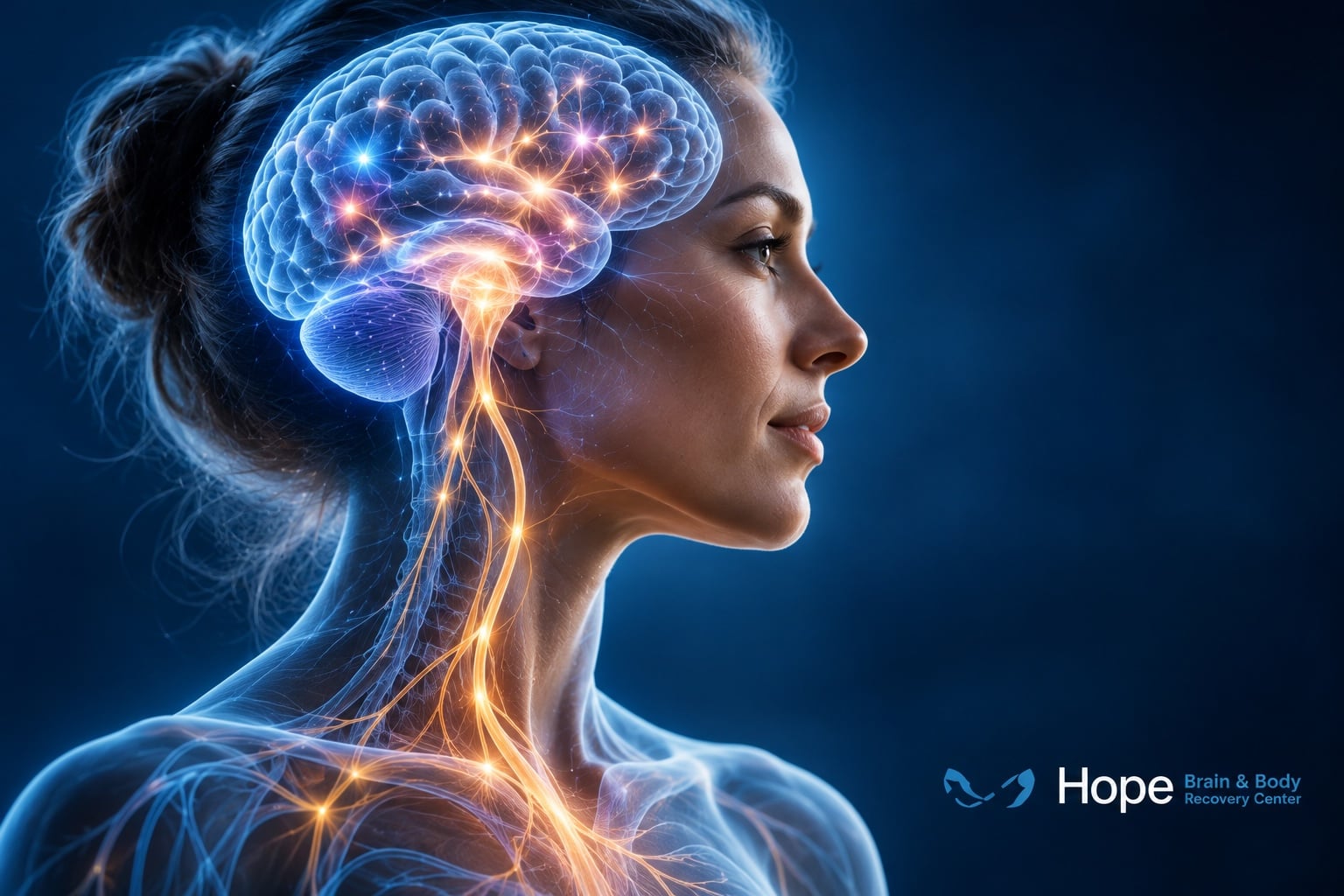
But every time your muscles contract, something remarkable is happening far beyond your arms and legs.
Your muscles are communicating with your brain.
Physical activity releases molecular signals into the bloodstream, alters blood flow within the brain, increases important neurotrophic factors, and influences the biological environment surrounding neurons.
Some of the most interesting effects appear within the hippocampus, a brain region deeply involved in learning and memory.
Research into exercise-induced neuroplasticity is now revealing how signals including BDNF, irisin, VEGF, IGF-1, and lactate may work together to create an environment that supports brain adaptation and, potentially, adult hippocampal neurogenesis. How-Exercise-Triggers-Brain-Cel…
At Hope Brain & Body Recovery Center, this relationship between movement and the brain is particularly relevant because neurological rehabilitation isn’t simply about exercising the body.
It’s about providing the nervous system with the appropriate stimulation to promote neuroplasticity—the brain’s ability to adapt, reorganize, and form new functional connections.
Can Adults Really Grow New Brain Cells?
For many years, scientists believed that humans were born with essentially all the neurons they would ever have.
We now know the story is considerably more complicated.
Adult neurogenesis has been extensively demonstrated in animal models, particularly within an area of the hippocampus called the dentate gyrus.
The dentate gyrus contains neural stem and progenitor cells capable of developing into new neurons.
Exercise appears to influence several stages of this process, including progenitor-cell activity, survival, maturation, and eventual integration into existing neural networks. How-Exercise-Triggers-Brain-Cel…
But there is an important scientific distinction.
Directly observing the birth and functional integration of individual new neurons inside a living human brain is technically extremely difficult. The source therefore notes that direct cell-level proof of exercise-induced neurogenesis in living humans remains inaccessible.
Instead, human research provides converging evidence of exercise-related hippocampal plasticity through biomarkers, brain imaging, cognitive changes, and cerebral blood-flow measurements. How-Exercise-Triggers-Brain-Cel…
So saying “exercise definitely grows new brain cells in humans” goes beyond what current evidence can directly demonstrate.
What we can say is that exercise creates many of the biological conditions associated with neurogenesis and brain plasticity—and measurable changes in human hippocampal structure and function have been observed following exercise training.
Why Is the Hippocampus So Important?
The hippocampus plays a central role in learning, memory, navigation, and contextual processing.
Within it, the dentate gyrus sits at the gateway to an important hippocampal circuit.
One of its functions is pattern separation.
Imagine parking your car in slightly different places in the same parking garage every day. Your brain needs to distinguish today’s highly similar memory from yesterday’s.
Pattern separation helps keep those experiences distinct rather than blending them together.
The source describes new dentate-gyrus granule cells as contributing to pattern separation and spatial-memory encoding—functions that are particularly relevant when studying the relationship between exercise, neurogenesis, and cognition. How-Exercise-Triggers-Brain-Cel…
BDNF: One of Exercise’s Most Important Brain Signals
If you’ve read about exercise and brain health, you’ve probably encountered BDNF, or brain-derived neurotrophic factor.
BDNF is sometimes casually described as “fertilizer for the brain.”
That’s an oversimplification, but it captures an important idea.
BDNF helps support neuronal survival, synaptic plasticity, dendritic growth, and other processes involved in the brain’s ability to adapt.
The source identifies BDNF as one of the neurotrophins most consistently increased following physical activity.
Even a single aerobic exercise session can temporarily increase circulating BDNF, while repeated training over time may increase resting BDNF levels. How-Exercise-Triggers-Brain-Cel…
At a cellular level, exercise-related BDNF interacts with TrkB receptors, activating signaling pathways involved in neuronal survival, growth, and maturation.
This is one reason exercise has become such an important area of interest in neuroscience and Brain-Specific Rehabilitation.
Your Muscles Talk to Your Brain
One of the most fascinating discoveries in exercise neuroscience is that skeletal muscle isn’t merely mechanical tissue.
Muscle can behave like an endocrine organ.
When muscles contract, they release signaling molecules—sometimes called myokines—that can influence tissues throughout the body.
The source highlights one particularly interesting pathway:
PGC-1α → FNDC5 → irisin → BDNF
During endurance exercise, skeletal muscle increases activity of a molecule called PGC-1α.
This increases expression of FNDC5, a membrane protein from which irisin is derived.
Irisin enters circulation and participates in signaling associated with increased hippocampal BDNF.
Interestingly, the source also notes that FNDC5 is induced within hippocampal neurons during endurance training, potentially creating a local amplification mechanism for BDNF signaling. How-Exercise-Triggers-Brain-Cel…
Think about what that means.
When you go for a run, brisk walk, cycle, or perform another sustained exercise, you’re not merely training your legs.
You’re triggering biological communication between muscle and brain.
Exercise Also Builds the Brain’s Vascular Environment
Neurons need energy.
They need oxygen.
They need nutrients.
And they need a vascular environment capable of delivering those resources.
Exercise influences that environment through angiogenesis—the development and remodeling of blood vessels.
The source describes increased vascular density within the dentate gyrus in exercise models, potentially improving local oxygen availability and delivery of trophic factors to the neurogenic environment. How-Exercise-Triggers-Brain-Cel…
A major molecule involved is VEGF, or vascular endothelial growth factor.
Exercise increases VEGF signaling, which helps promote vascular remodeling.
Another molecule, IGF-1, can be released from the liver and contracting muscle during exercise. The source describes IGF-1 crossing the blood-brain barrier and interacting with signaling pathways within hippocampal progenitor cells. How-Exercise-Triggers-Brain-Cel…
This gives us an important principle:
Supporting brain plasticity isn’t just about neurons.
Blood vessels, metabolism, immune cells, muscles, and growth factors all participate in the environment that allows the nervous system to adapt.
What About Lactate?
For decades, lactate had a bad reputation.
Many people still think of it simply as an unwanted waste product produced during hard exercise.
Modern physiology paints a very different picture.
Lactate is also a signaling molecule and metabolic fuel.
During higher-intensity exercise, circulating lactate rises. The source describes lactate entering neurons through monocarboxylate transporter 2, or MCT2, and influencing CREB signaling, BDNF transcription, and mitochondrial processes. How-Exercise-Triggers-Brain-Cel…
This helps explain why exercise intensity can change the molecular signal produced by a workout.
Higher-intensity exercise can create larger temporary lactate elevations, which are associated with larger transient BDNF responses in the research summarized by the source. How-Exercise-Triggers-Brain-Cel…
But this does not mean everyone should immediately start doing maximal-intensity interval training.
Intensity is only one part of the equation.
Recovery matters too.
HIIT vs. Moderate Exercise: Which Is Better for the Brain?
This is where the research gets especially interesting.
High-intensity interval training and moderate continuous aerobic training don’t necessarily produce identical biological effects.
According to the source, HIIT generates pronounced lactate surges and strong irisin-linked signaling, creating larger temporary BDNF elevations.
Moderate continuous training, meanwhile, appears particularly useful for supporting sustained vascular remodeling and a more consistent trophic environment within the hippocampus. How-Exercise-Triggers-Brain-Cel…
So which is better?
That may be the wrong question.
The source describes them as complementary rather than competing.
HIIT may provide powerful acute molecular signals, while moderate continuous exercise can provide sustained vascular and trophic support.
Most importantly, very intense exercise isn’t automatically better.
The source cautions that extremely intense regimens may increase some aspects of neuronal differentiation without equivalent vascular and trophic support, potentially limiting functional benefits. Exercise volume, regularity, and adequate recovery all influence the overall response. How-Exercise-Triggers-Brain-Cel…
How Much Exercise Does the Brain Need?
This is probably the question most people want answered.
The evidence summarized in the source identifies a useful target:
At least 30 minutes per session, 3–4 times per week, for at least 12 weeks, at moderate-to-vigorous intensity. How-Exercise-Triggers-Brain-Cel…
Programs of three weeks or less frequently failed to produce sustained changes in resting BDNF, suggesting that the brain’s longer-term adaptations require consistency.
Longer individual sessions can also generate greater acute BDNF responses.
Perhaps most encouragingly, the source indicates that consistency and overall exercise volume may matter more than choosing one perfect exercise modality. Multimodal programs performed several times per week can increase BDNF similarly to purely aerobic programs. How-Exercise-Triggers-Brain-Cel…
In other words:
The best brain exercise program may be the one you can perform appropriately and consistently.
Exercise May Change More Than Today’s Brain Chemistry
Exercise doesn’t only create temporary chemical changes.
Repeated exercise may influence how certain genes are regulated.
The source describes epigenetic remodeling involving neurogenic and vascular-related genes.
Chronic aerobic exercise can alter DNA methylation patterns around genes such as VegfA, potentially contributing to more persistent changes in gene expression. How-Exercise-Triggers-Brain-Cel…
This may help explain why a single workout and a consistent exercise habit don’t have identical effects.
One workout sends a signal.
Repeated training can create adaptation.
That’s one of the fundamental principles of neuroplasticity.
Exercise Can Influence the Brain’s Immune Environment Too
There’s another player in this story: microglia.
Microglia are specialized immune cells within the central nervous system.
Their behavior can influence the environment surrounding developing and existing neurons.
The source describes exercise-related changes in hippocampal microglia through the CX3CL1–CX3CR1 fractalkine pathway, shifting their behavior toward a state described as more supportive of neurogenesis. How-Exercise-Triggers-Brain-Cel…
Again, this illustrates why the effects of exercise cannot be reduced to a single molecule.
BDNF isn’t acting alone.
The source’s central model involves multiple signals converging simultaneously:
BDNF + irisin + VEGF + IGF-1 + lactate + vascular remodeling + immune modulation. How-Exercise-Triggers-Brain-Cel…
The brain responds to exercise as an integrated biological event.
What Evidence Do We Actually Have in Humans?
This deserves special attention because much of the mechanistic neurogenesis research comes from animal models.
Human studies cannot currently watch individual new hippocampal neurons being born and integrated in real time.
But researchers can measure other outcomes.
The source highlights four major lines of human evidence.
Circulating biomarkers: Regular aerobic exercise increases circulating BDNF and irisin.
Brain imaging: Randomized studies in older adults have demonstrated hippocampal volume changes following sustained aerobic training.
Cognition: Exercise programs have been associated with improvements in functions that depend heavily on the hippocampus, including spatial navigation, episodic memory, and pattern separation.
Cerebral blood flow: MRI techniques have demonstrated increased hippocampal perfusion following exercise training. How-Exercise-Triggers-Brain-Cel…
These findings don’t individually prove that a particular person has generated a particular number of new neurons.
Together, however, they provide compelling evidence that exercise changes the human brain.
Why This Matters for Neurological Rehabilitation
For a healthy person, exercise may help support cognitive performance and long-term brain health.
For someone recovering from neurological injury or living with neurological dysfunction, movement can potentially serve another purpose.
It can become a controlled neurological stimulus.
At Hope Brain & Body Recovery Center, Brain-Specific Rehabilitation is based on the understanding that the nervous system can change in response to appropriate stimulation.
This is the principle of neuroplasticity.
But “exercise more” isn’t a neurological rehabilitation program.
The type of movement, intensity, duration, complexity, sensory input, cardiovascular demand, and patient’s tolerance can all matter.
A person recovering from a Traumatic Brain Injury may require a very different starting point from a healthy athlete.
Someone recovering from a stroke may need exercise integrated with targeted motor, sensory, visual, or balance rehabilitation.
And someone with dysautonomia or POTS may not initially tolerate the same upright or high-intensity exercise prescription as someone with normal autonomic function.
The goal isn’t maximum exercise.
It’s the appropriate neurological dose.
More Exercise Isn’t Always Better
This point is especially important.
It’s tempting to read that HIIT produces strong BDNF and lactate responses and conclude:
“Then I should exercise as hard as possible.”
That’s not what the evidence says.
The source specifically emphasizes volume, regularity, and recovery as determinants of the overall neurogenic response. How-Exercise-Triggers-Brain-Cel…
For some patients, vigorous exercise may be inappropriate.
People with significant exercise intolerance, post-exertional worsening, autonomic dysfunction, recent neurological injury, cardiovascular disease, or other medical conditions may require individualized exercise guidance.
The objective is to provide enough stimulus to encourage adaptation without overwhelming the person’s ability to recover.
Your Brain Was Built to Respond to Movement
Exercise isn’t simply a way of burning calories.
Movement creates biological information.
Your contracting muscles release signals.
Your cardiovascular system changes blood flow.
Your brain increases neurotrophic signaling.
Blood vessels remodel.
Metabolic molecules communicate with neurons.
Immune cells alter their behavior.
And repeated training may even change how certain genes are regulated.
The source summarizes the process as a convergence of multiple signals rather than a single “exercise molecule.” How-Exercise-Triggers-Brain-Cel…
That may be one reason physical activity has such wide-ranging effects on the brain.
The body and brain were never separate systems.
When the body moves, the brain receives the message.
Can You Use Exercise to Support Your Brain?
For many healthy adults, consistent aerobic activity provides a powerful foundation for supporting brain health.
The evidence reviewed here favors regularity over occasional heroic workouts.
But if you’re dealing with a neurological condition, concussion, stroke, dizziness, autonomic dysfunction, cognitive changes, balance problems, or exercise intolerance, the question becomes more individualized.
Instead of simply asking:
“How much exercise should I do?”
A better question may be:
“What type and dose of exercise gives my nervous system the stimulation it needs while still allowing me to recover?”
That’s where neurological assessment and individualized rehabilitation become particularly valuable.
Build a Brain That Can Adapt
At Hope Brain & Body Recovery Center, we use the principles of neuroplasticity to help patients understand and address complex neurological dysfunction.
Exercise can be an extraordinarily powerful signal for the brain—but it is only one potential component of neurological rehabilitation.
By understanding how your brain is functioning and identifying which systems need support, rehabilitation can be designed around your nervous system rather than a generic exercise prescription.
👉 Schedule your FREE 15-minute consultation with Hope Brain & Body Recovery Center and talk with our team about whether a comprehensive neurological evaluation and individualized rehabilitation approach may be appropriate for you.
📍 Our Location: 6 Dickinson Dr suite 310 Building 300, Chadds Ford, PA 19317, United States