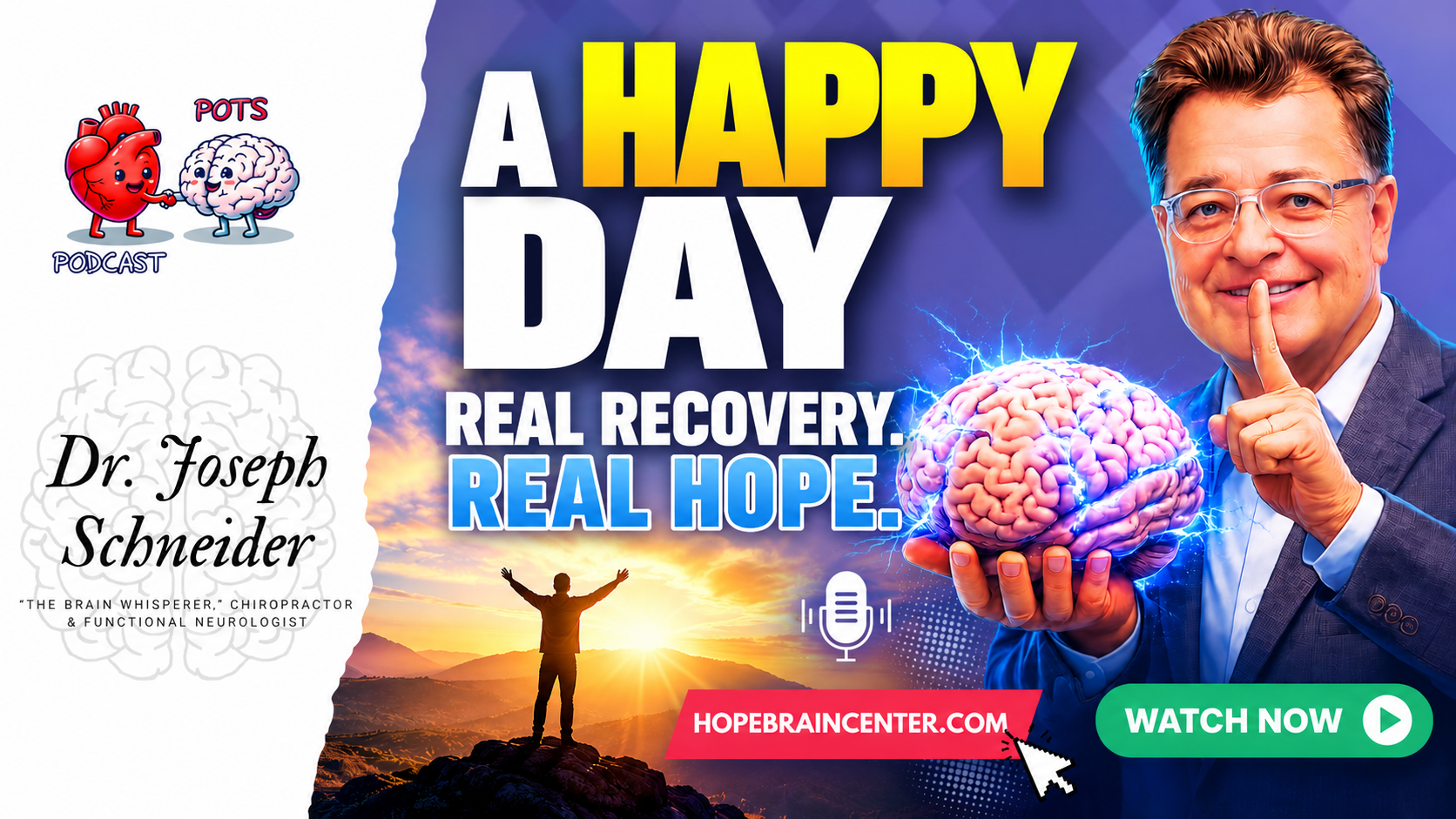
Host: Dr. Joseph Schneider — “The Brain Whisperer”
What happens after the symptoms begin to improve? In this deeply personal episode of MyPOTSPodcast, Dr. Joseph Schneider looks beyond neurological rehabilitation to something patients aren’t always prepared for: returning to life. Drawing on his own stroke, multiple brain traumas, childhood losses, family relationships, divorce, and recovery, Dr. Schneider explores why getting physically better can uncover a completely new set of challenges. From returning to work and rebuilding relationships to confronting fear, setting boundaries, finding support, and rediscovering purpose, this episode is ultimately about four things Dr. Schneider believes can help people move forward after life-changing illness: hope, faith, courage, and resilience.
Getting Your Life Back After Brain Injury
When Dr. Joseph Schneider was recovering from his stroke at Jefferson, one word became enormously important to him.
Hope.
But it wasn’t because he initially felt hopeful.
It was because he experienced the opposite.
Hopelessness.
The feeling that there might be no way out.
No way to get better.
No way to return to the person he had been.
No way to get his life back.
That experience ultimately helped shape not only Dr. Schneider’s recovery but also the philosophy behind Hope Brain Center.
Because treating an illness is one thing.
Helping someone get their life back is another.
Recovery Isn’t Just About Symptoms
When someone becomes seriously ill, life can begin to revolve around symptoms.
Appointments.
Tests.
Treatments.
Pain.
Fatigue.
Medications.
Rehabilitation.
Whether today is a good day or a bad day.
But eventually, for some patients, something begins to change.
Symptoms decrease.
Function improves.
Energy returns.
And suddenly a question appears that may be more complicated than expected:
What do I do with my life now?
Dr. Schneider says he sees this challenge in real patients.
When illness has profoundly changed someone’s life, getting physically better doesn’t automatically restore everything that was lost.
Sometimes recovery exposes problems that illness temporarily pushed into the background.
The Red Bicycle That Started a Lifetime of Memories
To explain where his own understanding of resilience comes from, Dr. Schneider goes back to childhood.
One of his strongest memories involves his grandfather.
When Joe was about four years old, the older children in his neighborhood were riding bicycles while he tried desperately to keep up on his tricycle.
His grandfather noticed.
He told Joe’s father:
It’s time to buy him a two-wheeler.
Cost didn’t matter to his grandfather.
At the toy store, Joe saw a beautiful red bicycle sitting high on a shelf.
That was the one.
His grandfather bought it.
When they returned home, Joe’s father expected him to use the training wheels for a while.
His grandfather had another idea.
Take them off.
Teach him to ride.
That day, his father ran alongside him until young Joe learned to ride the bicycle.
Cycling would remain important throughout Dr. Schneider’s life.
But the memory means far more than a bike.
It represents being seen.
Being encouraged.
And having someone believe you can do something before you’re completely sure yourself.
Losing His Grandfather—and Then His Father
Those memories became even more precious because the people behind them disappeared far too soon.
Dr. Schneider’s grandfather died when Joe was five.
His father died when he was seven.
He describes them as two powerful patriarchs in his family.
Both were deeply connected to their community in Riverside, New Jersey.
As a young child, Joe had accompanied them everywhere.
Then, within only a few years, both were gone.
Those early losses became part of his life story.
They also exposed him to something he would encounter repeatedly throughout adulthood and eventually in clinical practice:
Trauma changes people.
Trauma Doesn’t Always Look the Same
Dr. Schneider also remembers his Uncle Herb, who had served during the Battle of the Bulge.
He describes his uncle returning from war profoundly affected by what he had experienced.
At the time, people commonly used terms such as “shell shock.”
Today, we have a much broader understanding of post-traumatic stress disorder and trauma-related symptoms.
Trauma can follow combat.
But it can also follow:
- Serious illness
- Accidents
- Physical injury
- Loss
- Relationship breakdown
- Frightening medical experiences
- Chronic stress
- Other emotionally overwhelming events
Not every stressful experience produces PTSD, and ordinary work stress should not automatically be described as a brain injury.
But prolonged or overwhelming stress can have significant effects on sleep, cognition, mood, autonomic regulation, behavior, and overall health.
For someone already recovering from neurological illness, those additional burdens can matter enormously.
What Does It Mean to Lose “Capacity”?
Dr. Schneider often talks about capacity.
Following his stroke, he experienced firsthand what it felt like when his brain could no longer perform at its previous level.
He uses a simple analogy.
Imagine an eight-cylinder engine.
Now imagine only six cylinders are working properly.
The engine may still run.
But it doesn’t have the same capacity.
Following a stroke or other neurological injury, damage to brain tissue and neural networks can impair particular functions.
That might affect:
- Memory
- Attention
- Processing speed
- Movement
- Balance
- Speech
- Reading
- Mental endurance
- Emotional regulation
- Other neurological abilities
The exact effects depend on the injury.
For Dr. Schneider, understanding reduced capacity also changed the way he views patients.
Sometimes people aren’t refusing to perform at their old level.
They may not yet have their old level available to them.
A Patient Is More Than a Brain Scan
Neurological patients rarely arrive with one perfectly isolated problem.
Dr. Schneider describes patients dealing simultaneously with issues such as:
- Pain
- Fatigue
- Digestive problems
- Immune-related concerns
- Hormonal problems
- Cognitive difficulties
- Emotional stress
- Relationship problems
- Work-related stress
That complexity matters.
A clinician may be treating a neurological problem, but the patient is still living inside a family, a career, a marriage, a social network, and a personal history.
All of those things can influence the experience of recovery.
This is one reason Dr. Schneider believes the ultimate goal must extend beyond improving neurological findings.
The patient wants a life.
What Happens When You Get Better—but Don’t Want Your Old Life Back?
Dr. Schneider describes a situation he sees with some patients.
At the beginning, they say:
“Get me better so I can go back to work.”
So they work.
They rehabilitate.
Their capacity improves.
And suddenly returning to work becomes realistic.
That’s when anxiety appears.
Because perhaps that job was deeply stressful.
Perhaps they hated it.
Perhaps the environment was unhealthy.
Perhaps returning to the old life means returning to some of the same circumstances they no longer want.
Recovery can therefore force a difficult question:
Do I really want my old life back—or do I want to build a different one?
Physical Recovery and Life Recovery Are Not the Same Thing
Dr. Schneider makes an important distinction.
Getting better is one challenge. Facing life afterward is another.
Think about an athlete returning after a major injury.
The body may be ready.
But the athlete remembers what happened.
What if I get injured again?
What if I have to go through rehabilitation again?
What if I’m not the same athlete?
Fear of reinjury is a recognized challenge in sports rehabilitation.
A similar dynamic can occur after serious illness.
The patient may technically be capable of doing more while emotionally remaining afraid of what happens next.
That doesn’t mean the recovery failed.
It means another stage has begun.
Recovery Can Change Relationships
Illness also changes relationships.
During the worst period of a person’s illness, other people may step in.
They help.
They drive.
They make decisions.
They provide reassurance.
They take on responsibilities.
As independence returns, those dynamics may change again.
Dr. Schneider discusses how complicated that can become.
Some relationships become stronger.
Others reveal problems that had been there long before the illness.
And sometimes recovery requires establishing boundaries.
Learning to Set Boundaries
Dr. Schneider is careful to point out that he isn’t a psychologist or psychiatrist.
But through his own experiences and those of his patients, he has seen how often recovery forces people to confront difficult relationships.
Sometimes misunderstandings can be resolved.
Sometimes support appears from places you didn’t expect.
And sometimes, he says, a relationship continually pulls a person down.
That’s when boundaries may become necessary.
The neurological rehabilitation may happen in the clinic.
The decisions about how to live afterward often require a broader support system—and, when appropriate, help from qualified mental-health professionals.
Dr. Schneider’s Own Recovery Wasn’t Just Neurological
This isn’t theoretical for Dr. Schneider.
He speaks openly about experiencing three brain traumas and a stroke.
At the same time, his personal life was undergoing enormous change, including a divorce.
People he expected to be there weren’t always there.
The experience required him to reconsider relationships and establish boundaries of his own.
That’s why he doesn’t speak about courage and resilience as abstract motivational concepts.
He needed them himself.
The Person Who Helped Him Keep Going
Dr. Schneider also speaks with extraordinary gratitude about his wife.
He describes her as one of the greatest sources of support in his current life.
Mental support.
Physical support.
Emotional support.
Faith.
Prayer.
Partnership.
Dr. Schneider believes deeply that God placed her in his path during a period when he needed that support.
Every morning, he says, gratitude is one of his first thoughts.
For him, recovery wasn’t something he accomplished completely alone.
And that’s another important lesson.
Resilience doesn’t necessarily mean doing everything yourself.
Sometimes resilience means accepting the people who are willing to walk beside you.
Resilience Was Something He Learned Early
Long before his own stroke, Dr. Schneider had examples of resilience around him.
His mother was one.
After his father’s death, she had to work and support the family.
She raised her children.
She worked demanding jobs.
She earned her real estate license.
She continued caring for other members of the family.
Dr. Schneider remembers her simply continuing to get up and do what needed to be done.
Again.
And again.
That became one of his earliest models of resilience.
Aunt Catherine: More Than 100 Years of Resilience
Another was his Aunt Catherine.
After Dr. Schneider’s father died, she became an important figure in his childhood.
She helped care for the children while his mother worked.
And she had endured struggles of her own.
At the time of this recording, Dr. Schneider says Aunt Catherine was more than 100 years old.
He was planning to see her the following day.
For him, her longevity isn’t the most remarkable part of the story.
It’s what she lived through.
Difficulty.
Loss.
Stress.
Family challenges.
And yet she continued.
When Dr. Schneider talks about resilience, he’s thinking about people like his mother and Aunt Catherine.
People who demonstrated it long before he had a word for it.
Hope Doesn’t Mean Pretending Everything Is Fine
There is an important distinction in Dr. Schneider’s message.
Hope isn’t denial.
It doesn’t mean pretending brain injury isn’t serious.
It doesn’t mean ignoring pain.
It doesn’t mean assuming everything will return exactly to the way it was before.
And it certainly doesn’t guarantee a particular medical outcome.
Hope means believing that there may still be something worth working toward.
Another improvement.
Another relationship.
Another meaningful experience.
Another version of life.
That distinction matters enormously when someone is living through chronic illness or neurological injury.
Courage Is What Comes After Hope
Hope gives someone a reason to imagine another future.
But imagining it isn’t enough.
Eventually, action requires courage.
Courage to undergo rehabilitation.
Courage to discover what abilities have changed.
Courage to return to work—or decide not to.
Courage to step back onto the playing field.
Courage to change a relationship.
Courage to establish a boundary.
Courage to ask for help.
And sometimes courage simply to get up tomorrow and continue.
Resilience Isn’t Returning to the Person You Were
People often describe resilience as “bouncing back.”
But neurological recovery isn’t always that simple.
A serious illness can change someone.
Sometimes permanently.
You may have different capacities.
Different priorities.
Different relationships.
Different values.
Different limitations.
Different goals.
Recovery may therefore be less about recreating the exact person who existed before the injury and more about learning how to build a meaningful life with the person you are becoming.
That is where resilience becomes particularly important.
Faith, Hope, Courage and Resilience
Dr. Schneider ultimately brings the episode back to his Christian faith.
For him, faith and hope cannot be separated.
He draws strength from Jesus Christ, the Blessed Mother, St. Joseph, his family, and the people he has watched endure extraordinarily difficult circumstances.
Other patients may draw strength from different beliefs, relationships, communities, or sources of meaning.
But Dr. Schneider’s personal message is clear:
You need something that reminds you not to give up.
For him, that foundation is faith.
From faith comes hope.
Hope makes room for courage.
And courage helps build resilience.
Getting Your Life Back
The phrase Dr. Schneider returns to throughout this episode is simple:
Get your life back.
Not just your balance.
Not just your memory.
Not just your ability to work.
Your life.
Because ultimately, rehabilitation isn’t happening for the sake of a neurological test.
It’s happening so someone can participate in the world again.
Love people.
Ride a bicycle.
Work.
Travel.
Play a sport.
Spend time with family.
Make decisions.
Build new relationships.
Set boundaries.
Laugh.
Pray.
Live.
The goal isn’t simply to survive what happened.
It’s to discover what comes next.
Real Stories. Real Science. Real Hope.
Dr. Schneider’s story began with hopelessness in a hospital room after his stroke.
But it didn’t end there.
His recovery required neurological rehabilitation.
It also required confronting loss, relationships, fear, identity, and major changes in his personal life.
And through it all, he kept returning to examples of resilience—from his grandfather and father to his mother, Aunt Catherine, and eventually his wife.
That’s why hope isn’t simply a word in the name Hope Brain Center.
For Dr. Schneider, it comes from experience.
He remembers what hopelessness felt like.
And he knows why giving someone a reason to believe there may still be another chapter matters.
Ready to Start Getting Your Life Back?
If a brain injury, concussion, stroke, POTS, dysautonomia, dizziness, cognitive problems, or another chronic neurological condition has significantly changed your ability to participate in everyday life, a comprehensive neurological evaluation may help identify areas that deserve further attention.
At Hope Brain Center, Dr. Joseph Schneider and his team evaluate neurological function and develop individualized rehabilitation strategies based on each patient’s findings, history, and goals.
Start With a Discovery Call
📞 Call Hope Brain Center: (610) 652-4732
📅 Book Online:
https://hopebraincenter.com/book/
Hope Brain Center
6 Dickinson Dr, Suite 310
Chadds Ford, PA 19317
Getting better is one thing. Getting your life back is the goal.
Frequently Asked Questions
Why is hope important during brain injury recovery?
Hope can give patients a reason to continue participating in rehabilitation and working toward meaningful goals. Dr. Schneider discusses hope primarily through his own experience of profound hopelessness following his stroke.
Can a stroke reduce cognitive or neurological capacity?
Yes. Depending on the location and severity of a stroke, damage to brain tissue can affect movement, cognition, language, balance, memory, attention, and other functions.
What does Dr. Schneider mean by “capacity”?
Dr. Schneider uses capacity to describe the functional resources available to the brain and nervous system. He compares neurological injury to an eight-cylinder engine operating with fewer functioning cylinders.
Can emotional trauma affect recovery from neurological illness?
Psychological stress, trauma, anxiety, depression, and PTSD can influence sleep, cognition, behavior, quality of life, and participation in rehabilitation. Patients experiencing significant psychological symptoms may benefit from appropriate mental-health care alongside medical and neurological treatment.
Why can returning to work be difficult after recovery?
Improved physical or neurological function doesn’t necessarily remove anxiety about returning to a stressful environment. Recovery can also cause patients to reassess whether their previous job or lifestyle remains appropriate for them.
Why might athletes fear returning to sport after injury?
Fear of reinjury is common after significant sports injuries. An athlete may worry about another injury, losing performance, or repeating a difficult rehabilitation process.
Can relationships change during chronic illness?
Yes. Serious illness can change roles, responsibilities, dependence, communication, and expectations within relationships. As health improves, those relationships may need to adjust again.
What role do boundaries play in recovery?
Dr. Schneider discusses boundaries as part of protecting physical and emotional well-being when patients return to everyday life. Significant relationship difficulties may also benefit from support from a qualified mental-health professional.
What is resilience?
Resilience generally refers to the ability to adapt and continue functioning in the face of adversity. It doesn’t mean a person isn’t affected by trauma or illness.
Does resilience mean doing everything alone?
No. Dr. Schneider specifically describes the importance of his wife’s support during his own recovery. Support from family, friends, clinicians, faith communities, and mental-health professionals can all play important roles.
What role does faith play at Hope Brain Center?
Christian faith is personally important to Dr. Schneider and is a recurring part of his own recovery story and philosophy. In this episode, he describes faith as a major source of hope, gratitude, courage, and resilience in his life.
How can I schedule a consultation with Hope Brain Center?
Call (610) 652-4732 or visit https://hopebraincenter.com/book/ to request a consultation.