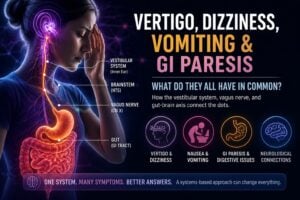
In this episode, Dr. Joe Schneider dives deep into the complexities of POTS (Postural Orthostatic Tachycardia Syndrome) and its broader connection to dysautonomia—a condition affecting the autonomic nervous system. Patients often face a wide range of debilitating symptoms, including chronic fatigue, tachycardia, digestive problems, erratic weight changes, and disrupted neuroendocrine function.
Overview: E3 – Beyond POTS – Understanding the Complex Web of Dysuatonomia
- POTS encompasses a range of autonomic issues; dysautonomia is a more encompassing term for patient’s symptoms, including chronic fatigue, tachycardia, and digestive problems.
- Cardiologist screening is critical in the initial assessment of POTS patients to rule out potential heart conditions before proceeding with treatment.
- Autonomic nervous system is extremely complex, involving multiple components for brain-body communication, highlighted by the hypothalamus-pituitary axis.
- Dr. Schneider’s personal experience with stroke and resultant neurological dysfunction provides a compelling context for understanding dysautonomia.
- The neuroendocrine system communicates via hormones affecting crucial bodily functions such as metabolism and blood pressure, often disrupted in dysautonomia cases.
- In pediatric patients, overactive sympathetic and underactive parasympathetic systems manifest as key symptoms, such as bedwetting in adolescent boys.
- Neuroinflammation can weaken brain function and connectivity, impacting cognitive processing and emotional regulation in individuals with dysautonomia.
- Patients with dysautonomia often experience erratic weight changes, with some gaining significant weight while others face severe appetite suppression.
- Emphasis on individualized, non-pharmacological treatment approaches is essential for effectively addressing the complexities of each patient’s case.
- Dr. Schneider advocates for health policy reform, supporting Robert F. Kennedy Jr. in promoting transparency and health improvements to combat chronic diseases.
Notes
👋 Introduction & Welcome (00:00 – 00:30)
- Dr. Joe Schneider introduces himself as a functional neurologist with 35 years of experience, sharing his personal stroke recovery journey and mission to help patients with POTS and neurological wellness.
- Podcast focuses on breakthrough solutions for neurological challenges, from basic daily activities to nervous system rebuilding.
🩺 POTS and Dysautonomia Overview (01:36 – 03:00)
- POTS patients present with wide range of autonomic issues beyond postural orthostatic tachycardia syndrome, making dysautonomia a more accurate umbrella term.
- Common symptoms include chronic fatigue, fibromyalgia, migraine headaches, digestive issues, temperature sensitivity, dizziness, and tachycardia.
- Cardiologist screening identified as essential first step to rule out heart pathology before treatment.
- Traditional treatments like hydration and electrolytes help but don’t address complete autonomic nervous system dysregulation.
🧠 Autonomic Nervous System Complexity (01:36 – 03:24)
- Autonomic nervous system described as the most complex control mechanism between brain and body, involving multiple interconnected components.
- Hypothalamus-pituitary axis breakdown includes various pituitary regions, hormones for endocrine function, sleep regulation, and circadian rhythm control.
- System involves both peripheral wiring and bloodstream communication via hormones.
🩹 Dr. Schneider’s Personal Medical Experience (03:24 – 05:21)
- Dr. Schneider shares his hemorrhagic stroke experience affecting left basal ganglion, resulting in Parkinson’s-like symptoms due to basal ganglion damage.
- Stroke also affected his thalamus and hypothalamus, providing personal insight into neurological dysfunction.
🔄 Neuroendocrine System Function (05:21 – 07:00)
- Hypothalamus-pituitary communication occurs through bloodstream rather than direct wiring, releasing hormones affecting thyroid, adrenal glands, thymus, and digestive tract.
- System controls metabolism, thermoregulation, blood pressure, thirst, mood, and sleep – all commonly dysregulated in dysautonomia patients.
👶 Pediatric Dysautonomia Manifestations (05:21 – 07:16)
- Young patients often present with overactive sympathetic and underactive parasympathetic nervous systems.
- Bedwetting in adolescent boys identified as key dysautonomia indicator, showing severe autonomic system dysfunction affecting central nervous system regulation.
🔥 Neuroinflammation Connection (08:59 – 10:30)
- Neuroinflammation causes destruction or weakening of brain areas and wiring systems, with hypothalamus and pituitary responding to reduce inflammation.
- Inflammation serves healing purpose but becomes problematic when it affects cognitive processing, emotional regulation, and physical functions like temperature regulation and blood pressure.
⚖️ Weight and Appetite Dysregulation (10:30 – 12:06)
- Dysautonomia patients experience dramatic weight changes – some gain 40 pounds rapidly due to increased hunger systems, while others develop anorexia-like symptoms.
- Eating disorders commonly seen in teens, with some autistic children requiring force-feeding due to autonomic dysfunction.
💡 Treatment Approach Philosophy (10:30 – 13:00)
- Focus on non-drug, non-surgical interventions to improve nervous system function, particularly autonomic nervous system.
- Each patient presents unique, complex cases requiring individualized approaches due to varying medical histories and interventions.
- Treatment goal involves transforming patient stories ‘from tragedy to hero mechanism’ by restoring central nervous system, peripheral nervous system, and neuroendocrine system function.
🗳️ Health Policy Discussion (13:43 – 14:30)
- Dr. Schneider expresses support for Robert F. Kennedy Jr. as potential Secretary of Health and Human Services.
- Advocates for Kennedy’s ‘Make America Healthy Again’ movement focusing on reducing chronic diseases through organic food and health system transparency.
- Clarifies Kennedy’s vaccine position as promoting transparency and safety improvements rather than anti-vaccination stance.
Transcript
00:05
Dr. Joe Schneider
Welcome to my POTS podcast. I’m Dr. Joe Schneider, and after 35 years as a functional neurologist, a personal journey through stroke recovery and helping thousands of patients, I’m here to share breakthrough solutions for POTS neurological wellness. From getting out of bed in the morning to rebuilding your nervous system, this is your guide to understanding and overcoming neurological challenges. Let’s begin this journey to recovery together. Okay. This is mindpods podcast. I’m Dr. Joseph Steiner, functional neurologist, functional medicine, functional neurological doc. And today we’re going to be talking about something that’s really talked about in the world of pots. Really, the people that we have calling us about POTS had a wide range of other autonomic issues.
00:57
Joseph Quirk
Yeah, it’s very widespread.
00:59
Dr. Joe Schneider
Widespread, right, exactly. So we have postural orthostatic tachycardia syndrome, chronic fatigue. We have fibrogylia headache, pain, like migraine type headaches. They have digestive issues. They have issues with if they take a hot shower or temperature change, cold temperature change. They can have dizziness, attack, cardia also. So we’re finding that it’s really the better term for people that are calling with POTS is dysautonomia. So we ask people that they get screened by the cardiologist. That’s the number one thing needs to be done. We need to know that the heart is, has no pathology in it. And so a lot of times people are on hydration, electrolytes, and they find that it helps, but it doesn’t take care of all the dysregulation they have in their autonomic nervous system or it doesn’t take care of all their dysautonomia.
02:08
Dr. Joe Schneider
So the autonomic nervous system is the most complex control mechanism of your brain and your body. Would you say that?
02:20
Joseph Quirk
So many components to it. I mean, just the breakdown of just trying to even get through the hypothalamus, pituitary axis alone, you know, with everything between all the different regions of your pituitary glands and all the hormones that they release in order to help with endocrine function, in order to help with sleep function, circadian rhythm. It really is just such a in depth topic and just kind of starting to break down that hypothalamus pituitary axis. We can just start right off with the hypothalamus.
02:59
Dr. Joe Schneider
Right. So we always talk about the peripheral effects of the sympathetic nervous system and the parasympathetic nervous system. Yes. So there’s distinct wiring that we get from the brain to the body through the spine and from the vagus nerve itself that comes from the midbrain. So we have this interaction of sympathetic parasympathetic. And there’s sometimes there’s the fright flight and the rest digest. But there’s some overlap interactions between that. And if you just concentrate on the brain and body wiring portion of it, you miss out on this beautiful effect that we get from the pituitary hypothalamus, which interacts with your body through your blood in your bloodstream. So we have a huge amount of wiring that goes into your peripheral circulation, your sweat glands, your capillaries.
04:09
Speaker 3
Right.
04:10
Dr. Joe Schneider
And that’s really important to make sure that is regulated properly. But you also have your thalamus. That’s in your subcortex. Now, I had a stroke. I had a hemorrhagic stroke. My blood vessel popped on my left and took out my basal ganglion. So by default, I have Parkinson’s because I had lost my power to my basal ganglion, which is what Parkinson’s is, really. It’s a degenerative disease of it. It’s not extrapolated. But neurologically, I had Parkinson’s. Another part of that subcortex that I had a lesion on is the hypothalamus or the thalamus.
05:01
Speaker 3
So the thalamus is a sensory integration area where it puts the information into different parts of your cortex. Kind of fascinating, don’t you think? And then from the thalamus, you have the pituitary gland and also the hypothalamus. And that’s going to communicate with the body, not by wiring. It’s going to communicate with the body by your bloodstream. And it’s going to put in all these hormones into your system. That changes the function of things like your thyroid gland, your. Your adrenal gland, those two. And then you look at your thymus for immune system. You look at also your digestive tract, because there are certain chemicals that communicate with the brain when you’re digesting food, like your stomach, right. Glucagon, insulin, from your pancreas, they all go into your bloodstream.
06:07
Speaker 3
And we know that the hypothalamus pituitary is controlling all those things for your metabolism and thermoregulation and blood pressure. Thirst, mood, sleep, which is the part of the dysautonomia that we see most often, are all these types of functions that are not regulated properly. Now, a lot of kids that we see in the office will have overactive.
06:45
Joseph Quirk
Sympathetic nervous system, underactive, parasympathetic.
06:48
Speaker 3
Yeah, but they’ll have. One of the key features that a lot of the boys have is bedwetting. Young boys. Right. You think young boys, but even 12, 13, 14, 15, 16 years old can have issues with bedwetting. Right. Which is a dis. Autonomic system. Your autonomic nervous system isn’t functioning properly, and they don’t realize it, but they’re peeing their beds. They’re peeing out their diaper onto the bed, onto the pad of the bed, then into the mattress. They’re peeing so much that dysregulation means is that your whole central effect of your nervous system, whether it’s the wiring to sympathetic and parasympathetic or it’s the neuroendocrine aspect of it, is totally out of whack. All right, so it’s dysfunctional. It’s not operating right. It’s totally out of whack. So then we’re left with what. What do we do with the system?
07:56
Speaker 3
Autonomic nervous system is out of whack.
07:58
Joseph Quirk
Try to return it to homeostasis.
08:00
Speaker 3
Yeah.
08:01
Joseph Quirk
I mean, try and find that original balance.
08:04
Speaker 3
So, you know, that’s what we come up with in the office, is the different types of functional things that we can get so that we can correct a maladapted, a malwired and a mal. Neuroendocrine aspect of function. All right, so last time we talked about neuroinflammation. And so with neuroinflammation, we know that we get a destruction or a weakening of different areas of the brain, different wiring systems. And also if you think about the hypothalamus and the pituitary that we just talked about, they’re responding to that inflammation. They want to kind of get rid of it, right? Yeah. They want to get your body to function beyond it. So nor inflammation can really start to cause your body to dysregulate. And that’s what we’re left with because.
09:02
Joseph Quirk
At what point is it too much? Inflammation can be great, but at what point is inflammation too much? You know, it’s there to fight off infections, and we. We want to fight off infections, especially within the brain.
09:15
Speaker 3
Well, that’s totally correct. Right. So it has to be a homeostasis. You need inflammation for healing. Right. To initiate healing within the body. But you’re right. When does it get too much? When it gets too much is when it affects your function. So if you look at the brain and what’s the purpose of the brain is for us to respond to our Environment and our world. Okay. And so if it affects you mentally, where you can’t process things cognitively the way you should. Right. Make the proper decisions, it can affect you emotionally and it can affect you in a lot of physical ways, like with temperature regulation, homeostasis, as far as your temperature is concerned, your blood pressure, food cravings, appetite. You know, people come in with dysautonomia and say, well, I just gained 40 pounds. Like, just like that.
10:16
Speaker 3
And that’s because that their hunger, the system of hunger has increased too.
10:22
Joseph Quirk
Well, what’s so wild about that is that it can go both ways with that as well. You know, you may have somebody come in who’s just kind of battling with anorexia now too. You know, they’re not just gaining weight either. It’s, it’s that loss of weight potentially as well. And it really just kind of comes down to each individual and how their body handles that dysfunction.
10:45
Speaker 3
Exactly. So, you know, we do have people that have come in with eating disorders and they have eating disorders through their teen years. I haven’t worked with a lot of people that have eating disorders later on, but there are eating disorders actually with kids with autism where they have to be force fed to get them to eat. And so I think in modern neuroscience, we’re going to look for ways that are non drug ways and non surgical ways to improve your nervous system, especially with your autonomic nervous system. I would say that’s the most important thing to do. So it’s kind of a new way of thinking and it’s a new way of approaching it. And we like to think that we’re in the forefront of solving those problems.
11:42
Joseph Quirk
I wouldn’t say we like to think it, I like to think that we know it. You know, I mean, technology advances each and each every day, and we’re right on top of it. New information comes out each day and right on top of it with that as well. So.
11:58
Speaker 3
Yeah, yeah, I think so. The approach is the right approach. And with each patient, they’re all different. It’s never a classical problem.
12:09
Joseph Quirk
Never an easy problem.
12:10
Speaker 3
No, exactly. And due to their medical interventions, due to the way they approach things, it can become very complex. And so when you take on a patient, especially a patient with POTS and with the overriding dysautonomia, then each person has a story to tell and we have to change the story from a tragedy to a hero mechanism. Right. So we want people to get their life back and they want people to be secure in their life. By making sure that their central nervous system, their peripheral nervous system, and their neuroendocrine system are all functioning the way they should. I’m wearing Make America Healthy again. I think that Kennedy is trying to take us in the right direction so that we don’t have all these chronic diseases or there’s less of chronic diseases. So we’re hoping that John Kennedy puts us out of business.
13:12
Joseph Quirk
John, are you aging yourself?
13:15
Speaker 3
Oh, yeah, I am aging myself. I’m thinking way back, that’s when I was a kid. You know what I mean? Like, my father loved John Kennedy, so the Kennedys are still a big part of what’s going on in this world. And, I mean, I hope he’s confirmed and becomes the new Secretary of Health and Human Services. Right? Yeah.
13:38
Joseph Quirk
It’s super important to just get back to the roots of healthy, organic food. Big movements with all of that.
13:46
Speaker 3
Well, a lot of people are just more fixated with him on vaccines. I don’t think he’s anti vaxxer. What I think he wants to do is he wants more transparency and he wants to develop the vaccine so that there’s less harm to our kids and our individuals having vaccine schedules that make more sense. Hopefully it gets confirmed and we get more scientific evidence about the good and the bad of everything that we’re doing in our health system. Well said. Yeah, well said. So thank you for participating in my Potts podcast and we’ll see you next time around.
14:32
Dr. Joe Schneider
Thank you for joining us on my POTS podcast. If you’re looking for more support, Visit us at hopeprayingcenter.com or follow our journey on Tik Tok, where we share daily insights and inspiration. Remember, healing is possible. I’m living proof. I’m Dr. Joseph Schneider and I’ll see you next time as we continue exploring paths to recovery.