Have you ever wondered why a sudden episode of dizziness can leave you nauseated—or even vomiting?
Or why some people with chronic migraines also struggle with digestive issues like bloating, delayed stomach emptying, or early fullness?
At first glance, these symptoms seem unrelated. Vertigo affects the inner ear, while nausea and digestive problems involve the stomach and intestines. Traditionally, they have often been treated by different specialists.
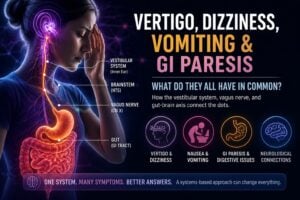
However, modern neuroscience is revealing something remarkable: these symptoms are frequently connected through a shared network involving the brain, vestibular system, vagus nerve, autonomic nervous system, and gastrointestinal tract. Rather than representing separate conditions, they may be different expressions of the same underlying neurological dysfunction.
Looking Beyond Individual Symptoms
Many patients spend years visiting neurologists, gastroenterologists, ear, nose, and throat (ENT) specialists, and primary care physicians—each addressing one symptom at a time.
A patient may receive treatment for:
- Vertigo
- Chronic dizziness
- Nausea
- Vomiting
- Gastroparesis
- Migraines
Yet despite multiple appointments and medications, the symptoms continue.
One reason may be that these conditions are not isolated. They can share common neurological pathways, making a systems-based approach essential for identifying the root cause.
The Surprising Connection Between Your Inner Ear and Your Gut
The vestibular system, located within the inner ear, is responsible for balance, movement, and spatial orientation.
Most people associate it only with dizziness or vertigo.
What many don’t realize is that the vestibular system has direct neurological connections to areas of the brainstem that also regulate digestion.
One of the key structures involved is the nucleus tractus solitarius (NTS)—a brainstem center that receives information from both the vestibular system and the gastrointestinal tract. Because these signals converge in the same region, disturbances affecting balance can also influence digestive function, helping explain why motion sickness, vertigo, and nausea often occur together.
The Vagus Nerve: The Communication Highway
One of the body’s most important communication pathways is the vagus nerve, also known as cranial nerve X.
Often called the “information superhighway” between the brain and the body, the vagus nerve carries approximately 80% of its signals from the body back to the brain.
It helps regulate:
- Stomach motility
- Digestive secretions
- Sensations from the gastrointestinal tract
- Communication with brainstem centers involved in balance and vomiting
Because of these extensive connections, changes in vagal function can influence both digestive health and vestibular symptoms.
Why Vertigo Often Causes Nausea and Vomiting
When the brain receives conflicting balance signals, it activates protective centers that help coordinate nausea and vomiting.
These include the chemoreceptor trigger zone (CTZ) and the brainstem vomiting center, which integrate information from multiple sources, including:
- Vestibular input
- Signals from the gut
- Circulating toxins
- Pain pathways
When activated, this network can produce a cascade of symptoms that includes dizziness, nausea, vomiting, and changes in digestive activity.
Vestibular Migraine: More Than Just a Headache
One of the most important conditions linking these symptoms is vestibular migraine.
Unlike traditional migraines, vestibular migraines may present primarily with:
- Vertigo
- Dizziness
- Motion sensitivity
- Nausea
- Vomiting
Some individuals experience little or no headache at all.
The presentation also highlights that migraine-associated gastroparesis—delayed stomach emptying during migraine attacks—may contribute to bloating, early fullness, prolonged digestive symptoms, and reduced absorption of oral medications.
The Role of the Autonomic Nervous System
The autonomic nervous system (ANS) regulates many automatic body functions, including:
- Heart rate
- Blood pressure
- Digestion
- Balance adaptation
- Vagal tone
When autonomic regulation becomes disrupted, both digestive and vestibular symptoms may appear together.
The presentation identifies conditions such as diabetic autonomic neuropathy, autoimmune disorders, and post-viral syndromes as examples where autonomic dysfunction may contribute to both gastroparesis and vestibular dysfunction. It also notes that autonomic testing—such as tilt-table testing and heart rate variability analysis—may help identify shared dysfunction.
A Real-World Example
The presentation describes the journey of a 38-year-old woman who initially sought care for vertigo and severe headaches.
Over time, she developed recurrent vomiting, bloating, and early satiety. Testing eventually confirmed gastroparesis, but her digestive condition was treated separately for 18 months before clinicians recognized the broader picture.
Ultimately, she was diagnosed with vestibular migraine involving autonomic dysfunction, and an integrated treatment approach led to significant improvement across all four symptom groups. This case illustrates how treating symptoms in isolation can delay recognition of an underlying neurological pattern.
Understanding the Gut-Brain Axis
Researchers increasingly recognize the gut-brain axis as a key framework for understanding complex symptom clusters.
According to the presentation, several mechanisms may contribute:
- Central sensitization, where amplified neural processing lowers the threshold for vestibular, pain, and gastrointestinal signals.
- Microbiome influences, which may affect vagal tone and neuroinflammation.
- Shared inflammatory pathways, potentially contributing to dysfunction in both vestibular nuclei and enteric neurons.
Why a Systems-Based Approach Matters
The biggest takeaway from this presentation is that patients benefit when clinicians look beyond individual symptoms.
Rather than asking, “Why is this person dizzy?” or “Why are they nauseated?” a broader question may be more helpful:
“Could these symptoms share the same neurological origin?”
This systems-based perspective encourages coordinated evaluation of vestibular function, migraine disorders, autonomic regulation, and digestive health, rather than treating each problem separately.
Hope Brain & Body Recovery Center’s Approach
At Hope Brain & Body Recovery Center, we understand that symptoms rarely exist in isolation.
Our comprehensive neurological evaluations consider how the brain, vestibular system, autonomic nervous system, and gastrointestinal function work together. By identifying the underlying patterns contributing to dizziness, migraines, digestive symptoms, and autonomic dysfunction, we create personalized care plans designed to improve function—not just manage symptoms.
Take the Next Step Toward Answers
If you’re experiencing recurring vertigo, chronic dizziness, nausea, vomiting, migraines, or unexplained digestive symptoms, there may be more connecting them than you realize.
You don’t have to keep treating each symptom separately.
👉 Schedule your FREE consultation today to learn how a comprehensive neurological evaluation at Hope Brain & Body Recovery Center can help uncover the root cause of your symptoms and create a personalized path toward recovery.