POTS doesn’t always arrive alone.
For many patients, the racing heart, dizziness and exercise intolerance associated with autonomic dysfunction are only one part of a much larger neurological picture.
Chronic fatigue.
Vestibular dysfunction.
Digestive problems.
Brain fog.
Mast cell issues.
Ehlers-Danlos syndrome.
Changes in motivation and behavior.
And sometimes symptoms that don’t fit neatly into any single diagnostic category.
In this episode of MyPOTSPodcast, Dr. Joseph Schneider sits down with longtime colleague Dr. Aaron Root, chiropractor and functional neurologist, to explore why today’s neurological patients appear increasingly complex—and why understanding the relationships between different brain and body systems may be just as important as finding the right diagnostic label.
Their conversation moves from POTS and post-COVID dysautonomia into vestibular function, Parkinson’s disease, neurochemistry, chiropractic neurology, nutrition, supplementation and interdisciplinary care.
But one theme connects nearly everything they discuss:
The nervous system doesn’t operate as a collection of isolated parts.
Podcast Episode
POTS Is Changing
Dr. Schneider begins the conversation with something both clinicians have noticed in practice:
They’re seeing more POTS and dysautonomia.
But they’re also seeing a different type of patient.
Dr. Root describes patients presenting with autonomic dysfunction alongside multiple other health challenges.
Dr. Schneider specifically points to combinations involving:
- Chronic fatigue
- Ehlers-Danlos syndrome
- Mast cell activation issues
- Post-infectious symptoms
- Other overlapping neurological and metabolic complaints
Both doctors discuss how the clinical picture appears to have become particularly complicated following COVID.
This means treating POTS as simply a heart-rate problem may fail to capture the broader neurological picture.
When the Diagnosis Is Only the Beginning
Today’s patients often arrive extremely well informed.
They may already have researched POTS extensively, joined patient communities, undergone genetic testing, explored functional medicine, and accumulated several diagnoses before ever entering a functional neurologist’s office.
That knowledge can be valuable.
But it can also create a problem.
When every symptom becomes attached to another diagnostic label, clinicians can lose sight of the relationships between the systems involved.
Dr. Root describes the need for lateral thinking.
Instead of asking only:
“Which diagnosis does this symptom belong to?”
A functional neurological approach may also ask:
“Which neurological systems are contributing to this patient’s overall pattern?”
Sometimes Complex Cases Need to Become Simple Again
Dr. Schneider describes one of his guiding principles:
When you’re in the middle of the storm with a complicated patient, sometimes you need to step back and simplify.
That doesn’t mean ignoring complexity.
It means breaking the problem into neurological systems that can actually be evaluated.
For example:
- Vestibular function
- Cerebellar function
- Basal ganglia activity
- Prefrontal cortical function
- Autonomic regulation
- Brainstem function
Dr. Schneider discusses using vestibular testing and specialized equipment to identify patterns of weakness and imbalance.
Once clinicians identify the systems involved, they can begin asking a more useful question:
What input does this nervous system need?
The Vestibular System Is About More Than Balance
Most people associate the vestibular system with dizziness and balance.
But its influence reaches much further.
Vestibular pathways communicate with regions involved in:
- Autonomic regulation
- Eye movements
- Spatial orientation
- Posture
- Emotional processing
- Motivation
- Brainstem function
Dr. Schneider and Dr. Root discuss patients whose vestibular dysfunction may coexist with digestive symptoms, anxiety, neurological changes and altered behavior.
This interconnectedness is one reason neurological symptoms can be so difficult to separate into individual boxes.
A patient may describe a stomach problem, a balance problem and an anxiety problem.
But those symptoms may involve neurological systems that are communicating with one another.
What Does Motivation Have to Do With Neurology?
One of the most interesting parts of this episode concerns apathy.
Patients with chronic neurological illness are sometimes described as lazy, unmotivated or unwilling to participate in their recovery.
But Dr. Schneider and Dr. Root discuss why motivation itself can have a neurological component.
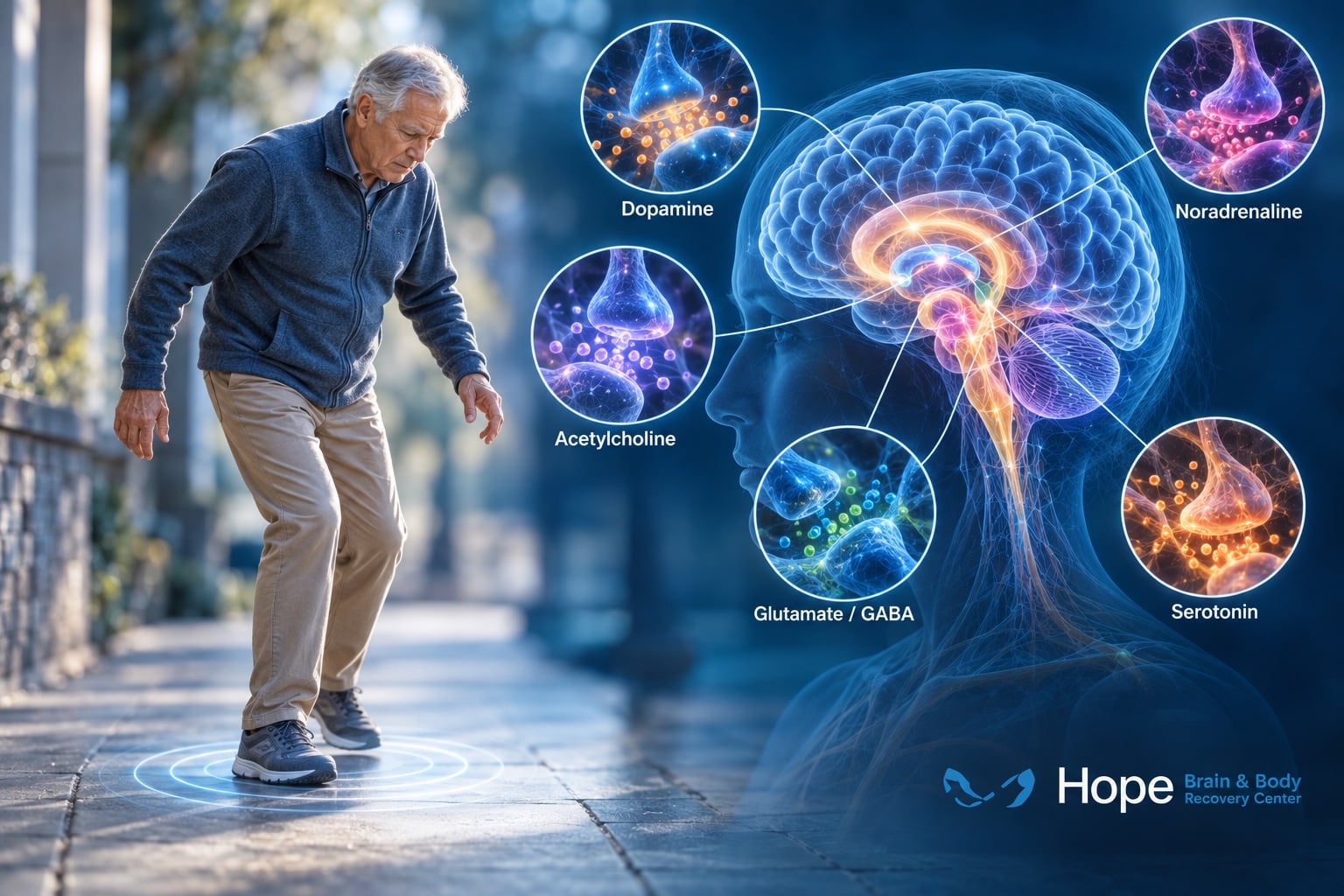
Dopamine plays an important role in motivation.
The basal ganglia are deeply involved in dopaminergic signaling.
The vestibular system, cerebellum, amygdala and prefrontal cortex also participate in networks that influence behavior and emotional regulation.
When these systems aren’t functioning normally, asking someone to simply “try harder” may completely misunderstand the problem.
Dr. Root offers a useful analogy.
It can be like asking someone to give you $20 when they only have $5.
The capacity simply isn’t there yet.
Why Understanding Apathy Can Change Patient Care
This distinction matters enormously for families.
Imagine a young person who has experienced repeated head injuries and now spends most of the day in bed.
From the outside, it may appear that the person simply lacks ambition.
But if neurological dysfunction is affecting motivation, energy regulation, vestibular processing or neurochemistry, the behavior may have a physiological component.
Recognizing that possibility changes the conversation.
Instead of asking:
“Why won’t you do this?”
The better question may become:
“What is preventing your nervous system from supporting this behavior?”
That doesn’t eliminate personal responsibility.
It gives clinicians and families another framework for understanding why recovery can be difficult.
Dysautonomia Can Appear Before Other Neurological Symptoms
The discussion becomes particularly interesting when Dr. Root talks about patients with neurodegenerative disorders.
He describes seeing autonomic problems such as dysautonomia and gastroparesis appearing earlier in the clinical picture than he might once have expected.
The doctors discuss Parkinson’s disease as an example.
Parkinson’s is widely recognized for motor symptoms such as tremor, rigidity and slowed movement.
But neurological disease can involve much more than movement.
Autonomic function, digestion, motivation and other neurological systems may also be involved.
For Dr. Root, these overlapping patterns reinforce the importance of looking beyond the most obvious symptom.
The Problem With Putting Every Symptom Into a Box
Modern medicine depends on diagnoses.
Diagnoses can be enormously valuable.
They give clinicians a common language and help patients understand what may be happening.
But Dr. Root raises an important concern.
Sometimes clinicians become so focused on establishing a distinct diagnosis that they lose the opportunity to investigate how multiple neurological problems overlap.
Is it POTS?
Is it Parkinson’s?
Is it dystonia?
Is it vestibular dysfunction?
What happens when a patient has features of several?
Functional neurology doesn’t require abandoning diagnosis.
Instead, it adds another layer:
How is this particular patient’s nervous system functioning right now?
Why Collaboration Between Doctors Matters
Complex neurological patients frequently see multiple practitioners.
That can include:
- Neurologists
- Cardiologists
- Functional neurologists
- Chiropractors
- Physical therapists
- Functional medicine practitioners
- Other specialists
That should be an advantage.
But only if those professionals communicate.
Dr. Root describes situations in which months can be lost when clinicians work independently or provide patients with conflicting directions.
He also describes a much more positive example involving a patient with overlapping Parkinsonian and dystonic symptoms whose neurologist was willing to collaborate.
Both doctors agree that this kind of relationship can be extremely valuable.
When the patient’s practitioners communicate, the patient doesn’t have to choose sides.
The team can focus on the person in front of them.
Chiropractic Through a Neurological Lens
Dr. Root and Dr. Schneider also revisit something fundamental to both of their careers:
The chiropractic adjustment.
Within a functional neurological framework, they don’t view an adjustment solely as a treatment for a painful joint.
Movement of the spine creates sensory information that enters the nervous system.
The doctors discuss the importance of the thoracic spine, ribs, cervical region, vestibular system and sympathetic nervous system.
Dr. Root explains that continued study of neurology has actually caused him to revisit basic chiropractic techniques with a different understanding of their potential neurological input.
Sometimes greater knowledge doesn’t require making treatment more complicated.
Sometimes it makes clinicians appreciate the fundamentals again.
The Brain Is the Master Control System
A recurring concept throughout the conversation is that seemingly unrelated symptoms may share neurological connections.
Posture.
Muscle tone.
Movement.
Balance.
Motivation.
Digestion.
Autonomic regulation.
Emotional responses.
These functions don’t exist in isolation.
The brain continually integrates information from throughout the body and adjusts its output accordingly.
This interconnectedness is precisely why functional neurological evaluation can become valuable in complicated cases.
Instead of treating every symptom as an independent problem, clinicians look for patterns.
Nutrition, Inflammation and the Nervous System
The conversation also turns toward food.
Dr. Schneider discusses his own experience eating a diet emphasizing foods such as pasture-raised meats, wild-caught fish and whole foods.
Both doctors discuss nutrition in the context of systemic inflammation and neurological health.
Their larger point isn’t that one diet cures neurological disease.
It’s that the environment in which the nervous system operates matters.
Nutrition is part of that environment.
Sleep is part of it.
Physical activity is part of it.
Stress is part of it.
Social connection is part of it.
And the neurological stimulation a patient receives is part of it.
Do You Really Need 50 Supplements?
Another fascinating part of the conversation concerns supplements.
Functional medicine patients can sometimes arrive with an entire bag of vitamins and nutritional products.
Dr. Root says his approach has changed considerably over the years.
Rather than automatically adding another supplement to an already complicated regimen, he increasingly prefers to simplify.
Why?
Because when a patient is taking numerous medications and supplements simultaneously, it becomes difficult to determine what is helping, what isn’t helping, and what may be contributing unnecessary metabolic burden.
Dr. Root describes returning patients toward foundational support before deciding what actually needs to be added.
His philosophy fits another theme running throughout this episode:
Reduce the noise so you can find the signal.
Your Environment Matters
Early in the conversation, Dr. Root discusses genetics and epigenetics.
Genetics can provide valuable information.
But genes aren’t the entire story.
He emphasizes environmental influences such as:
- Nutrition
- Medications
- Circadian rhythms
- Lifestyle
- Social environment
- Stress
- Other biological and environmental exposures
The years surrounding COVID provide an especially interesting example.
Beyond infection itself, people’s routines, activity levels, sleep patterns, social relationships and stress levels changed dramatically.
For patients already vulnerable to neurological or autonomic dysfunction, those changes may become part of the clinical history worth exploring.
Fear Can Become Part of Chronic Illness
Living with chronic neurological symptoms changes behavior.
Patients discover routines that make them feel safer.
They learn which activities trigger symptoms.
They may become afraid of changing medications, foods, exercise patterns or daily schedules because disrupting the routine could make them feel worse.
Dr. Root describes this partly through the lens of survival.
When someone finally finds something that allows them to function, changing it can feel threatening.
That’s another reason patient education matters.
A good rehabilitation program doesn’t simply tell patients what to do.
It helps them understand why they’re doing it.
Functional Neurology Requires Curiosity
Perhaps the strongest message from Dr. Root throughout the episode is the importance of continuing to learn.
Neurological patients aren’t becoming simpler.
Clinicians are seeing complicated combinations of:
- POTS
- Dysautonomia
- Chronic fatigue
- Vestibular disorders
- Neurodegenerative disease
- Head injury
- Digestive dysfunction
- Metabolic problems
- Behavioral and motivational changes
No practitioner can simply memorize one protocol and expect it to work for everyone.
Dr. Root credits his neurological education and mentorship with teaching him to think laterally.
Dr. Schneider shares the same philosophy.
Keep learning.
Keep measuring.
Keep asking questions.
And don’t become so attached to a diagnosis or treatment protocol that you stop looking at the patient.
Real Stories. Real Science. Real Hope.
That philosophy is at the heart of MyPOTSPodcast.
POTS and dysautonomia can be confusing conditions because they rarely affect just one part of life.
For many patients, the journey includes multiple doctors, multiple diagnoses and years of trying to understand why their body no longer behaves the way it once did.
Conversations like this one are intended to broaden that understanding.
Not every symptom belongs in a separate box.
The brain, autonomic nervous system, vestibular system, immune system, metabolism and body continually interact.
Understanding those interactions may help clinicians ask better questions—and help patients better understand their own recovery journey.
Ready to Take the Next Step?
If you’re struggling with POTS, dysautonomia, persistent dizziness, brain fog, balance problems, concussion symptoms or other complex neurological challenges, a comprehensive neurological evaluation can help identify which systems may be contributing to your symptoms.
At Hope Brain Center, Dr. Joseph Schneider and his team combine functional neurological assessment with individualized rehabilitation strategies designed around each patient’s findings.
Start With a Discovery Call
📞 Call Hope Brain Center: (610) 652-4732
📅 Book Online:
https://hopebraincenter.com/book/
Hope Brain Center
6 Dickinson Dr, Suite 310, Building 300
Chadds Ford, PA 19317
Brain health changes lives. Your next step starts with a conversation.
Frequently Asked Questions
What is dysautonomia?
Dysautonomia is an umbrella term for disorders involving dysfunction of the autonomic nervous system, which helps regulate involuntary processes such as heart rate, blood pressure, digestion and temperature regulation.
What is POTS?
POTS stands for Postural Orthostatic Tachycardia Syndrome. It is a form of orthostatic intolerance characterized by an excessive increase in heart rate after standing, together with associated symptoms.
Why can POTS be difficult to treat?
Patients may have multiple overlapping problems rather than one isolated abnormality. Dr. Root and Dr. Schneider discuss POTS occurring alongside chronic fatigue, Ehlers-Danlos syndrome, mast cell issues and other neurological or systemic complaints.
What is functional neurology?
Functional neurology evaluates how different neurological systems are functioning and interacting. Assessment may include areas such as vestibular function, eye movements, balance, coordination, autonomic regulation and other aspects of nervous-system performance.
What does the vestibular system have to do with POTS?
The vestibular and autonomic systems have important neurological connections. This means balance, spatial orientation and autonomic regulation may influence one another in some patients.
Can neurological problems affect motivation?
Yes. Motivation and behavior involve neurological networks and neurotransmitters, including dopamine. The doctors discuss how neurological dysfunction may contribute to apathy or reduced motivation in some patients.
Why is collaboration important for complex neurological patients?
Patients with overlapping neurological and autonomic symptoms may require several specialists. Communication between those practitioners can reduce conflicting advice and help create a more coordinated approach.
Does diet matter for neurological health?
Nutrition can influence the physiological environment in which the nervous system functions. The episode discusses food quality and inflammation as components clinicians may consider within a broader neurological care strategy.
Should people with POTS take supplements?
Supplement needs are highly individual. Dr. Root cautions against automatically adding more products to already complicated regimens and discusses the value of simplifying treatment to establish a clearer baseline.
Can chiropractic care affect the nervous system?
Chiropractic adjustments provide sensory input to the nervous system. Dr. Root and Dr. Schneider discuss spinal and rib manipulation through a functional neurological lens, particularly regarding vestibular and autonomic systems.
How can I schedule a consultation?
Contact Hope Brain Center in Chadds Ford, Pennsylvania to schedule a consultation and learn whether comprehensive neurological evaluation and rehabilitation may be appropriate for your symptoms.
📞 Call Hope Brain Center: +1 (610) 652-4732
📅 Book Your Free Discovery Call: Book Your Consultation
Hope Brain & Body Recovery Center
6 Dickinson Dr, Suite 310, Chadds Ford, PA 19317
Visit https://hopebraincenter.com/book/ to learn more about comprehensive neurological rehabilitation and request a personalized consultation.
Transcript
Dr. Joseph Schneider (00:01): So how you been now? How’s practice going and everything?
Dr. Aaron Root (00:04): Pretty good. Keeps us pretty busy, you know, Always changes as, you know, somewhat on top of things. It’s. It’s. Yeah, it’s. It’s steamrolling, you know, and then keeping up with, you know, the. The new folks, and they’re doing amazing stuff. Yeah. Really, really great new generation or two since. Since you and I started and just really innovative ideas and. And approaches. Can’t keep up with it, but it’s. You know, it just keeps changing, driving that motivation to keep up with. With things.
Dr. Joseph Schneider (00:56): Yeah. You know, sometimes, like, I say same thing to myself, and then I realized just in the process of treating people, it just. You want to get them better, so you just keep up anyway, so just. Yeah. With the explosion of AI, though, it makes you feel like little tiny person now. Tiny doctor. I’m a tiny doctor. Hey, I can spit it out, like, in, like, 10 minutes where it used to take me, like, three days to get. Get all the information together. So that’s. That’s. That’s pretty cool about that. It is.
Dr. Joseph Schneider (01:33): But I came up with the podcast, my POTS podcast, because, you know, I had POTS after an auto accident in 2004 and went through a lot with that, and then I had another auto accident, and my POTS got worse, and then I had a stroke. And so, you know, I mean, life. You know, life presents its challenges, but they also present the ability to get over the challenges. But I’ve been noticing since, and I’m sure you do that since COVID and Lyme disease and a lot of other comorbidities that are happening with patients, and that POTS is on the rise. Dysautonomia. And so I. I kind of want to get your perspective on it, you know, in Texas, are you finding the same thing?
Dr. Aaron Root (02:26): I am. And I’m also seeing more pots, Dysautonomia, you know, that realm mixed with. Mixed with myriad other things. You know, it confounds things, but also makes. Makes it more fascinating, I guess, and pushes. Pushes the motivation to. Like we were talking earlier to. To keep learning and to think laterally as. As. Professor Carrick was instrumental in teaching us, and his influence is always, always here.
Dr. Joseph Schneider (03:05): Yeah, every day. Every day.
Dr. Aaron Root (03:07): And I really loved, you know, that decentralized approach in the context of POTs, you know, for one, because it takes us out of what we’re supposed to do academically. That’s there, of course, but it forces us to consider all the integers that are integrating into the mix, come up with something creative. Perhaps while we’re, while we’re doing foundational academic stuff. But yeah, I’ve, I’ve been seeing more and, and yes, especially since COVID which gives it a different nuance. Right. It’s. It’s a, it’s a different pots. I don’t know if that makes any sense, but,.
Dr. Joseph Schneider (04:00): Yeah, a lot, lot more chronic fatigue and a lot more eds. Ehlers Danlos syndrome and mast cell activation syndromes and things like that. But yeah, you never see a past that doesn’t have many comorbidities. Right. They’re an educated population, which is a lot different than we. When we were. We’re younger in our practice. They come in telling you like, this is my God, my diagnosis and stuff like that.
Dr. Aaron Root (04:35): Yeah, that’s kind of like a running. Not a joke, but it’s just something that it, you know, end up saying frequently. It’s like our patients and consumers know more about their conditions than their practitioners these days.
Dr. Joseph Schneider (04:47): Yeah. With the age of these max gen, the DNA, looking at their, their genes and what they need with their genes, like, everybody’s like, you know, I got this and this and this and this. And so, you know, I’m, I’ve never been a gene guy. I’m like, well, you know what? We don’t always develop what’s in our genes. We’re not always what. What has happened in the past with our, our, our grandfathers and fathers and stuff like that. And I’m more of an epigenetic fan than anything else. Right. So the way we read their genes is dependent upon choices that we make in our life around health, you know, emotional choices and choices about our spirituality and everything else can have a greater impact on how we express ourselves through our DNA.
Dr. Aaron Root (05:48): That’s so validating. Joseph. Having done, I think, pro. About five years, it’s, it’s. It’s been a while. About five years of really a deep dive into gene testing until I realized it was. It was superfluous for the most part, for at least for our type of practice and, and the conditions we’re working with. And it became.
Dr. Joseph Schneider (06:13): Well, I’m glad you’re saying that because I, like when I started rejecting it, I felt like, oh, right, am I missing out on something? Or maybe I didn’t understand it the way it should be understood it.
Dr. Aaron Root (06:24): Well, it was almost a relief, you.
Dr. Joseph Schneider (06:25): Know, five years ago.
Dr. Aaron Root (06:29): Well, I mean, it’s still there and it’s still. It contributes, you know, to, to our learning and understanding of things. But then it became evident that it’s really it’s the environment, not the genesis. And of course, the environment being circadian environment or medications or nutrition or the epigenetics that you mentioned. Right. So we don’t have a lot of control. That, that was a, that was a reality check. Right. We don’t have a lot of control over the genes. So instead of trying to attend to each gene polymorphism or, or mutation, well, let’s just work the environment, you know, internal or external or both.
Dr. Aaron Root (07:12): And, and it actually made things much less tedious because I don’t, I don’t know about you, but those, those, those gene reports, genomics reports, they take about, you know, a good three hours to process and to weed through and, and to come up with something. Right. So they’re very time consuming. And in having not completely abandoned, but just not focusing so much on that, it frees up time for lateral thinking and being creative.
Dr. Joseph Schneider (07:49): Yeah. So in, in this dis real realm, where’s your lateral thinking going?
Dr. Aaron Root (08:01): I would say it’s going toward, you know, back to environmental. And in this case, because of recent events over the past six years or so, a stacking, if you will, of certain environmental events that happened.
Dr. Joseph Schneider (08:26): Right, yeah.
Dr. Aaron Root (08:28): That were somewhat imposed, I would say it changes the input and this and the signal to noise ratio of sorts. Right. So, yeah, in the POTS environment, there’s so much noise and it made it more challenging to find the signal. So the lateral thinking goes with, well, okay, what happened environmentally or what, what series of events happen environmentally with the immunological events that happened and, and then also the circadian events that happened. The social, the biopsychosocial component, that was, that was huge, of course, with the social isolation. Right. The abrupt changes in lifestyle and routine,.
Dr. Joseph Schneider (09:31): The very.
Dr. Aaron Root (09:36): Prevalent effects of. Family displacement, isolation, like I said. And there, there’s another term for that. I, you know, I think Jonathan Chung, our dear colleague, did some work on that and he presented something a couple years ago.
Dr. Joseph Schneider (10:06): I didn’t see that. I know, Jonathan.
Dr. Aaron Root (10:09): Yeah, the estrangement, that’s the term that happened. And with all the environmental factors, I mean, they’re all important, but it was the social estrangement that happened on a, on a very large scale that I think created much of the. Unique changes in, say, pick a condition, pots, right? Yeah, it’s autonomia.
Dr. Joseph Schneider (10:40): Well, dishonomia. Right. So let’s go back. You know, keep it simple, stupid. You know, I mean, that’s, you know, I always say that, keep your simple, stupid. Sometimes I say keep it simple. Brilliant guy here. But either way, either way, but simplicity, you know, when you. When you’re in the. In the storm with a patient, sometimes you need to step back and then simplify it. Right. Do you find that sometimes? Right, all the time, yeah. So, I mean, like, you know, you do that almost with every patient and then you start to divide, dive into each simple area. Now, I mean, I just got Spryson chair with goggles.
Dr. Joseph Schneider (11:29): And so we’ve been looking at vestibular nuclei, which ones are weak, which ones are strong and so forth, and seeing where the imbalances are. And then cerebellar influences and basal ganglionic influences and prefrontal cortex influences. And we’ve been finding that. Well, there’s a lot of difficulty getting people back into their life, in their lifestyle. The re. Engagement of being chronically ill over time. Do you find that too?
Dr. Aaron Root (12:06): I do it because it becomes exactly a calibrated in a new normal that probably related to just basic survival reflexes and.
Dr. Joseph Schneider (12:18): Yeah.
Dr. Aaron Root (12:18): Not even consciously. Right.
Dr. Joseph Schneider (12:21): Well, where we went with it and I’ll find it, if you find this interesting or not, that we get like Parkinson’s cases. Like, I mean, I’m. I’m Parkinson’s by stroke, so. But real neurodegenerative people with Parkinson’s. And you know, every day you have to pull yourself up and face your day. And as you get sicker, the. The idea of facing your day becomes more and more difficult. And then patients like, you know, they’re fighting it, fighting and fighting it, and then they get exhausted. So I saw an article on apathy, apathy with neurodegenerative diseases, especially Parkinson’s, super nuclear palsy, Alzheimer’s and so forth. And.
Dr. Joseph Schneider (13:21): So I went a little deeper into it, and we found that if you look at the vestibular system and we talk about comorbidities, so we’re getting a lot of patients that have vestibular issues, that have gut issues. Right. They get nauseated if they’re spinning. Right. So you have those controls that are happening autonomically in the brain stem vagal also. And then with that they get anxiety or they maybe have diagnosed with an eating disorder from a vestibular weakness in that system.
Dr. Aaron Root (14:06): Right.
Dr. Joseph Schneider (14:06): Yeah. So I’ve been thinking that, okay, a lot of these young women who have been diagnosed with eating disorders actually have a central vestibular issue.
Dr. Aaron Root (14:18): Interesting.
Dr. Joseph Schneider (14:20): Yeah.
Dr. Aaron Root (14:21): Yeah.
Dr. Joseph Schneider (14:21): And so, you know, a lot of people come in with gastric paresis. Have you been finding that too?
Dr. Aaron Root (14:28): I have, yeah.
Dr. Joseph Schneider (14:30): Big diagnosis. Right Ones. Yeah. And then the. Another proton pump inhibitors. Right. Reflux right. I’m losing you.
Dr. Aaron Root (14:54): I’m here, but I’m here, you say.
Dr. Joseph Schneider (14:57): I’m losing it.
Dr. Aaron Root (14:58): Can you hear me now?
Dr. Joseph Schneider (15:00): Yeah, I can’t. I can’t. I can’t hear you. Something’s happened with your computer.
Dr. Aaron Root (15:06): How’s that?
Dr. Joseph Schneider (15:13): You’re frozen. Can you hear me? Okay,.
Dr. Aaron Root (15:22): Let me see if there’s something with the volume. How about now? Okay. Is that better?
Dr. Joseph Schneider (15:33): No, I can’t. You’re still frozen.
Dr. Aaron Root (15:38): Is that better?
Dr. Joseph Schneider (15:39): Doc? I’m here. Yeah, I can’t. No, not better. It’s like you’re a picture right now, not a video. Yeah, just dbled. Yeah. Do you want to go out of the. The zoom and then come back in? Let’s try. Okay. So frozen. No. Yeah, I can hear you now. Yeah, just a little garbled. No, Now we’re still not. There we go.
Dr. Aaron Root (16:59): How’s that? Is that better?
Dr. Joseph Schneider (17:01): That’s better. It’s better, but not full,.
Dr. Aaron Root (17:05): So sorry. I moved everything inside, so maybe. Maybe it’s too hot.
Dr. Joseph Schneider (17:10): You’re on now. You’re on now.
Dr. Aaron Root (17:14): Okay. The. Yeah, that’s super fascinating because I’m, I don’t. I don’t know if this is something you’re noticing as well in, in the context of what you were just sharing is, you know, Parkinson’s is probably one of the most difficult scenarios that, That I work with. For me, I, I, I’m frequently challenged with that.
Dr. Joseph Schneider (17:42): Yeah.
Dr. Aaron Root (17:43): Those scenarios, and especially now, because it seems to be a different sequence of events in, in the, the cascade of, of the symptom, in the diagnostic picture and all that, it’s almost sometimes inverted. It’s not, it’s not the expected sequence of events that we might have learned about. So with the gastroparesis that I’m seeing more of that earlier. And earlier. And earlier.
Dr. Joseph Schneider (18:20): Yeah.
Dr. Aaron Root (18:20): Yeah. And then also the dysautonomia being first rather than last. That’s been something that’s been showing up a lot.
Dr. Joseph Schneider (18:29): Yeah.
Dr. Aaron Root (18:32): Which, which creates another layer of challenge in that a lot of times patients will seek out other specialists, which, which is. Which is good. I like the collaborative approach. If it was collaborative, if it’s collaborative at all, and frequently it’s not.
Dr. Joseph Schneider (18:52): So I’m not gonna say anything about that. I’m just gonna laugh.
Dr. Aaron Root (18:55): Okay, I hear you. So, you know, within that challenge is. Is in trying to keep up with the, the strategy we might be working on and not getting too distracted by. Other, you know, opinions. But what happens is we lose time. Right. So two months, four months, when we could have had time addressing something in. In a creative way, maybe from a functional neurologist perspective, whereas we could have collaborated, but we didn’t. And in terms of, you know, the door’s been open on my side for that, but it is what it is. So I’ve. No, I’m noticing that things have to be pigeonholed even more so in terms of, hey, this is dysautonomia, or this is, you know, Parkinson’s. And we get that. That conceptual bias with the diagnosis where the.
Dr. Aaron Root (20:05): The focus and the attention and the time tends to be dedicated toward getting a distinct diagnosis. And that kind of distracts from the lateral movement we can apply between working diagnoses. Right. Because they tend to overlap.
Dr. Joseph Schneider (20:25): And especially, you know, you’re right. Yeah. Right on, buddy. Yeah, exactly. Now, so since I’m old and grumpy, right?
Dr. Aaron Root (20:42): I didn’t. I didn’t find you old and grumpy.
Dr. Joseph Schneider (20:45): It was just, you know, just joshing a little bit here.
Dr. Aaron Root (20:48): Hang out in Florida a couple years.
Dr. Joseph Schneider (20:51): Yeah. But. But I. I get grumpy about this stuff. I really do. You know, so what. My wife and I, we decided that, you know, we’re going to eat really, really clean, really well, pasture raised, you know, beef, chicken, wild caught fish, you know, and really take a look at fatty acids, right. And. And the. The way fatty acids influence us with inflammation. So we did really good. We went on vacation in Miami, stayed a nice place and starting eating the food and immediately felt sick, right? And it was like, all right, we’ve really been putting a lot of time in to make sure we’re eating clean, making food at home rather than going out.
Dr. Joseph Schneider (21:47): And, yeah, it’s gotten to the point where we can’t go out anymore because the quality of our food, especially the fatty acid realm, is. It’s just not there, and it’s very pro. Inflammatory. And then I had Parkinson’s case that comes in, and his wife went to Greece. She has problems with her knees and her feet. And she went to Greece and had fresh fish out of the ocean or the Mediterranean and fruits, vegetables, like just really, really good, clean food. Fresh. And she came back and her inflammation was so low that her knees didn’t hurt anymore, her feet didn’t hurt anymore. And. And in that respect, she gave. She gained a new appreciation for how food affects your bodies. Right. Not quickly, too. Yeah, that quickly. Right.
Dr. Joseph Schneider (22:58): So she said, well, yeah, I’m going to have to dedicate myself to this since my husband has Parkinson’s. Poor guy. I’m gonna tell him what he’s allowed to eat, what he can’t eat.
Dr. Aaron Root (23:10): Right. So they’re moving to Greece.
Dr. Joseph Schneider (23:14): Oh, I. I think she, she has ideas about it. Well, they have enough money. He’s an international attorney. He’s a brilliant guy. But he really has Parkinson’s. Really bad. And then the other idea that a lot of these nor degenerative diseases start in your 30s and 40s and when by time you hit 60. Right. Yeah, things have been happening for a long time. It wasn’t. You got knocked on the head and all of a sudden had. Had these types of issues with Parkinson’s. The slow movement, tremor activity, pill rolling, all those things. And so getting back to the original concept of apathy that patients in the literature now, they talk about the motivation that comes from dopamine. So when the basal ganglion are degenerated, you’re not, you’re not generating enough dopamine.
Dr. Joseph Schneider (24:12): And then you have irregularities in other of the neurotransmitters like serotonin, norepinephrine, epinephrine, and acetylcholine and things like that. So you, you get an imbalance across the board, which changes behavior. And then if you do a deeper dive, the deeper dive is in the vestibular system. You have tracks that go to the amygdala and it changes behavior. Your vestibular and then the cerebellum. That’s trash. Goes to the migdala and changes behavior. Then you have basal ganglion who has a regulation of the amygdala. Right. Like a rheostat on a light switch. Okay. That affects behavior. And then you look at the prefrontal cortex, the right and left, they both are. Are doing the same thing. So there’s a great overlap in especially areas that you think are mostly musculoskeletal. Right.
Dr. Joseph Schneider (25:22): In control.
Dr. Aaron Root (25:23): You can’t segregate them. They’re.
Dr. Joseph Schneider (25:25): You can’t sacred. You can’t segregate anything. And I’m like, okay, I’m gonna shoot myself down, because how am I gonna figure this one out? And, and so, but you come in the next day and you find something, and then you feel better, comfortable with it. And then the other thing that I found with that is then you gain a new appreciation for a chiropractic adjustment.
Dr. Aaron Root (25:55): Right.
Dr. Joseph Schneider (25:55): You know what I’m saying?
Dr. Aaron Root (25:57): Totally.
Dr. Joseph Schneider (25:58): All right. Because then you, you know, you had the stellate ganglion in the cervical spine, you had the sympathetic chain ganglion in the thoracics, and you know, kind of away you go. So you start to like look at those things and say, okay, I had to be a better adjuster. I thought I perfected that.
Dr. Aaron Root (26:21): We understand this.
Dr. Joseph Schneider (26:22): Yeah, yeah, exactly.
Dr. Aaron Root (26:26): Revisiting technique and going, wow. Yeah, the, the upper, the upper thoracics. And as Professor Carrick, he did a few modules and a few audio pieces on, throughout the thoracic spine. And it’s kind of something we, we ignore, I guess, for, to a certain extent. And it reignited the importance of really understanding and utilizing thoracic spine mechanisms, either movement in, in the vestibular context that you brought up. And, and yeah, I started to, to go back to Chiropractic 101s. Like, yeah, I, I can see, I can see that now. Again, you know, revisiting that and then constantly tweaking technique to get a little bit better at employing that. It’s fun to watch somebody actually on the table start to connect the, make the connection themselves when then they have a, an event and they feel better immediately after just a simple manipulation.
Dr. Joseph Schneider (27:46): Yeah. Especially the rib. Right. You know, the rip at adjustments, you know, that Dr. Kyra’s done for years. I look at the releases that he gets. But you know, I mean, I’m like, okay, I’ll try better next time.
Dr. Aaron Root (28:00): Sometimes I’ll use the analogy of people, People pay a lot of money to go to Six Flags to have the experience that you’re having today, you know.
Dr. Joseph Schneider (28:14): Yeah.
Dr. Aaron Root (28:15): That helps them connect the vestibular system with their motivation situation and the, the, the, the symptom picture related to dopamine in front of an amygdala. Right. And it’s really challenging to ask someone, somebody to do a particular change, lifestyle change or a. Implement something when the motivation just, just physiologically isn’t there, the connectivity isn’t there, the integration isn’t there. So yeah, basically we’re asking somebody to give us $20 when they only have five. So, and it makes it even more important to explain, and I’ll do this a lot is just explain that it’s reflexogenic and I’ll explain that in terms that are easier to understand. Of course. So it’s not, it’s not your personality, it’s reflexogenic. It’s not even conscious. It’s, you know, neurochemistry.
Dr. Aaron Root (29:14): It’s the, it’s the connectivity with the vestibular system that allows us to be happy in gravity, things like that.
Dr. Joseph Schneider (29:22): And yeah, yeah. So, you know, so the kid that, you know, has had his head knocked several times and the mother can’t get him out of bed. Right. I Had a, I had a woman come in. She came in, she paid me for the program. She looked at her son. You’re coming for all your appointments and you’re gonna get a job and Dr. Joe is going to make sure that happens. Okay, let’s go, let’s go do it. And you know what? He ended up getting three jobs. He’s like, got his life back and was like really thrilled by it. And the mother came in and said, bingo. Like, that was it. She’s just like, I don’t want to hear it. I don’t want to hear it. He’s.
Dr. Joseph Schneider (30:12): He’s lazy or he’s just not motivated or anything like that. I don’t want a psychologic evaluation of him. I want him to do what he was made to do. Yeah. And so, I mean, that’s kind of like what happens with patients. That, that apathy sets in and it becomes like, can I, can I get the motivation or the courage to face where I’m at and to go where I can go as a possibility for it? And that’s. You’re right, physiological, neurological, physiological events that are happening with patients that make it more complicated. And so you’re going to get it with any type of brain injury, whether it’s a pathogen, an inflammatory event from a toxin, or could it be a blunt trauma that happens with it or all the above.
Dr. Aaron Root (31:12): Yeah.
Dr. Joseph Schneider (31:12): You know, so you know that that’s the kind of patience that we’re dealing with in this day and age. A lot more complicated than it was 26 years ago.
Dr. Aaron Root (31:20): Right.
Dr. Joseph Schneider (31:21): I can tell you that. Yeah. But a lot more satisfying too, when you can you get them to that point where they get, they get their life light back. Right, exactly.
Dr. Aaron Root (31:36): Yesterday I had a follow up with probably the second visit. And this is something I’m seeing more too, as, as chances are. You are too. Is the overlap between dystonia and Parkinson’s where this individual has both, one on each side.
Dr. Joseph Schneider (31:59): 10 Mils. Yeah. Excuse me, I’m sorry. Yeah.
Dr. Aaron Root (32:05): And you know, she, she’s a wonderful to work with. She, she has a Parkinson’s nitus on one side and dystonia on the other. And then of course the challenge is which one do you start with? In, in, in the assessment and the treatment. And fortunately we had a little breakthrough yesterday in some of it. You know, skill, experience and luck, I think. But also because she, she’s very open to the idea and she has a really good neurologist which, who is actually very collaborative. That, that, that was a, a up that’s the key.
Dr. Joseph Schneider (32:55): Yeah, that’s the key, definitely. Because they trust both of you. Right, exactly. You and the other doctor and. Yeah. It becomes a point of confusion when they’re, they’re. They don’t align at all. Yeah, yeah.
Dr. Aaron Root (33:11): And. And there was a vestibular component that came from they. A head injury, a mild concussion, if there’s such thing as a mild concussion, but which wasn’t in, in the picture, you know, like the intake form. It wasn’t in the history very prominently, I would say. But that seemed to be the one culinating event that, that fused the Parkinson’s and the dystonia. Right.
Dr. Joseph Schneider (33:47): Or.
Dr. Aaron Root (33:47): Or promoted that overlap.
Dr. Joseph Schneider (33:50): Yeah, yeah.
Dr. Aaron Root (33:52): So we’re doing a lot of distributor stuff and. Oh, the.
Dr. Joseph Schneider (33:54): Yeah. So you’re going to get overlap, buddy. You’re just gonna get overlap. You don’t want it. Don’t give me any overlap. You know, look at the patient. You’re saying about your head, don’t you dare give me overlap. Make my life a little more difficult. But even two. Like we talk about the adjustment, but the rotatories and multifidi are controlled through vestibular patterning. Right. Same thing with cerebellum. Right. Same thing with basal ganglion. Same thing with Right. Prefrontal cortex. There could be a memory too in which their back went out. Right. So, you know, you get like a lot of these guys that do this emotional release and they find the low back pain goes away.
Dr. Joseph Schneider (34:44): So even in the amygdala you’re going to get overlap too. But you know, that’s kind of that. You’re right. That overlap is quite fascinating with dystonia. Now, a lot of patients, when I, when I look at them, they first come in, they’ll have a high shoulder like this low shoulder on the other side. Right. And then you look at the scalings. Scalings are popping out like crazy. The trap is like really hard. Yeah, I get all. I get this Nick pain. I have, I have a shoulder problem. You know, I mean, I heard it like 20 years ago, right. And you’re saying, I think you got a brain problem. Sorry about that. So dystonic movements or even hypotonic movements, which we say EDS is.
Dr. Joseph Schneider (35:25): Hypotonic movements are really a reflection of brain patterning. So a lot of this EDS stuff, which is I find bunk, as much bunk as I find the max gen plus type people. And I mean they’re, they’re great individuals and pretty smart. It all goes with, with the same thing, that your brain is the master control System of, of the body. And we are fortunate that we’ve done work with that.
Dr. Aaron Root (36:06): Yes, 100%. Dr. Joe, do you. Do you find challenges with, you know, over. Over time, over the years, with experience and, and skill, as you become better at identifying the onset, the earlier and earlier onset of Parkinsonism and dystonias in terms of communicating to the patient and patient’s family that that’s what it is or going to be. Is there a. A word? It’s too early to say something.
Dr. Joseph Schneider (36:50): Well, two dirty, dirty words in the office, right? Yeah. Dirty, dirty, dirty. Parkinson’s and Alzheimer’s.
Dr. Aaron Root (36:59): Yes.
Dr. Joseph Schneider (37:00): Right. Dirty, dirty words. Right. They’re either going to deny it. They don’t even want to know anything about it.
Dr. Aaron Root (37:09): Yeah.
Dr. Joseph Schneider (37:10): Or in the case of Alzheimer’s, they don’t have the capability to grasp it.
Dr. Aaron Root (37:18): Yeah.
Dr. Joseph Schneider (37:19): Yeah. So. And even with dis, people now are accepting it because it’s very within the realm of understanding that what’s going on with their heart rates changing and things like that, and they come in with an ownership of pots. Whether it’s POTS or not, it’s just. Or dysautonomia, they don’t know, but it’s an ownership. And then they own all the comorbidities along with it. Chronic fatigue, mast cell activation syndrome, EDS and so forth. And. And sometimes they, they don’t want you to even say that you can take it away. So.
Dr. Aaron Root (38:07): Yeah, that survival instinct kicks in and then, you know, the routine, some routine has to be established and that becomes that maybe there’s a. There’s a fear component in terms of changing a routine and, and rocking the boat a little bit too much. Right. When they just, they just figured something out that, that works for now.
Dr. Joseph Schneider (38:33): Yeah. And really, it’s kind of post traumatic stress disorder now for me. I can’t go to a doctor anymore. I can’t go in the office. Don’t take my blood. Don’t take my blood pressure. Leave me alone. You’re gonna touch me and kill me. Ah, no, I can’t have it. I’m really serious. It’s a problem. So I get to understand where people are coming from.
Dr. Aaron Root (39:06): I’m hearing that from everybody more and more. Right. That they know or that, you know, the experiences aren’t. Aren’t ideal. And I suppose that’s why they’re consulting with us, so they don’t have an experience. And it would. It’s. It’s a little, well, disappointing. I guess back to the collaboration part is there’s, there’s a definite divide between the centralized protocol based model versus the thinking laterally model.
Dr. Joseph Schneider (39:43): And.
Dr. Aaron Root (39:48): I see the community at large understanding the difference now.
Dr. Joseph Schneider (39:56): Yeah, but maybe not the functional neurological part of it. They do with functional medicine makes sense to them because they’re used to taking a pill in pharmacy. Now we have nutritional pharmacy. That’s getting to be the same effect. I don’t know how many patients you have coming in that are taking 50 different vitamins.
Dr. Aaron Root (40:19): Yeah, I, I’m hands down, we, we, we put that to an end when possible. And.
Dr. Joseph Schneider (40:31): They bring their bag in, they’ll say, doctor, which one can I take?
Dr. Aaron Root (40:35): Yeah, I used to go through years ago, I used to go through everything and say, yeah, this one, this one, and yeah, we can do this. Now it’s almost zero. Just, just to start with a baseline and remove a mitochondrial burden. So whether it’s a drug or a supplement, I’m glad we’re talking about this. So this has been one of the challenges lately is the, the, the basket, the laundry basket full of vitamins that they, you know, they might bring in or the, the long list. And I’ll just blatantly say, well, no, no, no, no, not now and let’s just remove the burden for now and let’s just go with foundations right now. I, I completely agree with you. Let’s, you know, the, the collagen and the creatine and all, all those things that influencers are putting out there is, is all good.
Dr. Aaron Root (41:37): Well, not for everybody. Maybe not. When there’s 15 other supplements and medications in the mix, everything creates more noise. You lose the signal.
Dr. Joseph Schneider (41:52): Yeah, real good. So why don’t you tell the audience what your address is?
Dr. Aaron Root (42:02): The, the physical address.
Dr. Joseph Schneider (42:04): Yeah, your physical address for your office.
Dr. Aaron Root (42:06): It’s 14, 603 Huebner Road. H U E B N E R Building 5, San Antonio, Texas 78230.
Dr. Joseph Schneider (42:19): And you accept new patients? Yes. That’s what makes the world go around. Right? Yeah. So I think patients would be very fortunate to find you and to come into your office and get treated by you. And you know, so we have some really fantastic professionals in our functional neurology realm and I consider you one of them because you’ve been around for a while. You’re not old and grumpy like me. But, you know,.
Dr. Aaron Root (42:54): It was, you’re, it was so great to meet you two years ago in person in Florida and, and actually have the, have the time to be able to spend time with you. We had, you know, three days of a marvelous event and you’re one of those legends whom I wanted to meet and spend time with, and it just.
Dr. Joseph Schneider (43:13): Oh, wow. Thank you.
Dr. Aaron Root (43:15): Yes.
Dr. Joseph Schneider (43:16): Yeah, yeah. So sometimes I’m a legend my own mind, but we have really good staff, and Dr. Klossic’s here now with me, and he just stimulates a lot in my head. And so that’s why I said, like, let me. Let me get a hold of Aaron and let’s talk to Aaron and see what he’s doing. And we have to do this more often. Okay. Because it gets to a point where simple conversations kind of like, get you to learn a lot about what’s going on throughout the world. And so you were never in isolation, so really good.
Dr. Aaron Root (43:55): And I appreciate you hosting and inviting me today. I was not going to miss this.
Dr. Joseph Schneider (44:02): Yeah.
Dr. Aaron Root (44:03): So.
Dr. Joseph Schneider (44:03): All right, fantastic. All right. Probably I’ll contact you another three or four months. Okay, sounds great. Yeah. And so that’ll be great. And we can catch up. And then I’ll be posting this on my pods podcast probably within a week, and you can send patients to it and see. See what they can learn from it.
Dr. Aaron Root (44:26): All right, that’s great. Can. Can you give us your address for.
Dr. Joseph Schneider (44:33): Yeah, I’m. I’m in Chaddsford, Pennsylvania, and 6 Dickens Drive, Suite 310, Chadds Ford, Pennsylvania 19317. On. Between Wilmington and Westchester, just south of Philadelphia.
Dr. Aaron Root (44:49): Thank you.
Dr. Joseph Schneider (44:50): The city of brotherly Love.
Dr. Aaron Root (44:54): Right? Right. Thank you. And give my best to Dr. Klotzk. It’s been way too.
Dr. Joseph Schneider (44:59): Oh, yeah, man, he. He’s stellar. He really is. He’s really, really stellar, that guy. All right.
Dr. Aaron Root (45:07): When I saw that he was. He was gonna be joining your clinic, I thought, yeah, that. That is a good fit. That is.
Dr. Joseph Schneider (45:15): I had my eye on him for two years. Yeah. No clue. He had no clue. And then when I pulled it on him, he looked at me, he goes, yeah, I’ll do it. So it was good. It worked out really, really well. All right, I gotta get back to people. All right. All right. God bless you.
Dr. Aaron Root (45:34): Take care.