Healing the brain is not just about treatment — it’s about transformation. In this special Easter reflection episode of the POTS Podcast, Dr. Joseph Schneider shares powerful insights into how neuroplasticity, gut health, advanced AI technology, and daily habits shape long-term brain recovery. Blending science with spirituality, this episode highlights a deeper approach to healing that goes beyond symptoms and focuses on rebuilding the brain, body, and mind as one system.
Podcast Episode 40
Easter Reflection and Chicken Chow Mein
In Episode 40, Dr. Schneider delivers a unique and personal conversation that connects modern neuroscience with holistic healing principles.
From neuroplasticity to nutrition and faith, this episode explores how small, consistent changes can rewire the brain and improve overall well-being.
Neuroplasticity: The Foundation of Brain Healing
At the core of this episode is a powerful truth:
👉 Your brain is constantly changing — and you can influence how it changes.
Neuroplasticity refers to the brain’s ability to:
- Form new neural connections
- Strengthen useful pathways
- Prune unused or harmful patterns
- Adapt to injury, stress, or environment
These changes affect:
- Emotional stability
- Cognitive performance
- Behavior patterns
- Recovery from neurological conditions
The brain is “soft-wired,” meaning it responds directly to what you do daily — your habits literally shape your brain.
The Gut-Brain Connection
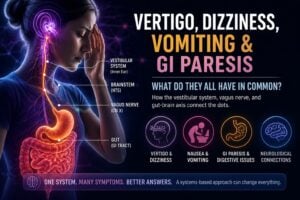
One of the most important (and often overlooked) insights in this episode is the powerful link between digestive health and brain function.
Key takeaway:
👉 Your gut health can predict your brain health years in advance.
For example:
- Chronic constipation may appear 20–30 years before Parkinson’s disease
- Gut inflammation can trigger brain inflammation
- Food sensitivities may impair neuroplasticity
This is why Hope Brain Center evaluates:
- Digestion and bowel patterns
- Inflammation markers
- Food sensitivities
- Gut integrity (leaky gut)
Healing the brain requires healing the gut first.
AI Technology: The Future of Brain Rehab
Hope Brain Center continues to lead innovation with the introduction of advanced AI-driven neurotechnology.
New breakthrough tools include:
- Rotating chair with AI-based neurochecks
- Eye movement and vestibular tracking
- Cognitive and neurological performance testing
- Parkinson’s and headache assessments
This technology allows clinicians to:
- Detect subtle neurological dysfunction
- Map brain-body communication
- Design highly targeted rehab programs
It’s a major step toward precision neurological care — where every treatment is personalized based on real data.
Nutrition: Fueling Brain Recovery
Recovery isn’t possible without the right fuel.
This episode highlights the importance of targeted nutritional support, including:
- Antioxidants for brain protection
- Mitochondrial support for energy production
- Cellular repair nutrients
A key recommendation is the Microdaily EMF multivitamin, designed to:
- Support brain and body at the cellular level
- Reduce oxidative stress
- Improve energy and recovery capacity
Rather than random supplements, the focus is on strategic, science-backed nutrition.
Habits Shape Your Brain
One of the most powerful messages in this episode is that your daily habits determine your brain’s future.
Positive habits that strengthen neuroplasticity:
- Regular exercise
- Consistent sleep routines
- Healthy digestion
- Deep breathing and oxygenation
- Emotional practices like gratitude and forgiveness
Even spiritual practices, such as prayer and reflection, play a role in shaping neural pathways and improving emotional resilience.
A Holistic Approach to Recovery
Hope Brain Center’s philosophy goes beyond traditional medicine.
Instead of treating isolated symptoms, they focus on:
- Brain function
- Body health
- Emotional well-being
- Lifestyle habits
- Spiritual resilience
This whole-person approach leads to:
- Better long-term outcomes
- Stronger neural connections
- Improved quality of life
A Message of Hope and Renewal
As an Easter reflection, this episode carries a deeper message:
👉 Healing is not just physical — it’s transformational.
Dr. Schneider shares how resilience, faith, and consistent effort can help patients:
- Rebuild their brain
- Regain control of their health
- Create a new future
Recovery is about building a new neurological reality, not just returning to baseline.
Start Your Brain Recovery Journey
If you’re dealing with:
- Brain fog
- Fatigue
- Neurological symptoms
- Digestive issues
- Stress or burnout
There are advanced, holistic solutions available.
Hope Brain Center offers personalized programs that combine:
- Neuroplasticity-based therapy
- AI-driven diagnostics
- Nutritional support
- Lifestyle and habit coaching
👉 Visit https://hopebraincenter.com/ to learn more or schedule a consultation.
Transcript
00:01
Dr. Joseph Schneider
Great time of the year for reflection. And so today I want to talk about chicken chow mein. Chicken chow mein. So when I was a kid, my mother used to make. Mother’s Irish, mostly Irish. She could cook almost anything from any culture. It was kind of crazy. But one of our favorites was always chicken chow mein. And it was great meal for us to have loaded vegetables and bean sprouts and all kinds of good stuff. But it was one of our favorite meals, soy sauce. And we used those little noodles. They’re like cracker noodles. Forget what they were called. It was a great meal, great food. You know, I always talk about food, talk about a gift in a diet. Excuse me. Because it was. Helped me through my brain recovery.
01:09
Dr. Joseph Schneider
Now when we talk about the word recovery, and I talk a lot about plasticity, neuroplasticity, one of the phrases that comes up all the time. And I, I did a blog post that I want to talk about today. So the blog post is called. Nerves that Fire Together, Wire Together. And neuroplasticity as an everyday phenomenon, you know, that’s how the brain’s not hardwired. The brain is soft wired. It’s soft wired so that it can change now, it can change in the negative. And we always think about our diseases and the negative and how our brain isn’t functioning right. But the brain is the powerhouse of the body. It’s our mental, emotional, and physical reality that’s played out every day. So we are challenged with experiences, and the brain responds to it. So when we’re a children mirror the people around them.
02:33
Dr. Joseph Schneider
They actually learn language from hearing, seeing your lips. And then they mimic it. They mimic. They mirror their environment. So remember that, because a good mirroring means a better brain for your children, and it helps their development. So the brain is always changing. So they’re born with a lot of nerves and a lot of pathways that are disorganized. And they will organize around their experience, they will grow, they will form better networks, they will form better core areas in the cortex, and they will actually get rid of nerves that they don’t need. So they’re growing nerves, they’re getting rid of nerves, they’re growing nerves, they’re getting rid of nerves. So plasticity is very dynamic, especially in young people. And they have to coordinate and integrate many different areas for them to become fully functional and optimized. So nerves that fire together, wire together.
03:49
Dr. Joseph Schneider
And it’s that consistency and habituation of firing that creates our function and how we respond to our environment and how we Respond to each other and how we make it our way through life so that we can thrive rather than just survive. But we’re made to try to survive at first and then learn enough so that when we become adults, our development takes a long time. When we become adults, then we can be on our own and create our reality so that we can feed ourselves, we can nurture good relationships, that we can be emotionally stable and think the process of thinking. And then our relationship to God. Our relationship to God becomes very important.
04:44
Dr. Joseph Schneider
So consistent plasticity is something that what life is all about, we develop through life and our life experiences and the things that we consistently do every day to keep our brain in order mentally, emotionally and physically. And if you think about plasticity, we think about nor our wiring and the neurons and the axons that we have and the dendrites and interconnections that are created. But there is support networks that must be plasticized also. So if you’re thinking about creating more of a brain, well, brain needs energy, and it doesn’t get energy by itself. It has to have circulation so we can supply it with nutrients and oxygen, right? Essential to the survival of the brain. So the brain grows. The brain needs to grow more blood vessels. It needs to grow more supportive neurons or glial cells called microglia, astrocytes.
06:03
Dr. Joseph Schneider
And there’s other cells that are supportive in the brain that also need maintenance too, and support. And so the foundation of. Of what happens in the brain is also the foundation of what happens in the rest of the body. So an expression of brain function is also a major expression of motor. The motor expression in the body is enhanced by your neurons and your nerves and your peripheral nerves and so forth. So we have muscles. We can either, in our behavior, we can move toward. We can talk softly, we can scream, we can shout, we can raise our voice. And it’s all a muscle movement. Even our breath sounds, which are created from the diaphragm. When we breathe in, our diaphragm kind of gets the flow of breath and air into our bodies so that we can oxygenate our brain also.
07:15
Dr. Joseph Schneider
So it’s very like, complex thing. And that brings us to the brain and plasticity of your gut function. Now, gut, your gut goes from your mouth all the way to your anus. And it’s a very complex system of communication to break food down, break it down into individual components, have it absorbed properly into your bloodstream, and then go to different other organs for it to be processed even more. So we have liver, kidney, pancreas, spleen and all those organs that are there that need proper timing. So if we think the brain responds to our environment, we also know that our digestive tract responds to our environment. And we can habitualize our digestive tract by the way we eat and when we eat, how much we eat. And the timing of that can be very important to de stress and calm down our digestive tract.
08:46
Dr. Joseph Schneider
So if we overeat, if we don’t eat at the right time, before we go to bed, go to sleep, then we mess with the dynamics of our digestion. One of the factors in which we judge brain function at the Hope center is by looking at digestive health. Now, one of the key factors in Parkinson’s is disease, is a history of constipation. A history of constipation can show that you’re developing neurodegeneration maybe 20 to 30 years before you even have symptoms of motor function, of slowness, of tremor, of tick activity. That happens when you develop full blown Parkinson’s disease. So the digestive tract, when I hear that, you start to wonder. You start to wonder what is really going on with our relationship with what we eat and what we do.
10:12
Dr. Joseph Schneider
So we also really like, we can get into inflammation that’s developed through the digestive tract and the way we treat it and the honor we give to it, and inflammation that happens within the body, but also gut brain axis causing inflammation in the brain. So one of the things we do is we look at food sensitivities for leaky gut. So for plasticity concerns, we really need to develop habit patterns within our life that create a response to our behaviors and our environment, that create a stronger brain, a more resilient brain, and a brain that ages well. So habit patterns are really exercise patterns that create better functionality within your digestive tract, Within a woman’s cycle number two, within the exercise that we do physically or the activity that we do physically on a frequent basis, and then on emotional patterns that we form.
11:39
Dr. Joseph Schneider
Now, we know that when we pray regularly or meditate, well, they talk about meditation, but you know what? Meditation is really prayer. When you connect with your God and you connect with it every day. And you have time for prayer, for reading the Bible, for considering where your relationships are, when you do forgiveness, when you are grateful, those things pattern you. It patterns your brain so that you can be thankful for anything. You can thankful for breathing, you can be thankful for your heart, you can be thankful for your digestive tract. You can be thankful that you get up in the morning, because I remember in May of 2017. I got up in the morning and I met my creator and whoa, all right. I guess I’m dead. So. So death wasn’t so bad. It was not painful. It was just. It was a.
12:51
Dr. Joseph Schneider
It was a great thing. And then I came back and God threw me back. And this is what I’m doing now is giving back. And I’m in service to people who have brain injury. Oh, it’s amazing what can happen in your life over a lifetime, whether you feel you deserve it or not. God will throw you challenges and gifts that will make your life better. Challenges and gifts, sacrifice and suffering and victories and things like that. So if you think about nerves that fire together, wire together, I want you to think about what your habits are, what your habit patterns are, and how you’re patterning your brain. And if you need help with any types of situations that you’re having with brain injury, then give us a call.
14:00
Dr. Joseph Schneider
Click on the link above and schedule a consult with our office and we’ll guide you to the next phase of your nerves that are wired together and creating a new reality of brain health and body health and emotional health and mental health that you never knew you could have. So one of the new things that we’re doing is we’re moving into neural AI, we’re moving into artificial intelligence. We’re going to have two units. We’re investing in it greatly because we think it’s the future of brain rehab and body rehab. And so it’s a rotating chair in which we look at eye movements and we’ll be doing neuro checks, we’ll be doing vestibular checks for balance, we’ll be doing checks for headache, we’ll be doing checks for Parkinson’s disease, will be doing checks for cognitive health in the brain.
15:09
Dr. Joseph Schneider
So watch out, watch our site when we get the units. All our past patients have the opportunity to come in the office and use the unit, be evaluated by the latest technology that’s out there. The best, I think that’s come along in many years to evaluate brain function. And we can use that unit to get your nerves to fire together and wire together and be stronger and more resilient so that life is better for you. Now, if you’d like to also click into the best nutritional supplements that we have, just click on the link above and go to our site for microdaily by Engage Global and you can order the microdaily EMF formulation that I think is one of the best multivitamin, multi mineral and vitamin with best antioxidant and mitochondrial health support.
16:25
Dr. Joseph Schneider
This is Dr. Joe Schneider from the Hope center wishing you a great Easter to celebrate the resurrection of our Lord Jesus Christ. And we’re looking forward to seeing you in the office. If you need help with any type of brain injury or struggle that you’re having. Thank you.