A major breakthrough in neurological care has arrived. In this episode of the POTS Podcast, Dr. Joseph Schneider introduces the Spryson NeuroAI system, a cutting-edge technology designed to transform how brain conditions are diagnosed and treated. After 18 months of development and integration, this advanced platform combines AI-driven diagnostics, multimodal therapies, and regenerative medicine to deliver highly personalized treatment plans for patients with complex neurological conditions.Spryson NeuroAI: The Next Evolution in Brain Recovery
This episode marks a pivotal moment for the Hope Brain and Body Recovery Center with the full deployment of the Spryson NeuroAI system.
This powerful technology enables:
- Advanced neurological screening
- Real-time feedback during therapy
- Highly personalized treatment protocols
- Comprehensive brain and balance assessments
At the core of the system is a specialized rotational chair equipped with high-speed goggles, allowing clinicians to evaluate vestibular function, eye movement, and central nervous system performance with unmatched precision.
A New Level of Neurological Diagnostics
The NeuroAI system significantly expands diagnostic capabilities, allowing clinicians to assess:
- Balance and fall risk
- Traumatic brain injury (TBI)
- Parkinson’s disease and neurodegeneration
- Cognitive decline and brain performance
- Vestibular and inner ear function
This creates a complete picture of brain-body communication, enabling more targeted and effective treatment strategies.
Multimodal Therapy: Treating the Brain as a System
One of the most important advancements is the integration of NeuroAI with existing technologies.
Combined therapies include:
- Neurofeedback systems
- Vestibular training (Gyrostim and balance tools)
- Eye movement and visual tracking exercises
- Whole-body vibration therapy
- Interactive cognitive training
These therapies are no longer used in isolation—they are combined into multimodal protocols that address the brain, body, and sensory systems together.
A Holistic Approach to Recovery
Recovery is no longer about treating one symptom at a time.
Instead, this approach combines:
- Physical movement
- Sensory stimulation
- Cognitive training
- Oxygen and metabolic support
This integrated strategy helps improve:
- Brain plasticity
- Coordination and balance
- Energy and circulation
- Overall neurological function
Regenerative Medicine Meets Neurology
In addition to advanced diagnostics, the center is expanding into regenerative therapies.
New offerings include:
- Stem cell therapies (intranasal, IV, and intramuscular)
- Exosome treatments
- Functional medicine protocols
These therapies aim to go beyond stimulation and support true neurological repair and regeneration.
Built on Real Experience
Dr. Schneider’s personal stroke recovery continues to shape the center’s approach.
Through combining:
- Exercise
- Neurological therapies
- Digestive and metabolic support
he has experienced measurable improvements in function, reinforcing the importance of a whole-system recovery model.
Expanding Access to Advanced Care
The launch of NeuroAI also opens new opportunities for both new and existing patients.
What this means:
- Previous patients can return for NeuroAI evaluations within the next 4 months
- Expanded treatment capacity is planned with additional equipment
- Greater access to advanced diagnostics and therapies
This ensures more patients can benefit from the latest advancements in neurological care.
A Mission-Driven Approach to Healing
This episode emphasizes a powerful shift in healthcare:
👉 Moving from symptom management to regeneration and restoration
The goal is to help patients:
- Improve function
- Prevent decline
- Regain independence
- Enhance quality of life
This philosophy challenges traditional approaches and offers a new path forward for patients with neurological conditions.
Start Your Recovery Journey
If you’re dealing with:
- Brain injury or concussion
- Dizziness or balance issues
- Neurodegenerative conditions
- Chronic fatigue or brain fog
Advanced solutions are now available.
The Hope Brain and Body Recovery Center offers personalized programs using AI-driven diagnostics, multimodal therapies, and regenerative medicine.
👉 Visit https://hopebraincenter.com/ to learn more or schedule a consultation.
Transcript
00:00
Dr. Joseph Schneider
All right, this is MyPod podcast. We have exciting news. We just had the last two days had the Spryson Noro AI system installed. Yeah, we’ve been waiting for it for 18 months. It’s advanced technology. Using the goggle that we have already, the dx, you can see the white goggle right there with a chair, it spins and it goes down and it spins in two directions also, so horizontal, and then in what they call RALPH and LARP positions. So we can access all the canals in the inner ear. We can evaluate the central vestibular system, the subcortex, the cortex. It is absolutely phenomenal. So what can we do with this? Well, we can do a comprehensive neurological screening of eye movement and movement in the canals, the endolymph in the canals.
01:09
Dr. Joseph Schneider
We can do it in a way that gives us some really vital information about the precision that the central nervous system is functioning at. So we can do what’s called a comprehensive neurological screening. We can do a balance and fall risk assessment with this system, a traumatic brain injury evaluation, a performance optimization protocol, a Parkinson’s protocol for Parkinson’s detection and monitoring. We can do other things. Like an equilibrium check, a dimension protocol. So we can do vestibular balance disorders, we can look for cognitive decline detection, and we can do cognitive wellness for aging check. So it’s a marvelous way to evaluate your central nervous system for many disorders. And that’s why we’re excited about having it. Now, a session on the chair will be for about an hour. So we’ll do an evaluation, a treatment, an evaluation and a treatment all in one.
02:37
Dr. Joseph Schneider
And we, in real time, we’re going to see how your central nervous system is functioning. And in real time, we can show improvements immediately. Now, we can’t really do that with our other types of technology. Well, with neurofeedback, we can with not only the braincore system, but the brain master system. We can get feedback from it immediately. Now, with the gyrostim that we have, the gyrostim, we get feedback by the number of targets you’re hitting at what level and speed you’re at. We can actually do cognitive things on the gyrostim also. So the gyrostim will remain a very important part of our protocols in the office. But it’s not the only thing that we have. Now, we also have some low technology spinners that we added. You can sit and spin just to get to find out how bad your vestibular system is functioning.
03:43
Dr. Joseph Schneider
And then we have a standing spinner, which you didn’t have before. So the gyrostim is seated, this is seated, and that unit is standing. So it’s very interesting, the different types of protocols that we can come up with and treatments that we can do with it. We also have interactive metronome. We have virtualis system goggles for the eyes that we work head movement, eye movement and coordination. We can do squats and balance while a person is on whole body vibrations. So we can do multimodal type of thing. We also have whole body vibration that we work with eye movements, whole body vibration that we work with oxygen. We do exercise with O2. We have two of those units. We do neurosensory integration where we can do the Alphabet numbers and things like that as they’re spinning on the dial.
04:46
Dr. Joseph Schneider
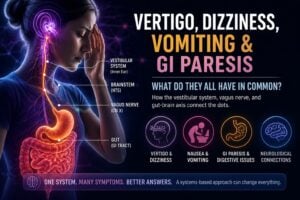
We can do balance tracking with that system. So if you take a look at Hope Brain and Body Recovery center, over the years since my stroke in 2017, never thought that I’d ever come back enough to have a system as fantastic as the systems that we’re using in this office now. Why? Why are we doing that? Because traumatic brain injury is complicated. It’s never the same for each person. You have to customize it and you have to do it comprehensively. And then you have to work the body and the brain together because it’s interconnected. Now, one thing that we’ve. We’ve been working on is that we get people with a lot of dysautonomia or pots. My POTS podcast. Right, Dysautonomia. And we know that even with Parkinson’s disease, that it’s a history of having digestive disorders, mostly constipation.
05:55
Dr. Joseph Schneider
Now, when I got my stroke, it’s a basal ganglion stroke on the left side right here. And I’ve been dealing with that and fighting that all these years, but it does cause me to have a lot of digestive disorders, mostly constipation. Sometimes the constipation can be really severe. If I leave the office early, you know that’s probably the problem. But it’s been getting better. So it’s been getting better, but things like Gyrostim improve it. Things like neuroai, things like an all core. I have an all core system that will spin you at one full rotation in a minute, and you’re kind of like at angle and you’re just like in space. And it’s fantastic for mobilizing the core.
06:53
Dr. Joseph Schneider
And now we know that if you exercise right, exercise 30 minutes a day, 150 minutes a week will improve your digestive tract, not only in motility. So the people that have gastric paresis, it will improve your motility and it will improve your microbiome. Can you imagine that? So they’re always saying it’s a gut brain effect, but it’s not just the gut brain effect, it’s the muscle system, the brain system all communicating properly to get your body to function in a really optimal way. So optimal function is what you want.
07:40
Dr. Joseph Schneider
Now, if you’ve had a traumatic brain injury, you’ve had a stroke, you have problems with balance and dizziness, if you have neurodegenerative condition like Parkinson’s or dementia or Alzheimer’s disease, the last part of it is, not only do we work your body so that we get better connectivity and we’re very specific about it. We don’t use a hammer, like Dr. McAllister said on our podcast on neurofeedback, we don’t use a hammer. We’re very specific about the plasticity that we generate in the body. Now we’re also doing stem cell work with our Hope Regeneration Center. It was run by a medical doctor, it’s run by nurse practitioner. And those systems that we’re doing intranasal work, IV, intramuscular, stem cell, mu cell and exosomes. So check that out.
08:56
Dr. Joseph Schneider
Also, because we’re finding that, you know, brains that have been injured need a little help, little more help than just the stimulation. We also do functional medicine. So if you know, and you’ve been to our office, been a patient, we do functional medicine. So what we’re doing is we’re offering everyone a chance who’ve been patients prior in this office to come back and get an evaluation. And one treatment in the NeuroAI system, the Spryson system. So go to spryson.com you’ll see a lot of information about it. Go to our website and look at NORA AI and you can understand that. So. So all previous patients that have been here can for the next four months schedule an appointment to have an evaluation on our new fantastic system, Neuro AI. And I want to thank God for the gift of life, my near death experience.
10:09
Dr. Joseph Schneider
He threw me back. And I think this is the purpose, this is why he threw me back, was to be able to do this, to achieve this, to help people with neurological conditions and to help them get their life back. Now, you know, anytime you get therapy, if it’s just therapy to minimize your symptoms, but not to regenerate your system, those therapies aren’t as valuable as these therapies because when you regenerate a system, you don’t allow it to keep degenerating. You don’t allow it to get worse and go downhill. And as we age, we’re like, always thinking, like, okay, I can’t get any better. I can’t exercise, can’t get my body better, can’t get my life better. I just have to deal with it. Well, you don’t have to deal with it.
11:03
Dr. Joseph Schneider
God gave us all the things that are necessary on this beautiful earth to bring our systems back. And so we are leading in this arena the Hope Brain and Body Recovery Center. The Hope Regeneration Center. We are our division now, the Hope Regeneration Center. And give us a call. Click on the link above and get a consult. See if we’re appropriate. Our center is appropriate for you. And see if there’s a possibility that we can bring you out of a hole in your health and get you active again. So life needs to be lived, and we’re here to help you live. Live your life through illness, through stroke, through neurodegenerative conditions, through neurodevelopmental conditions. Also real a lot of excitement with this. So this is our first chair. We’re going to get another chair. There’ll be two.
12:18
Dr. Joseph Schneider
Two of these chairs in the office and all the other wonderful technologies we have and our wonderful staff that makes it all happen. And to my wonderful wife, Dr. Unjin Yang, who is an amazing professional not only as a pharmacist, but also as a office manager and director of all the finances that goes in the office. So have a great day. Enjoy. Click on the link above. Remember, schedule your consult and stop being ill.