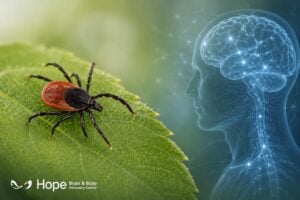
When most people think about Lyme disease, they picture a tick bite followed by the characteristic bull’s-eye rash.
But Lyme disease can become much more complicated when it affects the nervous system.
The infection can involve peripheral nerves and, in some cases, the central nervous system (CNS). Patients may develop symptoms ranging from facial weakness and nerve pain to severe headaches, cognitive difficulties, dizziness, fatigue, and other neurological problems.
And for some people, the story doesn’t necessarily end when antibiotic treatment ends.
A subset of appropriately treated patients continues to experience symptoms such as fatigue, pain, and cognitive difficulties. This is commonly referred to as Post-Treatment Lyme Disease Syndrome (PTLDS).
At Hope Brain & Body Recovery Center, patients with complex neurological conditions are evaluated from a broader brain-and-body perspective, particularly when persistent symptoms involve multiple neurological and physiological systems.
How Does Lyme Disease Begin?
Lyme disease in North America is primarily caused by the bacterium Borrelia burgdorferi, transmitted through the bite of infected Ixodes, or blacklegged, ticks.
The risk of transmission increases with the duration of tick attachment, making prompt removal important.
During the early localized stage, one of the most recognizable signs is erythema migrans, the expanding rash sometimes described as a bull’s-eye rash.
However, Lyme disease doesn’t always remain localized.
If the infection disseminates, the bacteria can spread through the bloodstream and potentially affect multiple systems throughout the body.
Neurological complications can include cranial neuritis, radiculoneuropathy, meningitis, and other forms of nervous-system involvement.
What Is Neurological Lyme Disease?
When Lyme disease affects the nervous system, it is often referred to as Lyme neuroborreliosis.
Importantly, neurological Lyme doesn’t produce one single pattern of symptoms.
It can affect the peripheral nervous system (PNS), the central nervous system (CNS), or both.
Peripheral nervous-system manifestations can include:
- Facial palsy
- Radiculoneuropathy
- Numbness
- Limb weakness
Central nervous-system manifestations may include:
- Lyme meningitis
- Fever and stiff neck
- Light sensitivity
- Severe headache
- Encephalopathic symptoms
PNS and CNS manifestations can also coexist.
That variability is one reason a detailed medical history and appropriate differential diagnosis are so important.
Facial Palsy Can Be an Important Clue
One of the more recognizable neurological manifestations of Lyme disease is facial nerve palsy.
The muscles on one side of the face may suddenly become weak or difficult to control.
What can make Lyme-associated facial palsy particularly noteworthy is that it may sometimes affect both sides of the face, unlike the more typical presentation of Bell’s palsy.
Facial weakness has several potential causes, however, so the presence of facial palsy does not automatically establish Lyme disease.
Exposure history, associated symptoms, clinical examination, and appropriate testing all matter.
Lyme Disease Can Affect Peripheral Nerves
Lyme-related neurological involvement can also affect nerves outside the brain and spinal cord.
This may produce symptoms such as:
- Numbness
- Tingling
- Radiating nerve pain
- Weakness
- Altered sensation
When peripheral nerve symptoms continue, a comprehensive neurological assessment can help determine which systems are involved and what factors may be contributing to ongoing dysfunction.
Hope Brain & Body Recovery Center provides individualized evaluation and care for patients experiencing neuropathy, using neurological diagnostics to help understand the source and pattern of peripheral nerve dysfunction.
When Lyme Disease Reaches the Central Nervous System
More severe neurological Lyme disease can involve the CNS.
Lyme meningitis, for example, can produce symptoms including:
- Severe headache
- Neck stiffness
- Fever
- Light sensitivity
Because these symptoms can resemble other forms of meningitis, Lyme disease must be considered within a broader differential diagnosis rather than assumed from symptoms alone.
The presentation emphasizes the importance of serologic testing combined with clinical history when differentiating Lyme-related CNS involvement from other conditions.
Early Recognition and Treatment Matter
When active Lyme infection is identified, antimicrobial treatment is an important part of care.
The presentation identifies oral doxycycline as a common first-line treatment for early Lyme disease and many cases involving Lyme radiculoneuritis or facial palsy.
More severe CNS involvement, such as Lyme meningitis or encephalitis, may require intravenous treatment such as ceftriaxone under appropriate medical supervision.
The key message is straightforward:
Early treatment matters.
Many patients recover well when Lyme disease is identified and appropriately treated early.
Problems become more complicated when infection goes unrecognized or when neurological injury has already occurred.
What Happens When Symptoms Continue After Treatment?
This is where Lyme disease becomes particularly challenging for some patients.
A subset of people continues experiencing significant symptoms after completing an appropriate course of antibiotic treatment.
This condition is commonly referred to as Post-Treatment Lyme Disease Syndrome, or PTLDS.
Persistent symptoms can include three particularly prominent areas:
Fatigue
Patients may experience profound fatigue that does not improve adequately with ordinary rest.
The fatigue can interfere with work, exercise, social activities, and normal daily life.
Cognitive Difficulties
Patients may describe:
- Brain fog
- Difficulty concentrating
- Word-finding problems
- Slowed information processing
- Short-term memory difficulties
These cognitive symptoms can be especially frustrating because someone may appear completely healthy externally while struggling significantly with everyday mental tasks.
Muscle and Joint Pain
Persistent migrating muscle or joint discomfort may also occur, sometimes without findings that fully explain the severity of the symptoms.
These lingering problems can create a complicated clinical picture in which the original infection has been treated but the patient still doesn’t feel recovered.
Does Persistent Illness Mean You Need More Antibiotics?
This is an important distinction.
Persistent symptoms following Lyme treatment do not automatically mean an ongoing bacterial infection is present.
The source presentation notes that multiple controlled clinical trials have not demonstrated lasting benefit from prolonged antibiotic treatment for persistent post-treatment symptoms compared with placebo.
Long-term antibiotics also carry potential risks, including C. difficile infection and complications associated with intravenous lines.
For patients who have received adequate treatment yet remain symptomatic, the next question therefore becomes:
What mechanisms are now driving the symptoms?
That question can shift the clinical focus from repeatedly targeting the original infection toward understanding the neurological, autonomic, immune, metabolic, and other systems that may still be dysfunctional.
Why Can Neurological Symptoms Persist?
There is not yet one single explanation that accounts for every case of persistent post-treatment symptoms.
The presentation highlights several proposed or emerging mechanisms.
Persistent Antigens or Microbial Remnants
One possibility involves bacterial debris, biofilms, or antigen persistence continuing to stimulate immune activity even after active infection has been treated.
Immune Dysregulation
The immune system may remain abnormally activated following infection.
Proposed mechanisms include:
- Molecular mimicry
- Cytokine changes
- Autoimmune activity
- T-cell activation
This may help explain why some post-infectious symptoms can persist after the triggering infection has resolved.
Neural and Autonomic Dysregulation
The infection or inflammatory response may disrupt neurological networks involved in autonomic regulation.
This is particularly interesting because persistent post-Lyme symptoms can overlap with conditions involving dysautonomia.
Gut Microbiome Disruption
The presentation also raises the possibility that antibiotic-associated gut dysbiosis may contribute to secondary problems involving histamine, mast-cell activity, digestive dysfunction, and neurological symptoms.
These mechanisms remain areas of active investigation, and no single mechanism should be assumed to explain every patient’s persistent symptoms.
The Lyme Disease and POTS Connection
Some patients with persistent post-infectious illness experience symptoms resembling dysautonomia or Postural Orthostatic Tachycardia Syndrome (POTS).
These may include:
- Dizziness
- Exercise intolerance
- Abnormal heart-rate responses
- Fatigue
- Cognitive fog
- Gastrointestinal problems
The autonomic nervous system controls functions that normally occur automatically, including heart rate, blood pressure, digestion, temperature regulation, and vascular responses.
If these neurological control systems become dysregulated, symptoms can appear throughout seemingly unrelated areas of the body.
Hope Brain Center has a dedicated Dysautonomia / POTS program for patients experiencing these complex autonomic symptoms.
Persistent Symptoms Can Extend Far Beyond Fatigue
The symptom spectrum described in the source extends well beyond the classic PTLDS triad of fatigue, pain, and cognitive difficulty.
Symptoms reported in post-Lyme and tick-borne illness contexts include:
- Dizziness
- POTS
- Migraines
- Chronic fatigue
- Neuropathy
- Digestive disorders
- Tics
- Tremors
- Post-exertional malaise
- Mast-cell or histamine-related flares
Alpha-gal syndrome is also identified within the broader tick-borne illness context.
This wide symptom range demonstrates why these patients can be so challenging to evaluate.
A person may end up seeing a neurologist for headaches, a cardiologist for heart-rate problems, a gastroenterologist for digestive symptoms, and another clinician for fatigue.
But the nervous system doesn’t operate as a collection of isolated departments.
Beyond Lyme: Other Tick-Borne Neurological Diseases
Lyme disease isn’t the only tick-borne illness capable of affecting the nervous system.
The source also identifies several other important conditions.
Tick-Borne Encephalitis
Tick-borne encephalitis (TBE) is a viral CNS infection seen more commonly in Europe and Asia.
It can produce a biphasic illness, beginning with fever before progressing in some patients to meningitis or encephalitis.
Tick-Borne Relapsing Fever
This condition is caused by Borrelia species other than B. burgdorferi and is characterized by recurrent episodes of fever.
Neurological involvement can occur if the condition is untreated.
Ehrlichiosis and Anaplasmosis
These bacterial tick-borne infections can produce severe systemic inflammation and may cause neurological complications such as encephalopathy or meningitis.
The important clinical lesson is that not every illness following a tick bite is Lyme disease.
Different organisms require different diagnostic and treatment considerations, making careful differential diagnosis essential.
Moving From Infection Treatment to Neurological Rehabilitation
When an active infection is present, treating that infection appropriately is essential.
But when infection has already been adequately treated and neurological symptoms remain, rehabilitation may need to address what is functionally happening now.
That may include investigating:
- Cognitive performance
- Balance
- Vestibular function
- Peripheral nerve function
- Autonomic regulation
- Exercise tolerance
- Sensory processing
- Brain-body communication
Hope Brain & Body Recovery Center’s Brain-Specific Rehabilitation program begins with comprehensive examination and neurological diagnostics before developing an individualized treatment program.
Depending on the patient’s findings, care may incorporate different neurological rehabilitation technologies and exercises rather than assuming that one treatment protocol will work for everyone.
Why Functional Medicine May Also Matter
Persistent neurological symptoms don’t always exist independently of metabolic, digestive, inflammatory, or nutritional factors.
Hope Brain Center’s Functional Medicine program takes a broader approach to evaluating metabolic health, including blood, urine, stool, saliva, and other testing when clinically appropriate.
For a patient whose post-infectious symptoms include neurological problems alongside digestive dysfunction, fatigue, inflammation, or nutritional issues, looking at these systems together may provide a more complete picture.
The goal isn’t to assume that every persistent symptom comes from Lyme disease.
It is to determine what is actually contributing to the patient’s symptoms now.
The Path Forward: Diagnose First, Then Treat the Mechanism
The final message of the presentation is perhaps the most important.
Complex post-Lyme and tick-borne neurological illness requires moving beyond a one-size-fits-all approach.
The framework emphasizes four interconnected priorities:
Accurate diagnosis.
Identifying and targeting the relevant mechanisms.
Neurological rehabilitation when appropriate.
Multidisciplinary care.
Patients experiencing combinations of dizziness, POTS, migraines, fatigue, neuropathy, tremor, cognitive dysfunction, digestive problems, or post-exertional malaise may require input from more than one specialty.
No single treatment—and no single specialty—necessarily explains the entire patient.
Still Struggling After Lyme Disease? There May Be More to Investigate
Finishing treatment for Lyme disease but continuing to feel unwell can be incredibly frustrating.
The symptoms are real, even when routine testing doesn’t provide an obvious explanation.
Persistent brain fog, dizziness, neuropathy, headaches, fatigue, exercise intolerance, autonomic symptoms, and other neurological problems deserve a careful evaluation based on the patient’s current neurological function—not simply another assumption about the original infection.
At Hope Brain & Body Recovery Center, our team looks at the brain, nervous system, autonomic function, metabolic health, and other contributing factors to build an individualized picture of what may be preventing recovery.
Ready to Find Out What’s Driving Your Symptoms?
If you or someone you love continues to experience neurological symptoms following Lyme disease or another tick-borne illness, our team can help you explore the next step.
👉 Schedule your FREE 15-minute consultation with Hope Brain & Body Recovery Center and speak with our team about your symptoms, previous treatment, and whether a comprehensive neurological evaluation may be appropriate.
📍 Our Location: 6 Dickinson Dr suite 310 Building 300, Chadds Ford, PA 19317, United States