When patients arrive at Hope Brain Center, they often don’t have just one symptom.
They may be dealing with dizziness, headaches, brain fog, chronic pain, balance problems, fatigue, symptoms following a traumatic brain injury, Long COVID, Lyme disease, or a combination of concerns that have been difficult to understand.
That’s why Dr. Joseph Schneider doesn’t begin by looking at a single symptom in isolation.
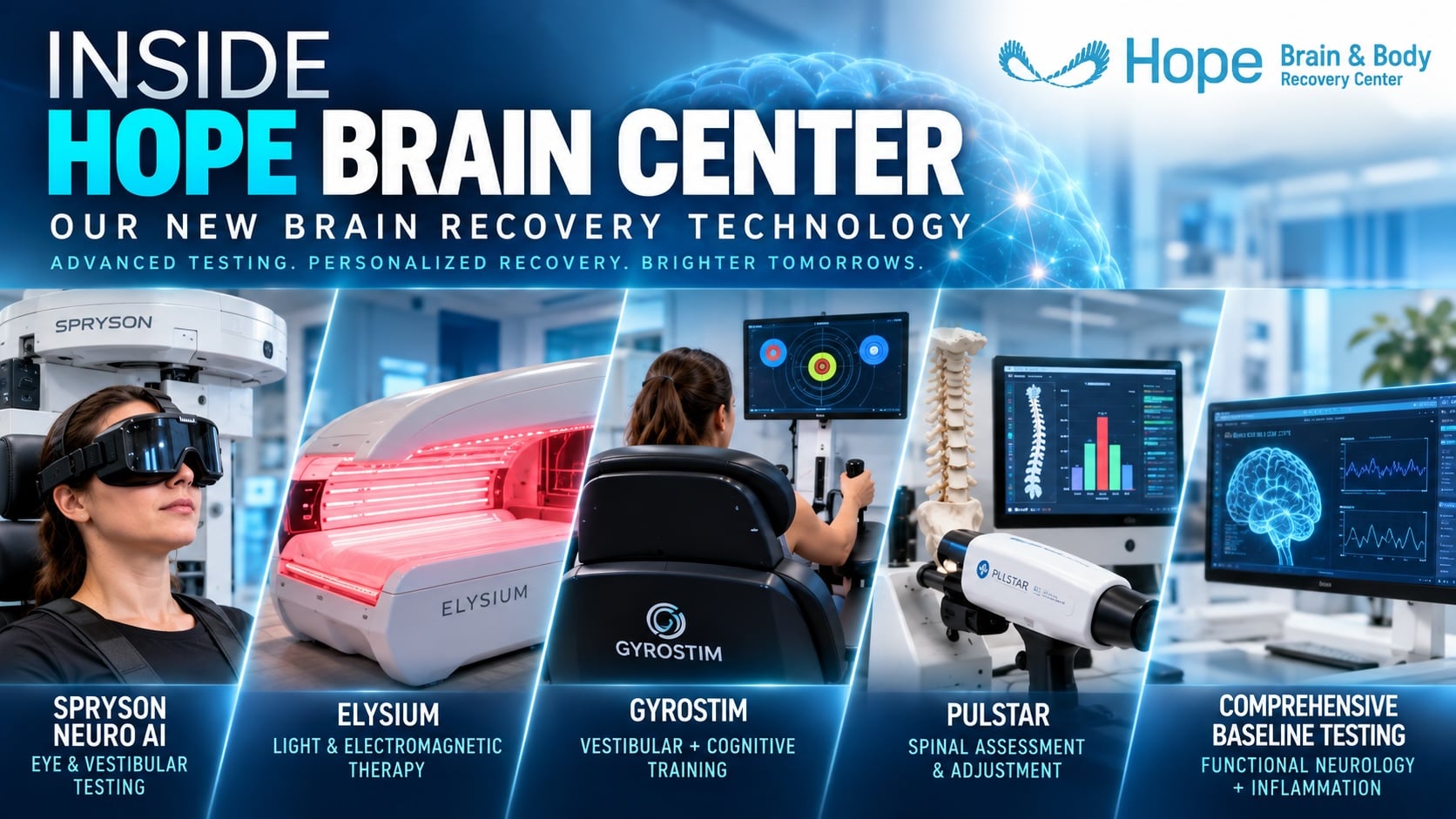
The goal of the diagnostic evaluation process at Hope Brain & Body Recovery Center is to establish a comprehensive baseline of neurological and functional health—and then use objective measurements to help develop an individualized care plan.
As Dr. Schneider explains, the center’s evaluation begins by asking a fundamental question:
How well is your nervous system actually functioning?
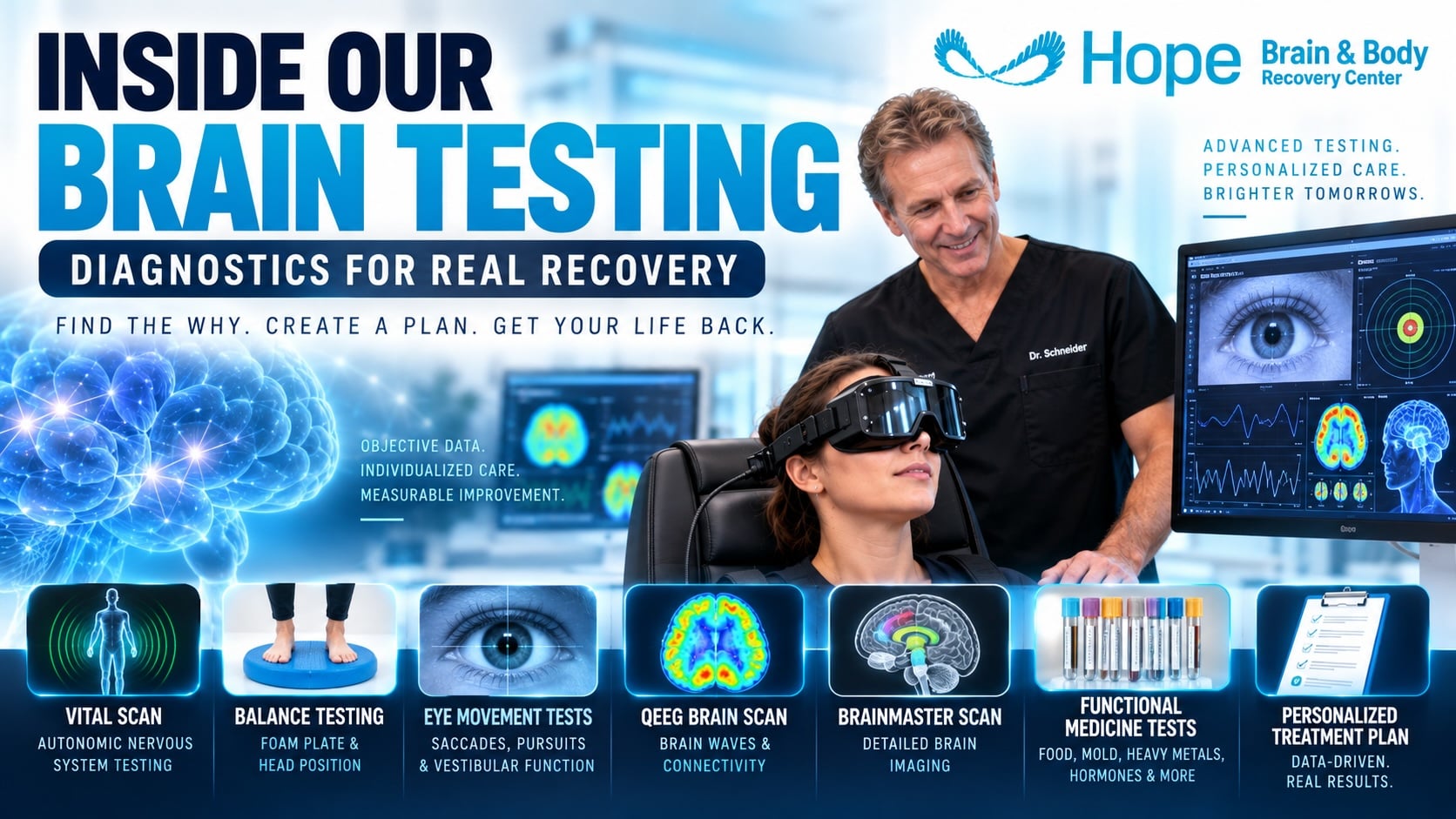
1. Vital Scan: Looking at Your Autonomic Nervous System
One of the first assessments may be the Vital Scan, which provides information about autonomic nervous system function.
The autonomic nervous system helps regulate functions you don’t consciously control, including heart rate, blood pressure, digestion, temperature regulation, and many other processes.
Hope Brain Center evaluates how the nervous system responds when a patient transitions from sitting to standing. Dr. Schneider uses these measurements to examine the relationship between the sympathetic and parasympathetic nervous systems.
This can be particularly relevant when evaluating patients experiencing symptoms such as dizziness, exercise intolerance, fatigue, or other complaints potentially involving autonomic regulation.
2. Balance Testing: What Happens When Vision Is Removed?
Balance is surprisingly complex.
Your brain continuously integrates information coming from your:
- Eyes
- Inner ears
- Muscles and joints
- Feet
- Neck
- Brain and brainstem
Hope Brain Center uses balance testing that may include having a patient stand on a foam surface with their eyes closed while changing head position.
Why make the test more difficult?
Removing reliable visual and surface information challenges the nervous system to rely more heavily on other sensory inputs. Changes in head and neck position can provide additional information about how these systems are working together.
The result can help identify patterns that aren’t obvious during normal standing or walking.
3. Vestibulo-Ocular Reflex Testing
Your eyes and inner ears are constantly communicating.
One important part of that relationship is the vestibulo-ocular reflex, or VOR.
The VOR helps keep your vision stable when your head moves. When you turn your head but continue looking at an object, this reflex helps your eyes compensate for that movement.
Hope Brain Center evaluates VOR responses in different head positions to look for differences or imbalances in vestibular function.
For someone experiencing dizziness, motion sensitivity, or balance problems, these findings may provide another piece of the neurological picture.
4. Eye Movement Testing
Your eye movements can reveal important information about neurological function.
Testing may examine several different types of eye movement, including saccades and smooth pursuits.
Saccades are the rapid eye movements you use when shifting your gaze from one target to another.
Smooth pursuit is your ability to smoothly follow a moving target.
Dr. Schneider demonstrates testing these movements both horizontally and vertically, allowing the team to compare performance in different directions and identify asymmetries that may warrant further investigation or rehabilitation.
5. Optokinetic Testing and Motion Sensitivity
Another assessment discussed by Dr. Schneider is optokinetic nystagmus (OKN) testing.
This challenges the visual system with moving patterns and allows clinicians to observe the resulting eye movements.
For patients who experience motion sickness or difficulty when their visual environment is moving, examining these responses can provide additional information about visual-vestibular processing.
Rather than simply asking, “Does movement make you dizzy?” the goal is to collect measurable information about how the nervous system responds to movement.
6. Rotational Vestibular Testing
The inner ear contains three semicircular canals on each side, oriented in different planes.
Together, these canals help your brain detect rotational movement.
Hope Brain Center can evaluate eye responses while patients undergo controlled rotation in different directions. This allows the clinical team to look for asymmetries and gather information related to the horizontal, anterior, and posterior semicircular canals.
This is particularly useful because vestibular dysfunction isn’t necessarily identical in every direction.
Understanding those differences can help make rehabilitation more individualized.
7. QEEG Brain Mapping
The evaluation can also move directly into measurements of brain activity.
A quantitative EEG (QEEG) records electrical activity from the brain and examines patterns across frequency bands such as:
Delta, theta, alpha, beta, and high beta.
Dr. Schneider describes using these measurements to examine patterns of brain activity and connectivity that can then become part of the patient’s neurological baseline.
Importantly, QEEG is a functional measurement of electrical activity—it is not the same as structural imaging such as an MRI or CT scan.
8. BrainMaster Assessment
Hope Brain Center also uses BrainMaster technology to gather additional information about brain activity.
Dr. Schneider describes the system as providing thousands of data points and allowing the team to examine activity associated with deeper brain regions, including areas involving the frontal cortex and cingulate.
The purpose of collecting this additional information is straightforward:
The more objective information clinicians have about neurological function, the more individualized the rehabilitation strategy can become.
9. Functional Medicine Testing
Hope Brain Center’s diagnostic philosophy doesn’t stop with neurology.
Dr. Schneider believes functional neurology and functional medicine should be considered together when appropriate.
Depending on the patient, testing discussed at the center includes:
- Heavy-metal screening
- Food-sensitivity panels
- Mold-related testing
- DUTCH hormone testing
- Cortisol and cortisone measurements
- Other metabolic and hormonal markers
The purpose is to examine potential biological factors alongside neurological findings rather than assuming every symptom originates exclusively in the nervous system.
Test results need to be interpreted in clinical context; not every abnormal laboratory result necessarily explains a patient’s symptoms.
Why Establish a Baseline?
One of the most important ideas behind this process is measurement.
Hope Brain Center doesn’t only want to know how a patient feels on the first day.
The team wants objective baseline measurements that can potentially be repeated later.
Dr. Schneider describes retesting patients during their programs so clinicians can compare the new measurements with the numbers recorded when treatment began.
That creates a much more useful question than simply:
“Do you feel better?”
The team can also ask:
“Is neurological function changing alongside the way you feel?”
Functional Neurology + Functional Medicine
This combination is central to Dr. Schneider’s philosophy.
The neurological evaluation looks for areas where nervous-system function may be impaired.
Functional medicine testing may examine factors associated with metabolic health, hormones, inflammation, nutrition, and environmental exposures.
Dr. Schneider describes this as looking for “points of inflammation” alongside “points of weakness in your nervous system.”
These findings can then be considered together when developing the patient’s care plan.
The Goal: Getting Your Life Back
Ultimately, sophisticated testing isn’t valuable simply because it produces graphs, numbers, or impressive-looking brain maps.
It needs to translate into something meaningful for the patient.
For Dr. Schneider, that means helping people improve their ability to function—to do more, participate in everyday activities, and spend meaningful time with their families.
That’s the philosophy behind the Hope Brain Center diagnostic process:
Measure first. Understand the individual. Create a plan. Measure again.
Because the objective isn’t simply managing a collection of symptoms.
It’s understanding the person behind them—and helping that person move toward getting their life back.
Ready to Find Out What Your Nervous System Is Telling You?
Ready to Take the Next Step?
Living with neuropathy, chronic nerve pain, brain injury, or complex neurological symptoms can be frustrating—especially when the treatments you’ve already tried haven’t delivered the progress you hoped for.
At Hope Brain Center, Dr. Joseph Schneider and his team take a comprehensive approach to neurological rehabilitation, including tPRF, combining advanced diagnostics with individualized therapies designed around how your nervous system is actually functioning.
Your first step is a conversation.
Book Your Consultation Today
Discover whether Hope Brain Center’s personalized neurological approach may be right for you.
👉 BOOK NOW: https://hopebraincenter.com/book/
Don’t settle for simply managing symptoms. Start exploring what’s possible when your brain and nervous system are evaluated as a whole.