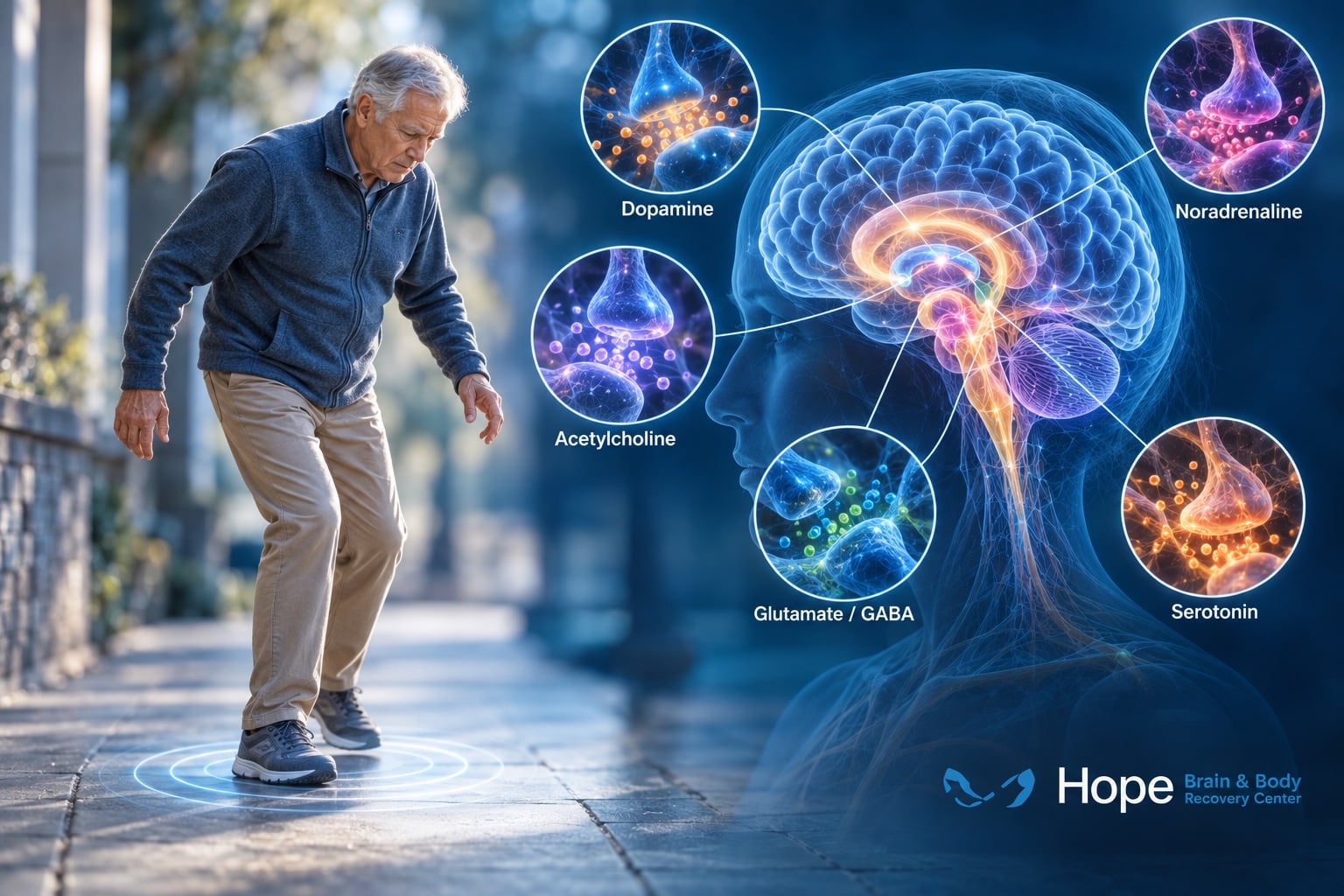
Imagine walking across your living room when, without warning, your feet stop moving.
You know exactly where you want to go.
You are trying to take another step.
But your body doesn’t respond.
For a few seconds, it feels as though your shoes have been glued to the floor.
This frightening experience is known as freezing of gait (FOG), and it is one of the most challenging movement symptoms associated with Parkinson’s disease.
Freezing episodes can occur while starting to walk, turning a corner, approaching a doorway, or trying to navigate a crowded environment.
For patients, these moments can be unpredictable and deeply frustrating. They can also significantly increase the risk of falling.
But why does the brain suddenly lose the ability to perform something as familiar as walking?
A 2026 research review by Cho and colleagues, published in the European Journal of Neuroscience, explores an important explanation: freezing of gait involves much more than a shortage of dopamine.
The research examines how several neurotransmitter systems interact with the brain’s locomotor networks, revealing why Parkinson’s-related walking difficulties can be so complex.
At Hope Brain & Body Recovery Center, understanding how different neurological systems work together is central to evaluating movement, coordination, balance, and other neurological challenges.
What Is Freezing of Gait in Parkinson’s Disease?
Freezing of gait is a sudden, brief inability to initiate or continue effective forward stepping despite the intention to walk.
Episodes often last only a few seconds, although they can feel considerably longer to the person experiencing them.
Some people become completely unable to move their feet.
Others produce rapid, tiny shuffling steps that fail to move the body forward.
Freezing commonly occurs during situations that place additional demands on the brain’s movement-control systems.
These include:
- Starting to walk from a standing position
- Turning around or changing direction
- Passing through doorways or narrow spaces
- Approaching a destination
- Walking while performing another task
- Moving under stress or time pressure
Freezing becomes more common as Parkinson’s disease progresses, although its occurrence and severity vary considerably between patients.
The most important distinction is that freezing is not simply muscle weakness.
The person may have sufficient strength to move but temporarily cannot coordinate the neurological processes required to produce effective stepping.
Why Dopamine Doesn’t Explain Everything
Parkinson’s disease is strongly associated with degeneration of dopamine-producing neurons.
Dopamine is essential for regulating movement through interconnected brain circuits involving the basal ganglia.
This is why medications such as levodopa are widely used to help manage Parkinson’s motor symptoms.
But freezing of gait presents a neurological puzzle.
Some patients experience freezing when their medication is wearing off.
Others continue freezing even when dopamine replacement improves their other movement symptoms.
A smaller group may develop or worsen freezing during periods of higher dopaminergic stimulation.
The research reviewed by Cho and colleagues describes a potentially nonlinear relationship between dopamine signaling and freezing.
Too little dopaminergic activity can interfere with movement.
But excessive stimulation may also disrupt the balance of neural circuits in selected patients.
This helps explain why simply increasing levodopa does not always resolve freezing.
Medication adjustments must always be directed by the patient’s treating neurologist. Patients should never reduce or increase Parkinson’s medication independently in response to freezing episodes.
Five Neurotransmitter Systems Involved in Freezing of Gait
The research highlights several chemical signaling systems that may contribute to freezing.
Rather than operating independently, these systems interact across brain networks involved in attention, motor planning, balance, and locomotion.
Understanding their different roles helps explain why two people with Parkinson’s disease can experience similar freezing symptoms for different neurological reasons.
1. Dopamine: The Movement-Regulation System
Dopamine helps regulate the initiation, scaling, and coordination of voluntary movement.
Within the basal ganglia, dopamine influences the activity of circuits that help facilitate desired movements and suppress competing motor activity.
When dopaminergic signaling is disrupted, movements may become slower, smaller, or more difficult to initiate.
For some patients, freezing improves when levodopa restores more effective dopamine signaling.
But the research also discusses dopamine-induced freezing, a less common pattern in which freezing emerges or worsens during higher dopaminergic states.
Case reports have described freezing associated with combinations of levodopa and deep brain stimulation.
This does not mean dopamine treatment is harmful in general.
It means that freezing may depend on the balance and timing of activity across multiple neural systems rather than dopamine concentration alone.
A careful evaluation of when freezing occurs relative to medication timing can provide valuable clinical information.
2. Acetylcholine: Why Walking Stops Being Automatic
Think about how you normally walk.
You don’t consciously instruct your left leg to move forward, shift your weight, activate specific muscles, and then repeat the process on the opposite side.
Much of walking happens automatically.
This automaticity allows you to navigate your environment while talking, thinking, or paying attention to other things.
The cholinergic system, which uses acetylcholine as a neurotransmitter, contributes to attention, sensory integration, and aspects of gait regulation.
The 2026 research describes cholinergic deficits in some patients with freezing of gait, particularly those whose freezing responds poorly to levodopa.
When these systems become impaired, walking may require more conscious attention.
That creates a problem.
If someone must actively concentrate on every step, their movement becomes more vulnerable to distractions and competing cognitive demands.
For example, a person may walk reasonably well along an empty hallway but freeze when asked a question while approaching a doorway.
The additional cognitive demand can overwhelm an already vulnerable movement-control system.
Walking has shifted from an automatic activity into a task that requires significant mental effort.
3. Noradrenaline: Adapting Movement Under Pressure
Noradrenaline, also called norepinephrine, plays an important role in alertness, attention, and adaptive responses to changing circumstances.
A major source of noradrenaline in the brain is the locus coeruleus, a small structure located in the brainstem.
This system helps the brain adjust behavior when environmental demands change.
Imagine walking across an open room and suddenly needing to avoid an obstacle.
Your brain must quickly detect the change, adjust attention, modify movement planning, and coordinate the next steps.
Noradrenergic pathways contribute to this adaptive process.
The research discusses imaging findings associating freezing of gait with changes in noradrenergic function, including reduced norepinephrine transporter binding in certain brain regions.
These findings suggest that some freezing episodes may involve difficulty adapting locomotion under challenging conditions.
This may help explain why stress, divided attention, and time pressure can worsen freezing.
However, these imaging associations do not establish that every freezing episode results from noradrenaline deficiency.
4. Glutamate and GABA: The Brain’s Accelerator and Brake
Movement requires a carefully coordinated balance between neural excitation and inhibition.
Two neurotransmitters play major roles in this process.
Glutamate is the brain’s principal excitatory neurotransmitter.
GABA is its principal inhibitory neurotransmitter.
Both are essential for normal brain function.
The basal ganglia and connected cortical networks rely on precisely timed excitatory and inhibitory signaling to coordinate movement.
If that balance becomes disrupted, the neural activity required for rhythmic stepping may become unstable.
The research describes how changes in glutamate-GABA signaling may contribute to freezing by interfering with the organization of locomotor circuits.
This does not mean that one neurotransmitter simply needs to be increased while the other is decreased.
The challenge involves the timing, location, and coordination of signals across complex networks.
5. Serotonin: An Emerging Piece of the Puzzle
Serotonin is often discussed in connection with mood.
But it also contributes to motor control and communication between cognitive and movement-related systems.
The 2026 review identifies serotonergic dysfunction as a potential additional contributor to freezing of gait.
Compared with dopamine and acetylcholine, serotonin’s specific role in freezing remains less clearly established.
Researchers are investigating whether serotonergic changes interact with other neurotransmitter abnormalities to increase vulnerability to freezing.
The important takeaway is that Parkinson’s-related gait dysfunction may involve several interacting chemical systems rather than one isolated neurotransmitter problem.
Freezing of Gait Is Also a Brain Network Problem
Neurotransmitters are only part of the story.
For walking to occur smoothly, different brain regions must communicate with one another at precisely coordinated times.
These include areas involved in movement planning, attention, sensory processing, balance, and automatic stepping.
The research describes several patterns of abnormal brain-network activity associated with freezing.
Beta-Band Activity: When the Brain’s Movement Brake Becomes Overactive
Neurons communicate partly through coordinated electrical activity.
One frequency range, known as the beta band, is commonly associated with movement-related processing in the basal ganglia.
In Parkinson’s disease, abnormal beta activity has been linked to difficulties initiating and performing movement.
The research discusses beta bursts within the subthalamic nucleus, a key structure in the basal ganglia.
These bursts may occur at particular phases of the walking cycle.
When beta activity becomes poorly timed or excessive, it may interfere with the transition from preparing a movement to actually performing it.
Researchers are investigating whether these signals could eventually help guide more adaptive forms of deep brain stimulation.
However, beta activity is not a simple on-off switch for freezing, and these approaches remain areas of active investigation.
Frontal Network Disconnection
The frontal regions of the brain contribute to movement planning, attention, and executive control.
Other brain regions process sensory information and help coordinate ongoing movement.
The research describes reduced communication between frontal and posterior networks in patients experiencing freezing.
This may interfere with the brain’s ability to maintain coordinated walking when conditions become more demanding.
Failure of Cortical Compensation
As automatic movement pathways become less efficient, the brain may recruit additional cortical resources to help maintain walking.
This compensation can be useful.
But it also creates vulnerability.
When attention is divided between walking and another activity, the compensatory system may become overwhelmed.
This is one reason dual-task situations can be particularly challenging for patients with freezing of gait.
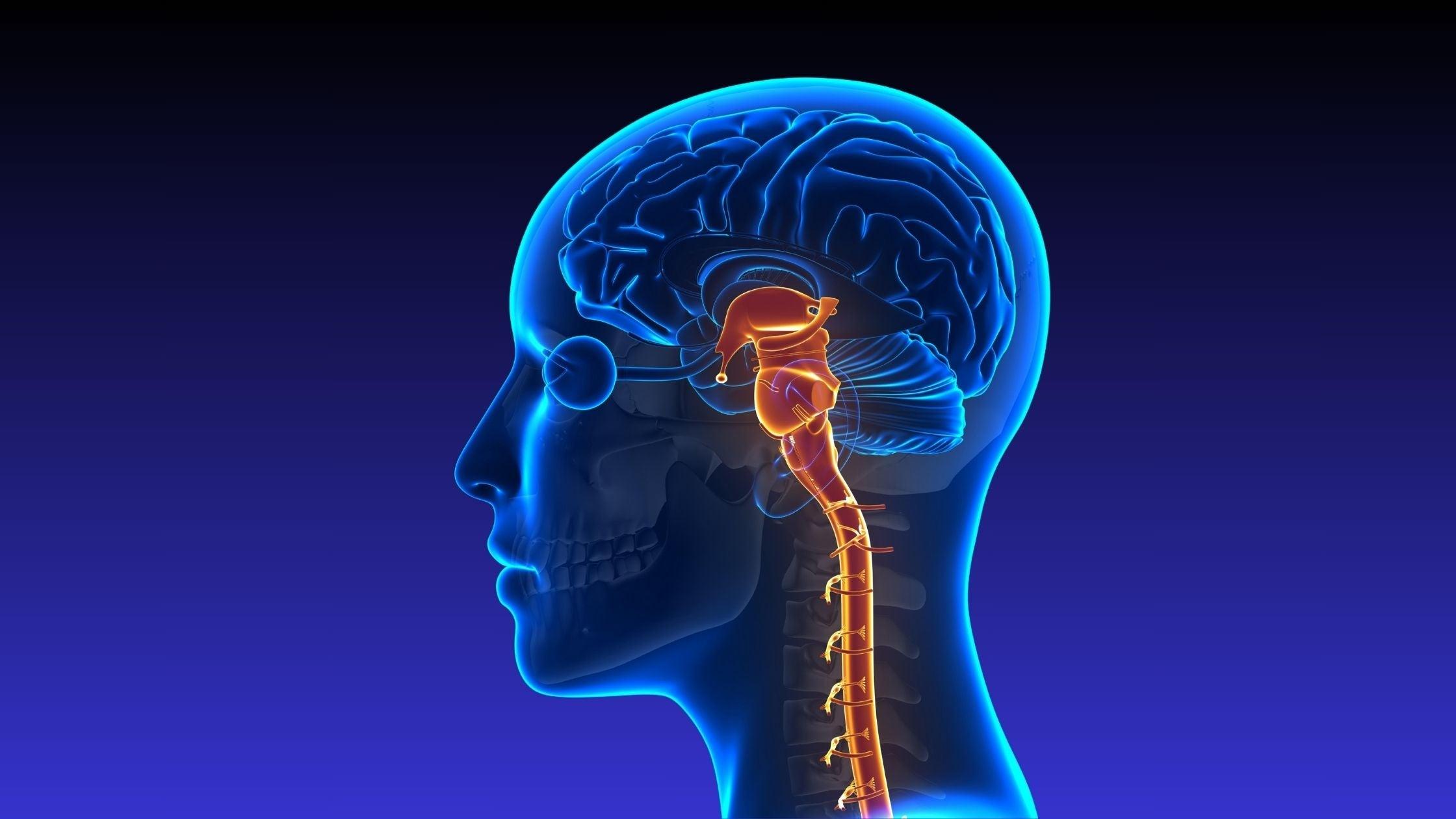
The Brainstem: Where Walking Commands Come Together
Deep within the brainstem are structures involved in coordinating locomotion.
Two important regions are the pedunculopontine nucleus (PPN) and cuneiform nucleus (CuN).
These structures participate in the mesencephalic locomotor region, which helps coordinate signals between higher brain centers and spinal movement circuits.
The research describes abnormal timing of electrical activity in these regions immediately before freezing episodes.
This suggests that freezing may occur partly because the brainstem cannot effectively coordinate or release the motor commands needed for stepping.
What Is the StartReact Effect?
The StartReact effect refers to the rapid release of a prepared movement in response to a startling stimulus.
Researchers have used this phenomenon to study how motor programs are prepared and initiated.
The presentation describes a reduced StartReact response in patients with freezing of gait.
This may indicate abnormalities in the systems responsible for preparing or releasing rapid movement responses.
It is an interesting experimental finding, not a recommendation to use startling noises to force someone to walk.
Why Some Patients Take Tiny, Rapid Steps Before Freezing
Freezing does not always look like a complete stop.
Some patients experience a phenomenon known as hastening.
Their steps become increasingly short and rapid, but forward movement becomes less effective.
The research describes stepping rhythms accelerating during some freezing episodes while coordination and ground-reaction-force patterns become disrupted.
The person may appear to be trying harder to walk, yet the movement becomes progressively less functional.
This highlights another important distinction.
More muscle activity does not necessarily mean better movement.
Effective walking requires appropriately timed muscle activation, weight shifting, balance control, and coordination between the legs.
When these processes become disorganized, movement can fail despite continued effort.
The Importance of Weight Shifting Before the First Step
Before taking a step, your body must make subtle postural adjustments.
For example, when lifting one foot, your center of mass must shift appropriately so the other leg can support your weight.
These are called anticipatory postural adjustments.
The research describes impaired preparatory weight shifting in patients with freezing of gait.
This suggests that some freezing episodes may begin before the visible step is attempted.
The brain may have difficulty organizing the sensory and motor information needed to safely initiate movement.
This is particularly relevant to neurological rehabilitation because walking involves more than moving the legs.
It also depends on balance, proprioception, posture, and accurate sensory integration.
Why Doorways, Turning, and Multitasking Trigger Freezing
Many freezing episodes occur in predictable situations.
Doorways require the brain to process changing visual and spatial information.
Turning requires coordination between posture, balance, and movement direction.
Walking while talking or carrying an object divides attention.
Stress and time pressure add further demands.
When automatic gait pathways are impaired, these challenges may exceed the brain’s available movement-control capacity.
That is why rehabilitation programs often focus directly on the circumstances that trigger freezing.
Rather than practicing only straightforward walking, therapy may incorporate carefully supervised turning, obstacle negotiation, changes in direction, and other real-world tasks.
Can Parkinson’s Freezing of Gait Be Treated?
Freezing of gait can be difficult to manage because its underlying mechanisms vary.
Treatment may involve medication optimization, targeted rehabilitation, fall-prevention strategies, and, in selected circumstances, advanced neurological interventions.
Medication Optimization
For some patients, freezing improves when Parkinson’s medication is appropriately adjusted.
For others, freezing may persist despite adequate dopaminergic treatment.
The research also discusses rare cases in which excessive dopaminergic stimulation contributes to freezing.
This is why medication decisions should be individualized and supervised by a movement-disorders neurologist.
Cholinergic and Noradrenergic Treatments
Researchers are investigating whether treatments targeting acetylcholine or noradrenaline could benefit particular freezing patterns.
However, the clinical evidence remains limited.
These approaches should not be presented as established treatments for every patient with freezing of gait.
Deep Brain Stimulation
Deep brain stimulation (DBS) is an established treatment for selected Parkinson’s symptoms.
Its effects on freezing of gait are more variable.
Some patients improve, while others experience persistent or worsening freezing depending on the clinical circumstances and stimulation parameters.
Researchers are investigating adaptive DBS systems that respond to changing brain signals, including beta activity.
These approaches may eventually allow more personalized stimulation, but they are not a universal solution for freezing.
How Targeted Gait Rehabilitation Can Help
One of the most clinically useful sections of the research presentation concerns exercise and rehabilitation.
The review highlights several approaches that may help reduce freezing severity or improve walking function.
Benefits vary between patients, and continued practice is often necessary to maintain improvements.
1. Auditory Cueing
Some patients walk more effectively when their steps are guided by a consistent external rhythm.
For example, a therapist may use a metronome or rhythmic auditory cues.
These signals can provide an alternative timing reference when internal movement timing is impaired.
2. Visual Cueing
Visual markers can help some patients initiate or continue walking.
Examples include floor lines or other structured visual targets.
Rather than relying entirely on automatic stepping, the patient uses an external visual reference to guide movement.
3. Treadmill Training
The presentation discusses research suggesting that treadmill-based rehabilitation, particularly when combined with appropriate visual or auditory cues, may improve certain walking outcomes.
However, treadmill training must be selected carefully because patients with significant freezing or balance instability may require close supervision and safety support.
4. Turning and Obstacle Training
Because freezing frequently occurs during turning and obstacle negotiation, practicing these tasks can be especially relevant.
Therapists may gradually introduce controlled challenges involving changes in direction, narrow spaces, and environmental obstacles.
The objective is to improve the patient’s ability to manage situations that commonly trigger freezing.
5. Balance and Strength Training
Muscle strength, postural control, and balance contribute to safe walking.
The research discusses adapted resistance training and exercises that challenge coordination.
These may help support mobility, particularly when combined with task-specific gait training.
Importantly, exercises involving unstable surfaces or challenging balance tasks should be supervised when fall risk is elevated.
What Should You Do During a Freezing Episode?
If you or someone you care for experiences freezing, safety comes first.
Trying to force the legs forward can increase instability.
Depending on the individual’s abilities and rehabilitation guidance, useful strategies may include stopping, regaining balance, shifting weight deliberately, and using a familiar visual or rhythmic cue to restart walking.
Some people benefit from consciously stepping over an imaginary line or following a rhythmic count.
Others require different strategies.
Because freezing can cause falls, these techniques are best practiced with a qualified neurological rehabilitation professional before being used independently.
Why a Personalized Neurological Assessment Matters
Two patients may both experience freezing of gait but have different contributing factors.
One may freeze primarily when medication wears off.
Another may freeze during turning or divided-attention tasks.
A third may experience persistent freezing despite otherwise adequate medication response.
A comprehensive evaluation may consider medication timing, gait initiation, turning, balance, sensory processing, cognitive demands, and fall history.
The research reinforces the importance of looking at the interaction between brain chemistry, network coordination, and motor execution.
At Hope Brain & Body Recovery Center, our Brain-Specific Rehabilitation approach emphasizes individualized neurological assessment and targeted rehabilitation strategies.
For patients with Parkinson’s disease and other movement disorders, understanding how different neurological systems contribute to function may help inform an appropriate rehabilitation plan alongside specialist medical care.
Learn more about our approach to Neurodegenerative Disorders.
The Future of Parkinson’s Gait Rehabilitation
The 2026 research highlights several directions for future investigation.
Scientists are exploring how neurotransmitter abnormalities interact with changes in brain-network activity.
They are also studying whether neural signals such as beta bursts could help identify freezing vulnerability or guide adaptive stimulation.
At the same time, rehabilitation research continues to investigate how external cueing, task-specific training, and coordinated movement practice may help patients manage freezing.
The goal is not simply to find one chemical responsible for every episode.
It is to understand which neurological systems are contributing to freezing in a particular patient.
That broader perspective may eventually support more individualized treatment strategies.
Parkinson’s Freezing of Gait Is More Than a Dopamine Problem
Freezing of gait can feel sudden and inexplicable.
But the research suggests that these episodes emerge from complex interactions among neurotransmitters, brain networks, motor planning, balance, and movement timing.
Dopamine remains important.
So do acetylcholine, noradrenaline, glutamate, GABA, and potentially serotonin.
The brainstem, basal ganglia, frontal cortex, and sensory-motor systems must also work together to produce smooth walking.
When these systems become disrupted, a familiar movement can suddenly become difficult or temporarily impossible.
Understanding this complexity helps explain why freezing does not respond equally to every treatment—and why rehabilitation needs to address more than muscle strength alone.
Walking is not simply a mechanical activity. It is a highly coordinated neurological process.
Ready to Take the Next Step?
Living with neuropathy, chronic nerve pain, brain injury, or complex neurological symptoms can be frustrating—especially when the treatments you’ve already tried haven’t delivered the progress you hoped for.
At Hope Brain Center, Dr. Joseph Schneider and his team take a comprehensive approach to neurological rehabilitation, including tPRF, combining advanced diagnostics with individualized therapies designed around how your nervous system is actually functioning.
Your first step is a conversation.
Book Your Consultation Today
Discover whether Hope Brain Center’s personalized neurological approach may be right for you.
👉 BOOK NOW: https://hopebraincenter.com/book/
Don’t settle for simply managing symptoms. Start exploring what’s possible when your brain and nervous system are evaluated as a whole.