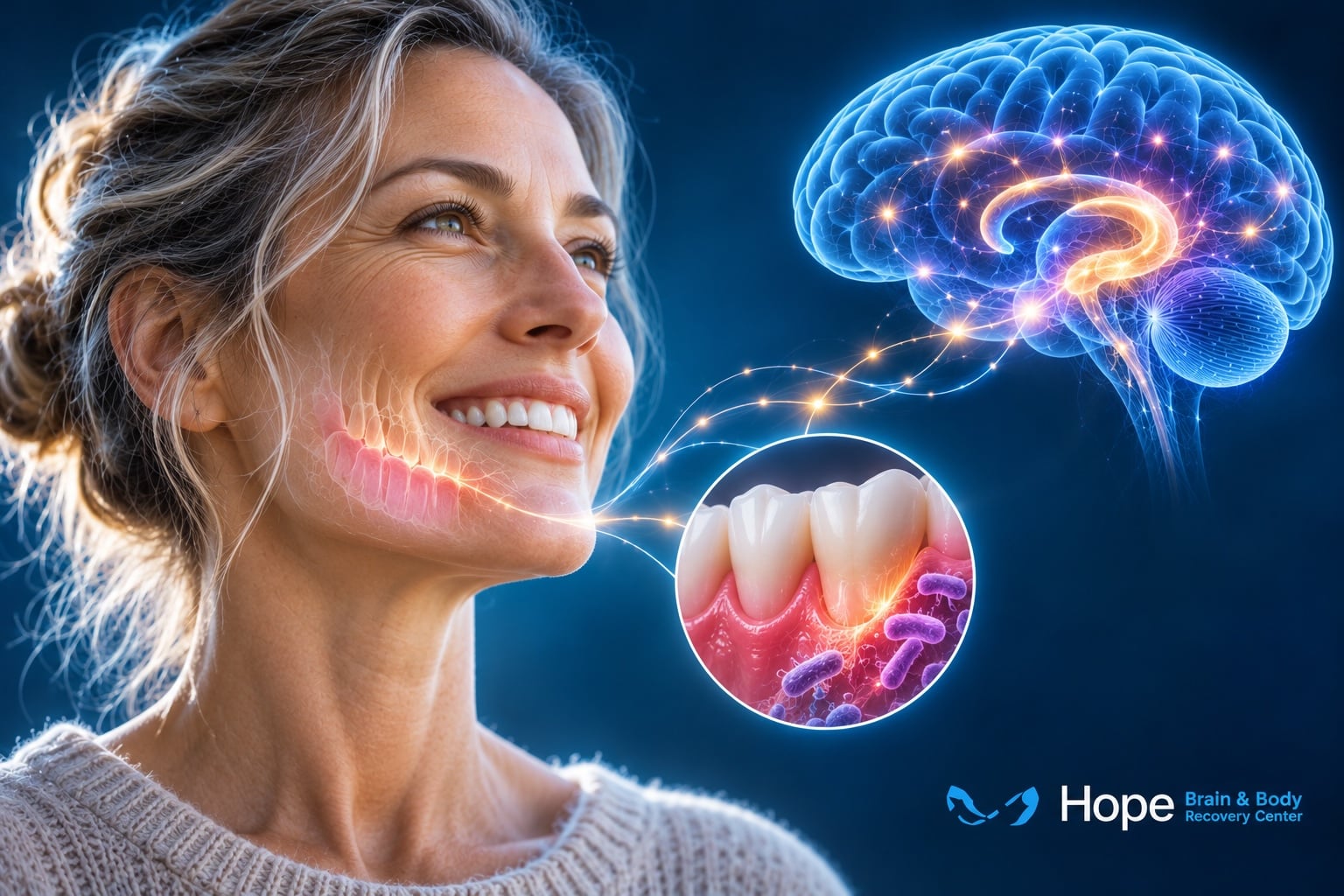
What if one of the simplest habits supporting your long-term health starts in your bathroom?
Most people brush their teeth to prevent cavities, avoid bad breath, and keep their smile healthy.
But researchers are discovering that the health of your gums may be connected to something much bigger: your brain.
Over the past several years, studies have identified associations between periodontal disease, chronic inflammation, cognitive decline, and Alzheimer’s disease.
Scientists are investigating whether bacteria associated with gum disease can influence inflammatory pathways, blood vessels, and neurological processes involved in brain aging.
Some observational studies have even found that people who consistently brush their teeth and clean between them experience lower rates of dementia.
Does this mean brushing your teeth can prevent Alzheimer’s disease?
Not necessarily.
The relationship is complex, and researchers have not established that gum disease directly causes dementia.
But the findings highlight an important principle: the mouth is not separate from the rest of the body.
At Hope Brain & Body Recovery Center, understanding how neurological health interacts with inflammation, circulation, and other physiological systems is an important part of evaluating complex conditions.
Let’s explore what the research tells us about the surprising connection between gum health and brain health.
What Is Gum Disease?
Gum disease refers to inflammatory conditions affecting the tissues surrounding and supporting your teeth.
Two important forms are gingivitis and periodontitis.
Gingivitis: The Early Stage of Gum Inflammation
Gingivitis occurs when the gums become inflamed, often because of bacterial plaque accumulating along the gumline.
Common signs include:
- Red or swollen gums
- Bleeding during brushing or flossing
- Gum tenderness
- Persistent bad breath
Gingivitis can often be reversed with effective oral hygiene and professional dental care.
However, if inflammation persists, some people develop more serious periodontal disease.
Periodontitis: When Supporting Tissues Become Damaged
Periodontitis is a chronic inflammatory condition that damages the structures supporting the teeth.
These include the gums, periodontal ligaments, and surrounding bone.
As the disease progresses, periodontal pockets may deepen, supporting bone can be lost, and teeth may become loose.
Unlike uncomplicated gingivitis, periodontitis can cause irreversible damage to supporting tissues.
But the potential effects of chronic periodontal inflammation may extend beyond the mouth.
Researchers are now examining how these inflammatory processes relate to cardiovascular, metabolic, and neurological health.
How Are Your Gums Connected to Your Brain?
Your mouth contains a complex community of microorganisms.
Many of these bacteria are normal members of the oral microbiome.
Others are associated with periodontal inflammation and tissue damage.
When gum tissue becomes inflamed, its protective barrier may become easier for bacterial components and inflammatory signals to cross.
This creates a potential route through which substances originating in the mouth can enter the bloodstream.
The proposed connection involves three stages:
1. Inflamed gums: Periodontal inflammation compromises the local tissue barrier.
2. Circulation: Bacteria, bacterial components, and inflammatory signals may enter the bloodstream.
3. Brain-related effects: Circulating inflammatory signals may influence blood vessels and neurological processes, while experimental studies suggest possible routes of bacterial exposure to brain tissue.
This pathway is biologically plausible and supported by experimental research.
However, it does not mean that every person with bleeding gums has bacteria entering their brain or that periodontal disease inevitably causes neurological injury.
Porphyromonas gingivalis: A Bacterium Under Investigation
One of the most extensively studied bacteria in this field is Porphyromonas gingivalis, commonly abbreviated as P. gingivalis.
This bacterium is associated with periodontal disease and can contribute to inflammatory processes in the gums.
Researchers are particularly interested in the substances it produces and how they may affect tissues beyond the mouth.
Experimental studies suggest several possible mechanisms through which P. gingivalis could influence neurological health.
1. Bacterial Components and Toxins
P. gingivalis produces biologically active substances, including enzymes known as gingipains.
Researchers have investigated whether these substances can contribute to cellular injury and inflammatory signaling.
Laboratory studies have also explored whether bacterial components can influence the blood-brain barrier.
2. Alzheimer’s-Related Protein Changes
Alzheimer’s disease is associated with changes involving proteins such as amyloid-beta and tau.
Experimental research has examined whether periodontal bacteria or their products can influence processes related to these proteins.
Some findings suggest that bacterial exposure may alter amyloid-related pathways under laboratory conditions.
But this does not establish that P. gingivalis causes Alzheimer’s disease in humans.
3. Activation of Brain Immune Cells
The brain contains specialized immune cells called microglia.
Microglia help monitor the nervous system, respond to injury, and support normal tissue maintenance.
When inflammatory signaling becomes persistent or dysregulated, microglial responses may contribute to neurological damage.
Experimental research suggests that bacterial products associated with periodontal disease can influence microglial activation.
These findings offer possible mechanisms connecting oral inflammation and brain health.
They remain hypotheses requiring further human investigation.
What Have Researchers Found in Alzheimer’s Brain Tissue?
One particularly interesting area of research involves the detection of oral bacterial signatures in brain tissue.
The presentation Gum Health and Brain Health describes a brain-tissue study reporting approximately sevenfold greater oral bacterial diversity in Alzheimer’s samples compared with controls.
Researchers have also investigated bacteria such as Treponema denticola and Fusobacterium nucleatum.
These findings have generated interest in whether oral microorganisms or their components might participate in neurological inflammatory processes.
However, bacterial diversity and bacterial quantity are not the same thing.
Greater diversity means a wider variety of bacterial signatures were identified, not necessarily that seven times as many bacteria were present.
Additionally, detecting bacterial material in brain tissue does not prove that the bacteria caused Alzheimer’s disease.
Questions about contamination, disease-related changes, and the direction of the relationship must also be considered.
The findings are scientifically interesting, but they do not establish a new infectious explanation for Alzheimer’s disease.
Does Gum Disease Increase the Risk of Alzheimer’s Disease?
Several observational studies have identified associations between periodontal disease and dementia.
The presentation highlights some notable findings.
Long-Term Periodontitis and Alzheimer’s Risk
One study associated having periodontitis for more than ten years with approximately 1.7 times the risk of Alzheimer’s disease.
This suggests that the duration of periodontal disease may be relevant when studying long-term neurological outcomes.
Moderate-to-Severe Periodontitis and Dementia
A review covering 20 studies reported that moderate-to-severe periodontal disease was associated with approximately 2.13 times the odds of dementia.
This is a substantial statistical association.
But an odds ratio does not mean that every individual with periodontitis has twice the probability of developing dementia.
Tooth Loss and Dementia
The presentation also describes research linking the loss of five or more teeth with approximately 48% higher dementia incidence over a 15-year period.
Tooth loss can reflect a history of periodontal disease, but it may also be associated with other factors, including nutrition, healthcare access, socioeconomic circumstances, and overall health.
These studies use different statistical measures and populations, so their results should not be directly compared as though they measure the same outcome.
Most importantly, observational associations do not establish cause and effect.
Could Dementia Itself Contribute to Poor Oral Health?
This is an important question.
The relationship between oral health and cognitive decline may operate in more than one direction.
People experiencing memory difficulties may find it harder to maintain consistent oral hygiene.
As dementia progresses, brushing, flossing, scheduling dental visits, and communicating dental discomfort can become more difficult.
Changes in diet, medications, and dependence on caregivers may also affect oral health.
Therefore, some of the association between periodontal disease and dementia may reflect the effects of cognitive impairment on daily dental care.
Researchers must account for these possibilities when interpreting the evidence.
This is one reason randomized clinical trials are needed before concluding that periodontal treatment can prevent dementia.
The Blood-Brain Barrier: Another Possible Connection
Your brain has a specialized protective system called the blood-brain barrier.
This barrier helps regulate which substances can move from circulating blood into brain tissue.
It depends partly on tightly connected cells lining small blood vessels.
The presentation describes a proposed inflammatory pathway in which bacterial components and immune signals influence blood-brain barrier integrity.
For example, bacterial lipopolysaccharides, or LPS, can activate immune responses.
Inflammatory signaling molecules such as IL-1β, TNF-α, and IL-6 may then participate in broader inflammatory processes.
In experimental models, these processes can influence blood-brain barrier function and microglial activity.
Researchers are investigating whether chronic periodontal inflammation contributes to similar processes in humans.
However, the proposed sequence from gum inflammation to blood-brain barrier disruption and Alzheimer’s-related protein accumulation has not been established as a universal pathway in patients.
Gum Disease and the Brain’s Small Blood Vessels
The relationship between oral health and brain health may extend beyond Alzheimer’s disease.
Researchers have also identified associations between periodontal disease and changes in the brain’s small blood vessels.
These vessels supply oxygen and nutrients to deep brain structures and surrounding white matter.
Damage to small cerebral vessels can contribute to neurological dysfunction.
The presentation highlights associations involving:
- Lacunar strokes, which affect small regions deep within the brain
- White matter hyperintensities, which appear as bright areas on certain MRI sequences
- Other manifestations of cerebral small-vessel disease
Some of these changes may occur without obvious symptoms in their early stages.
Chronic inflammation is one possible pathway researchers are investigating.
But small-vessel disease has many established risk factors, including hypertension, diabetes, smoking, and aging.
Periodontal disease should not be assumed to be the cause of an individual’s MRI findings.
At Hope Brain & Body Recovery Center, our services for Stroke Treatment and Neurodegenerative Disorders address neurological conditions in which vascular and brain function may be relevant.
Does Mild Gingivitis Matter?
Much of the research focuses on advanced periodontal disease.
But the presentation also discusses why earlier gum inflammation deserves attention.
Gingivitis can develop before permanent damage to supporting tissues occurs.
Inflamed gums may permit increased exposure to bacterial products and inflammatory signals.
A 2025 study discussed in the presentation linked gingivitis with altered immune function among people with Alzheimer’s disease.
However, this finding does not establish that mild gingivitis causes cognitive decline.
The presentation also notes that P. gingivalis has been detected in dental plaque in young children.
This should not be interpreted as evidence that children are developing Alzheimer’s-related disease processes.
Oral bacteria can be present without producing the neurological outcomes being investigated in adult populations.
The practical message is simple:
Address gum inflammation early because healthy gums matter—not because every episode of gingivitis threatens your brain.
Can Brushing Your Teeth Reduce Dementia Risk?
This is where the research becomes especially relevant to everyday habits.
The presentation describes an 11-year Korean cohort study involving more than 825,000 participants.
Researchers found that people who brushed their teeth at least twice daily had lower observed rates of dementia.
The reported adjusted hazard ratio was approximately 0.85, corresponding to a 15% lower relative rate in the studied population.
A separate 2025 meta-analysis involving more than 261,000 participants also reported an association between more frequent brushing and lower dementia risk.
These findings are encouraging.
But they are observational.
People who maintain consistent oral hygiene may also differ in diet, education, healthcare access, physical activity, and other behaviors that influence health.
Even with statistical adjustments, researchers cannot eliminate every possible source of confounding.
Therefore, brushing twice daily should not be described as a proven method of preventing Alzheimer’s disease.
It is already a well-established habit for maintaining oral health.
The possible neurological association provides an additional reason to study it.
Why Brushing and Interdental Cleaning Work Better Together
Brushing cleans accessible tooth surfaces.
But it does not reliably remove plaque from every space between the teeth.
That is why dental professionals also recommend interdental cleaning.
The presentation describes a study comparing several oral-hygiene routines.
Compared with people who rarely brushed and did not clean between their teeth, the reported adjusted hazard ratios were:
- Brushing twice daily: 0.85
- Consistent interdental cleaning: 0.89
- Brushing twice daily plus interdental cleaning: 0.75
The combined routine was associated with approximately 25% lower dementia incidence in the observational analysis.
This does not mean the combination has been proven to prevent one in four dementia cases.
It means the group following both habits had a lower adjusted rate during the study.
For oral health, however, the combination makes practical sense.
Brushing and interdental cleaning address different surfaces where plaque can accumulate.
Is It Important to Brush Before Bed?
Yes, brushing before bedtime is a valuable oral-hygiene habit.
During sleep, saliva production generally decreases.
Saliva helps protect teeth and oral tissues by supporting natural cleansing and buffering processes.
Removing plaque before sleep reduces the amount of bacterial buildup remaining on the teeth overnight.
The presentation describes an observational study associating consistent bedtime brushing with a dementia hazard ratio of approximately 0.82.
Again, this does not establish a direct protective effect against dementia.
But brushing before bed is a sensible habit for maintaining dental health.
A practical daily routine generally includes brushing twice with fluoride toothpaste, including before sleep, and cleaning between the teeth.
How Important Are Professional Dental Cleanings?
Even with careful home hygiene, plaque can accumulate in areas that are difficult to reach.
Over time, plaque can harden into calculus, commonly called tartar.
Once hardened, calculus generally requires professional removal.
The presentation describes research associating professional dental cleaning within the previous year with a lower observed dementia rate, with an adjusted hazard ratio of approximately 0.88.
It also notes that periodontal scaling can reduce inflammatory markers such as C-reactive protein, IL-6, and TNF-α in some studies.
These findings are relevant because they suggest periodontal treatment may influence systemic inflammatory measurements.
However, lowering inflammatory markers does not prove that dental cleaning prevents Alzheimer’s disease.
Professional cleaning and periodontal treatment are important because they help manage oral disease.
Your dentist or dental hygienist can recommend the appropriate interval based on your gum health and individual risk factors.
Floss, Interdental Brushes, or Water Flossers: Which Is Best?
There is no single interdental-cleaning device that works best for everyone.
The presentation compares several options.
Interdental Brushes
Interdental brushes are small brushes designed to clean spaces between teeth.
A review of 22 trials found that they produced the greatest reduction in a gingival inflammation index among the devices compared.
They can be particularly useful when spaces between teeth are large enough to accommodate them safely.
Water Flossers
Water flossers use a directed stream of water to clean around teeth and along the gumline.
The presentation describes a four-week trial in which water flossers performed better than interdental brushes for reducing gum bleeding.
However, results depend on the outcome being measured.
Traditional Dental Floss
Dental floss remains useful, particularly where teeth are closely spaced.
Its effectiveness depends on technique and consistent use.
The important takeaway is that no single device has been established as superior across every oral-health outcome and every patient.
A dental professional can help you select the most appropriate method.
Could Antiseptic Mouthwash Improve Brain Health?
Researchers are also investigating whether reducing certain oral bacteria could influence outcomes in people with cognitive impairment.
The presentation describes a 24-week study involving people with mild Alzheimer’s disease who used a chlorhexidine-containing oral rinse.
The rinse reduced levels of several periodontal bacteria, including P. gingivalis, Treponema, and Tannerella.
However, cognitive test scores did not improve during the study period.
This distinction is important.
Reducing oral bacterial levels does not automatically translate into measurable neurological improvement.
Chlorhexidine is also not intended for unrestricted long-term use without professional guidance.
It can cause tooth staining and other adverse effects.
Patients should use medicated oral rinses only as recommended by their dental team.
What Can You Do Today to Support Gum Health?
You do not need an experimental treatment to begin improving your oral-health routine.
The presentation concludes with three practical recommendations.
Brush at Least Twice Daily
Use a soft-bristled toothbrush and fluoride toothpaste.
Pay particular attention to the gumline, where plaque commonly accumulates.
Include brushing before bedtime.
Clean Between Your Teeth Every Day
Use dental floss, interdental brushes, or a water flosser according to your dental professional’s advice.
The most effective method is one that fits your mouth and that you can use consistently.
Maintain Regular Professional Dental Care
Schedule dental examinations and cleanings at intervals appropriate for your oral health.
If you experience persistent bleeding, gum swelling, loose teeth, or other symptoms, seek evaluation rather than waiting for a routine appointment.
These habits have clear benefits for preventing and managing oral disease, regardless of whether future research confirms a causal relationship with dementia.
What This Research Means for Brain Health
The connection between periodontal disease and neurological health is an emerging field of investigation.
Several lines of evidence suggest that the relationship deserves serious attention.
Observational studies have linked periodontal disease with dementia and cognitive decline.
Experimental research has identified possible inflammatory and bacterial pathways.
Brain-tissue studies have detected oral bacterial signatures in some Alzheimer’s samples.
Neuroimaging research has associated periodontal disease with certain cerebrovascular changes.
And large population studies have linked better oral-hygiene habits with lower observed dementia rates.
Taken together, these findings support continued investigation.
But important questions remain.
Does periodontal inflammation contribute directly to neurodegeneration?
Could Alzheimer’s-related changes make periodontal disease more likely?
Do shared risk factors explain some of the associations?
And most importantly, can treating gum disease reduce the future risk of dementia?
We do not yet have definitive answers.
Brain Health Requires Looking Beyond the Brain
One of the most important lessons from this research is that neurological health is influenced by many interconnected systems.
Circulation, immune signaling, metabolic function, sleep, physical activity, and other aspects of health can all contribute to neurological outcomes.
Oral health may be another part of this broader picture.
At Hope Brain & Body Recovery Center, our Functional Medicine and Brain-Specific Rehabilitation services emphasize individualized evaluation of complex neurological and physiological concerns.
Dental disease itself requires evaluation and treatment by a qualified dentist or periodontist.
Neurological rehabilitation and dental care serve different purposes, but they can be complementary parts of comprehensive healthcare.
A Healthy Smile Is Already Worth Protecting
The research connecting gum health with brain health is fascinating.
But the strongest reason to care for your gums doesn’t depend on proving a link to Alzheimer’s disease.
Healthy gums help preserve your teeth, reduce oral inflammation, support comfortable eating, and contribute to overall wellbeing.
The possibility that oral health may also influence long-term neurological outcomes makes the subject even more important to study.
For now, the evidence supports a practical message:
Brush twice daily. Clean between your teeth. Maintain professional dental care. And treat persistent gum inflammation rather than ignoring it.
These are sensible habits with established oral-health benefits—and potential broader implications that science is still exploring.
Concerned About Memory, Cognitive Changes, or Neurological Health?
If you or someone you care about is experiencing memory difficulties, cognitive changes, balance problems, or other neurological symptoms, a comprehensive evaluation may help clarify appropriate next steps.
At Hope Brain & Body Recovery Center, we focus on identifying patterns of neurological dysfunction and developing individualized rehabilitation strategies based on each patient’s clinical findings.
Our approach can complement ongoing care from neurologists, primary care physicians, and other healthcare professionals.
Schedule your FREE 15-minute consultation with Hope Brain & Body Recovery Center to discuss your symptoms and whether a neurological evaluation may be appropriate.
Our Location: 6 Dickinson Dr suite 310 Building 300, Chadds Ford, PA 19317, United States
Ready to Take the Next Step?
Living with neuropathy, chronic nerve pain, brain injury, or complex neurological symptoms can be frustrating—especially when the treatments you’ve already tried haven’t delivered the progress you hoped for.
At Hope Brain Center, Dr. Joseph Schneider and his team take a comprehensive approach to neurological rehabilitation, including tPRF, combining advanced diagnostics with individualized therapies designed around how your nervous system is actually functioning.
Your first step is a conversation.
Book Your Consultation Today
Discover whether Hope Brain Center’s personalized neurological approach may be right for you.
👉 BOOK NOW: https://hopebraincenter.com/book/
Don’t settle for simply managing symptoms. Start exploring what’s possible when your brain and nervous system are evaluated as a whole.