Have you ever learned a new language, mastered a musical instrument, recovered from an injury, or developed a new habit?
If so, you’ve witnessed one of the brain’s most remarkable abilities in action: neuroplasticity.
For decades, scientists believed the adult brain was largely fixed—that once development was complete, the brain’s wiring could no longer change. Today, neuroscience tells a very different story.
Your brain is constantly adapting, reorganizing, and strengthening connections based on how you use it. Every experience, movement, thought, and behavior influences the way your nervous system is wired.
At Hope Brain & Body Recovery Center, neuroplasticity forms the foundation of many of our rehabilitation programs because the brain has an incredible capacity to learn, adapt, and recover throughout life.
Schedule Your Complimentary Consultation
If you’re ready to regain your confidence, improve your balance, and get back to living life, schedule your FREE consultation today. Our experienced team will help determine the underlying cause of your symptoms and design a treatment plan focused on long-term recovery.
“Nerves That Fire Together Wire Together”
One of the best-known principles in neuroscience comes from Hebb’s Law, often summarized by the phrase:
“Nerves that fire together wire together.”
This simple statement explains how learning occurs inside the brain.
Whenever groups of neurons activate together repeatedly, the connections between them become stronger and more efficient.
Over time, these strengthened pathways allow information to travel faster and with less effort.
This is the biological basis for:
- Learning new skills
- Forming memories
- Developing habits
- Improving athletic performance
- Recovering neurological function
Simply put, the more often you practice something, the more efficiently your brain performs it.
What Is Neuroplasticity?
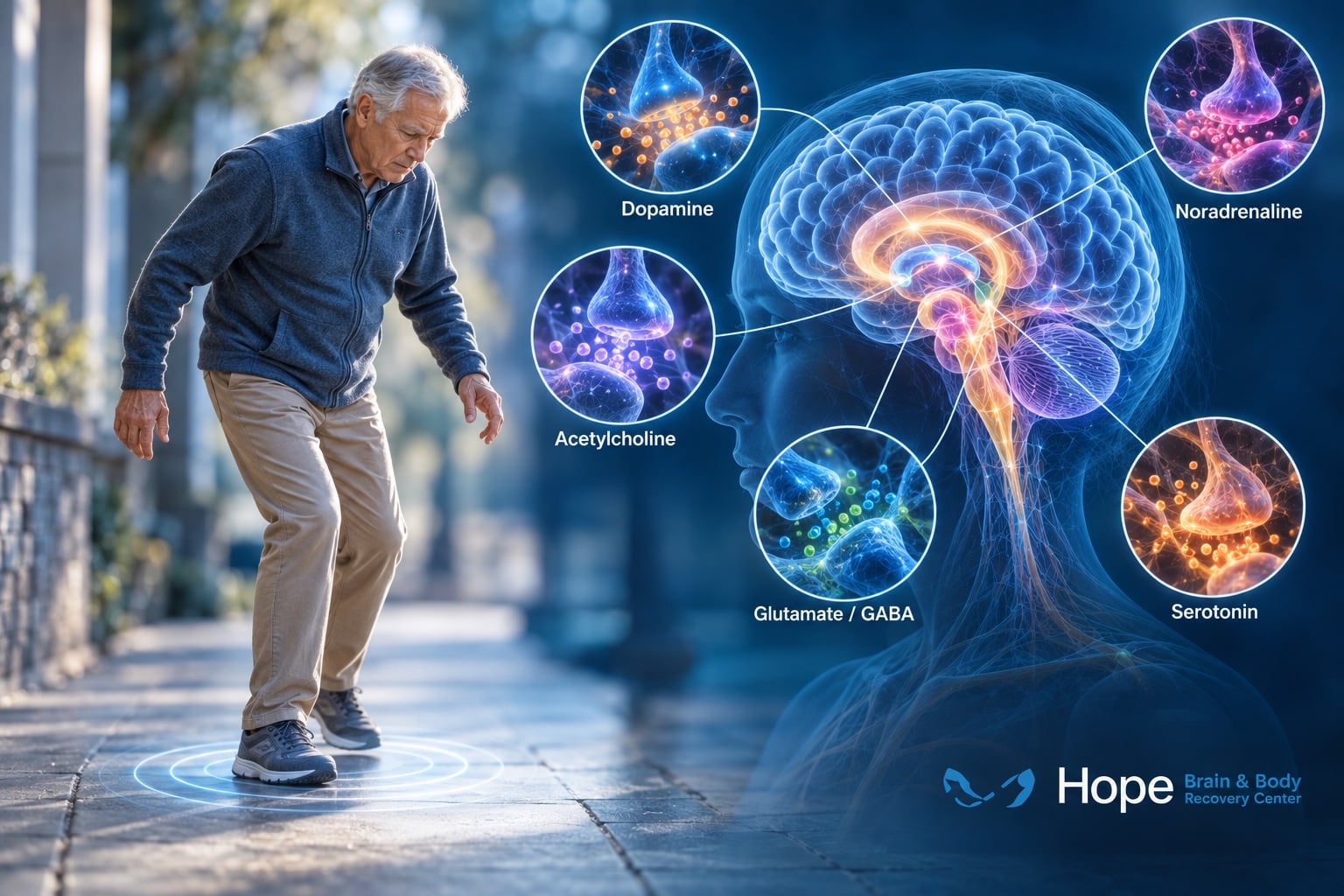
Neuroplasticity refers to the brain’s remarkable ability to reorganize itself by forming and modifying neural connections throughout life.
This allows the nervous system to:
- Adapt to new experiences
- Learn new information
- Recover from injury
- Develop new skills
- Improve movement
- Strengthen memory
Rather than being a rigid organ, the brain is constantly remodeling itself in response to daily life.
Neuroplasticity Doesn’t End in Childhood
Children often learn quickly because their brains are highly adaptable.
However, one of the most exciting discoveries in modern neuroscience is that neuroplasticity continues throughout adulthood.
While the pace of change may slow with age, research has demonstrated that adults retain a significant ability to develop new neural pathways and strengthen existing ones.
This discovery has transformed neurological rehabilitation and offers hope to individuals recovering from stroke, concussion, vestibular disorders, and many other neurological conditions.
Your Brain Changes Every Day
Neuroplasticity isn’t limited to rehabilitation after injury.
It happens continuously during ordinary life.
Learning New Skills
Whether you’re learning to play the piano, speak another language, or improve your golf swing, repeated practice strengthens the neural circuits responsible for those skills.
The more consistently you practice, the more efficient those pathways become.
Adapting to New Environments
Starting a new job, moving to a different city, or learning a new routine requires your brain to build entirely new networks.
As unfamiliar situations become familiar, your nervous system becomes more efficient at processing them.
Building Habits
Habits are among the clearest examples of neuroplasticity.
Positive habits—such as regular exercise, meditation, or healthy eating—strengthen beneficial neural pathways.
Negative habits also become reinforced through the same process.
This explains why both healthy routines and unhealthy behaviors become easier to repeat over time.
The Two Sides of Neuroplasticity
Neuroplasticity involves both building and removing connections.
Synaptic Strengthening
Frequently used neural pathways become stronger.
Repeated activation increases communication between neurons and improves the efficiency of information processing.
This strengthening supports:
- Skill development
- Learning
- Memory
- Coordination
- Automatic movement
Synaptic Pruning
At the same time, the brain eliminates pathways that are rarely used.
This process, known as synaptic pruning, helps remove unnecessary connections and improves overall efficiency.
Think of it as cleaning up a road system—well-traveled highways are expanded while unused roads gradually disappear.
This concept is often summarized as:
Use it—or lose it.
Real-Life Examples of Neuroplasticity
Scientists have observed neuroplasticity in countless fascinating situations.
Stroke Recovery
After a stroke, undamaged areas of the brain may gradually assume functions previously performed by injured regions.
Through targeted rehabilitation, patients often regain movement, speech, or balance that once seemed permanently lost.
Professional Musicians
Brain imaging studies show that musicians develop enlarged motor and auditory regions after years of practice.
Their brains literally become specialized for musical performance.
London Taxi Drivers
One famous study found that experienced London taxi drivers developed larger hippocampi—the brain’s memory centers—after memorizing the city’s incredibly complex street network.
Braille Readers
Individuals who read Braille develop expanded sensory representation of their reading fingertip within the brain.
Repeated touch-based learning physically reshapes the sensory cortex.
Learning a Second Language
Bilingual individuals often demonstrate increased gray matter density in regions involved in language processing.
The earlier and more consistently a second language is practiced, the greater these changes may become.
Why Neuroplasticity Matters in Rehabilitation
Neuroplasticity is the foundation of modern neurological rehabilitation.
Rather than simply compensating for deficits, therapy aims to encourage the brain to develop healthier, more efficient pathways.
At Hope Brain & Body Recovery Center, treatment programs are designed to stimulate meaningful neurological change through carefully targeted interventions.
Depending on the patient’s needs, this may include:
- Functional neurological rehabilitation
- Vestibular therapy
- Balance training
- Vision rehabilitation
- Cognitive exercises
- Motor retraining
- Sensory integration
- Lifestyle interventions
Every activity is selected with the goal of encouraging beneficial neuroplastic changes.
Can You Improve Neuroplasticity?
Although everyone’s brain changes naturally, certain behaviors appear to promote healthy neuroplasticity.
These include:
Deliberate Practice
Focused repetition strengthens neural pathways more effectively than passive repetition.
Physical Exercise
Movement increases blood flow to the brain and supports overall neurological health.
Lifelong Learning
Continuously challenging the brain with new experiences encourages ongoing adaptation.
Mindfulness
Paying close attention during learning appears to enhance the brain’s ability to strengthen new connections.
Variety
Exposing yourself to new environments, skills, and experiences helps build greater cognitive flexibility and resilience.
Every Choice Shapes Your Brain
One of the most empowering aspects of neuroplasticity is realizing that your daily choices matter.
Every time you:
- Practice an instrument
- Exercise
- Read
- Solve a puzzle
- Learn something new
- Improve your balance
- Challenge your memory
…you are actively influencing the structure and function of your brain.
Small, consistent actions performed over time create meaningful neurological change.
Hope Brain & Body Recovery Center’s Functional Neurology Approach
At Hope Brain & Body Recovery Center, we view neuroplasticity as the foundation of healing.
Whether someone is recovering from a concussion, stroke, vestibular disorder, neuropathy, or another neurological condition, our goal is to help the brain establish healthier communication pathways.
By combining advanced diagnostics with personalized neurological rehabilitation, we work to maximize the brain’s natural ability to adapt, recover, and improve function.
Every patient receives an individualized treatment plan designed to stimulate meaningful neurological change while supporting long-term brain health.
Your Brain Is Always Learning
The remarkable thing about neuroplasticity is that it never completely stops.
Every experience leaves its mark.
Every habit strengthens a pathway.
Every new challenge creates an opportunity for growth.
The question isn’t whether your brain is changing.
It’s how you’re helping shape those changes.
Start Your Journey Toward Better Brain Health
Whether you’re recovering from a neurological condition or simply looking to optimize your cognitive function, Hope Brain & Body Recovery Center can help.
Our personalized functional neurology programs are designed to harness the power of neuroplasticity and support healthier brain function at every stage of life.
Schedule Your Complimentary Consultation
If you’re ready to regain your confidence, improve your balance, and get back to living life without constant dizziness, schedule your FREE consultation today. Our experienced team will help determine the underlying cause of your symptoms and design a treatment plan focused on long-term recovery.