How many doctors have told you your POTS symptoms are “just in your head”?
If you’re like the majority of patients we see, you’ve been through multiple tests. Standard testing couldn’t pinpoint what’s wrong, though. Your doctors ran the usual tests and said “there’s nothing more we can find.”
NeuroAI technology is changing that story for patients like you.
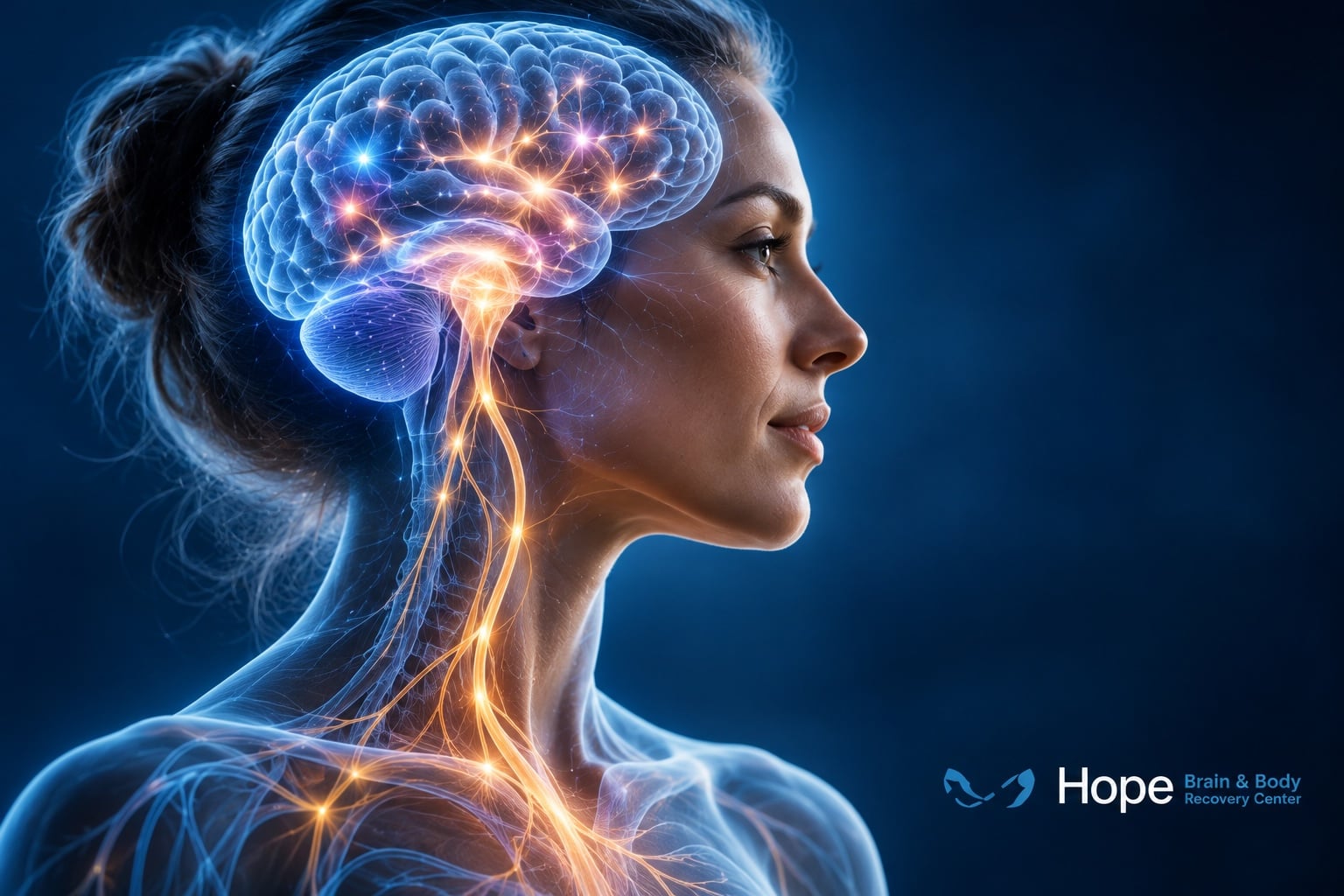
This AI-powered system analyzes your brain function with precision that wasn’t available in clinical practice until now. The technology uses eye tracking to give us earlier, more accurate diagnosis. We get real answers where traditional testing falls short.
We’re now using specific tools – Falcon vHIT Goggles, DX200 VNG Goggles, NOTC Pro+ Rotary Chair, CX100 At-Home Monitoring, and the NeuroAI Cloud Platform. These create treatment plans based on your unique neurological patterns.
You’ll learn exactly how NeuroAI works. More importantly, you’ll discover what this means for getting your life back.
What You Need to Know About NeuroAI Technology
How NeuroAI Actually Works
NeuroAI is an FDA-cleared diagnostic platform. It watches your eyes to reveal how your brain functions. Testing on over 12,000 patients shows 94% accuracy in identifying brain dysfunction and 91% precision in ruling out false positives. The system examines 800 different brain function markers across 26 clinical tests, delivering results three times faster than conventional approaches.
Think about it this way: your eyes tell a story about your brain.
The technology monitors tiny movements in your eyes during specific tasks. These micro-movements expose problems that standard tests miss completely. Four core technologies work at the same time: eye-tracking diagnostics, predictive analysis, real-time data processing, and biomarker detection. Machine learning algorithms connect eye-movement patterns to physical and cognitive disability measures, with research showing that multiple eye-movement parameters explain between 53% and 74% of variance in clinical outcomes.
Why Your Previous POTS Tests Failed You
POTS diagnosis faces real challenges. Healthcare professionals often miss the symptom burden, resulting in substantial diagnostic delay. Despite requiring an orthostatic challenge test for diagnosis, POTS complexity means symptoms frequently go unrecognized. Limited access to autonomic specialists and testing leads to underdiagnosis.
Here’s what the research shows: Machine learning studies found that models trained solely on symptom surveys performed poorly, with areas under the curve of only 0.68 and 0.63 respectively.
Your symptoms were real. The testing just wasn’t good enough.
Our Approach Looks at Your Whole System
NeuroAI follows one core philosophy: you cannot treat the brain in isolation.
Instead of treating pieces of your condition, the system evaluates brain connectivity and function, autonomic nervous system balance, vestibular and balance systems, cardiovascular and metabolic health, plus eye movement and neurological coordination. This approach identifies both strong and weak neurological pathways. We can then design targeted rehabilitation strategies.
The NeuroAI Cloud Platform unifies data from all devices, analyzing those 800+ data points to detect subtle dysfunctions that traditional testing overlooks. We find problems where other doctors found nothing.
HOW WE HELP – The Tools That Give Us Answers
Five specialized devices work together to build a complete picture of how POTS affects your brain and balance systems. Each tool captures different aspects of your neurological function.
Falcon vHIT Goggles for Vestibular Testing
These goggles use ultra-sensitive motion sensors to track vestibulo-ocular reflexes during head impulse testing. The open goggle design allows rapid assessment of all six semicircular canals within minutes. This technology detects both overt and covert catch-up saccades that bedside testing misses entirely.
Your inner ear function gets measured with precision that wasn’t possible even five years ago.
DX200 VNG Goggles for Eye Movement Analysis
The DX200 functions as an industry-leading VNG platform with a virtual 3D display built directly into the goggles. At a 250 Hz sampling rate and spatial resolution of 0.01° for horizontal and vertical movements and 0.1° for torsional tracking, the system detects micro-movements other platforms miss. Each camera captures at 350×248 resolution, enabling precise oculomotor testing for concussion research and neurological populations.
NOTC Pro+ Rotary Chair for Balance Assessment
The NOTC Pro+ delivers gold-standard vestibular assessment through six degrees of motion. Rotary chair testing measures the vestibulo-ocular reflex by rotating patients at varying speeds while monitoring eye movements. This method proves especially valuable for detecting bilateral vestibular loss, a condition that conventional VNG testing often produces false results for.
CX100 At-Home Monitoring for Daily Tracking
The CX100 enables remote neurological assessment between clinical visits. Patients receive this device after in-clinic evaluation to continue visual movement exercises at home, supporting continuous care for progressive conditions.
NeuroAI Cloud Platform for Data Integration
The cloud platform unifies data from all devices. It analyzes those 800+ data points across 26 clinical tests. This integration allows the system to detect subtle dysfunctions traditional testing overlooks while continuously improving through machine learning.
Instead of the focus being all about individual symptoms, our focus is on building a complete profile of your neurological function.
HOW WE HELP With NeuroAI Treatment
Treatment success depends on catching problems early. You need care based on real data, not guesswork.
NeuroAI shifts POTS management from “let’s try this and see what happens” to knowing exactly what your brain needs.
Earlier Detection That Actually Works
Wearable devices collect data during your routine daily activities. They capture natural variability that clinic-based tests miss. Machine learning models analyze ECG and accelerometer metrics to identify posture-change points and detect changes occurring naturally throughout your day. Studies involving 66 POTS patients and 20 controls demonstrated promising performance in accurately differentiating POTS from healthy individuals.
This wearable-based approach addresses key limitations of conventional tilt-table tests. Instead of a snapshot in a clinic, we monitor subtle yet clinically significant variations in real-world settings.
Your Personal Treatment Plan
AI algorithms evaluate your unique data and select interventions based on how you specifically react. Hydration trackers estimate your daily volume requirements. Salt intake recommendations adapt to your personalized heart rate and blood pressure trends.
Digital twin technology simulates your specific medication responses. We predict which drugs will work best for your unique autonomic profile. POTS patients often respond differently to medications like midodrine or pyridostigmine. This personalization reduces trial-and-error and minimizes side effects.
Real-Time Adjustments That Keep You Safe
Continuous monitoring detects subtle warning signs like changes in heart rate variability that happen before acute episodes. AI forecasts potential complications such as cardiovascular instability. We can intervene before you crash. Wearable apps provide real-time clinical suggestions and reminders, promoting awareness of heart rate and associated symptoms.
Finding Hidden Conditions
POTS frequently presents alongside other conditions. Migraine affects 55% of POTS patients. You might also deal with chronic fatigue syndrome, fibromyalgia, and irritable bowel syndrome. Common co-morbidities between POTS and autonomic neuropathy may reflect shared pathophysiology.
We find these connections. We treat the whole picture, not just isolated symptoms.
Learn More
What Happens When You Come to See Us
Your First NeuroAI Visit
On your initial visit, you will consult with our doctors about your symptom patterns – when they started, how often they occur, and what triggers them like heat or standing too long. We assess your medical history, particularly any autoimmune conditions that increase POTS risk. You’ll then undergo measurements of your vital signs while lying down, sitting, and standing.
Our multi-system approach evaluates your brain connectivity, autonomic nervous system balance, vestibular systems, cardiovascular health, and eye movement coordination. This isn’t like the fragmented testing you’ve probably experienced before.
Reading Your Test Results
You receive detailed reports that highlight which brain regions show abnormalities, confidence scores, and your risk analysis. The platform processes data across 800+ markers to catch subtle problems that traditional testing misses completely.
We find that these detailed results often explain symptoms you’ve had trouble describing to other doctors.
The Reality About Costs
Many specialized centers no longer contract with insurance providers. You’ll receive a superbill to submit for possible out-of-network reimbursement.
Some insurance companies deny autonomic testing. Appeals succeed in the vast majority of cases, though. Prepayment is typically required one week before scheduled visits.
We know this isn’t what you want to hear about costs. The investment in proper testing, though, often saves money on treatments that actually work.
Finding a Center Near You
Autonomic testing requires specialized equipment and training. Due to high demand and limited specialists, wait times can be substantial. The Dysautonomia Project maintains an interactive provider map.
Don’t wait to get started. The sooner you get proper testing, the sooner you can begin recovery.
BOOK FREE PHONE CONSULTATION
Get a free 15-minute consultation with a Hope Brain & Body Recovery Center Specialist.
You Don’t Have to Accept “There’s Nothing More We Can Do”
NeuroAI technology changes everything for POTS patients who’ve been told their case is hopeless.
You’re no longer stuck with outdated testing methods. You don’t have to accept misdiagnosis or delayed treatment anymore.
We can detect problems earlier. We adjust your treatment based on real data from your brain, not guesswork.
Finding a NeuroAI-equipped center means getting answers that match what you’re actually experiencing. Your treatment plan works for your unique neurological patterns.
We find that prognosis is rarely true.
Key Takeaways
NeuroAI technology is revolutionizing POTS diagnosis and treatment by providing precise, data-driven insights that traditional testing methods often miss.
• NeuroAI achieves 94% diagnostic accuracy using AI-powered eye tracking to analyze 800+ brain function markers across 26 clinical tests • Five specialized devices work together to create personalized treatment plans: Falcon vHIT Goggles, DX200 VNG Goggles, NOTC Pro+ Rotary Chair, CX100 At-Home Monitoring, and NeuroAI Cloud Platform • Real-time monitoring enables earlier detection of POTS symptoms and allows for immediate treatment adjustments based on your unique neurological patterns • The technology identifies co-existing conditions like migraine and chronic fatigue syndrome that commonly occur with POTS, providing comprehensive care • While insurance coverage varies, NeuroAI-equipped centers offer hope for patients who’ve experienced diagnostic delays with traditional testing methods
This breakthrough technology transforms POTS care from reactive symptom management to predictive, personalized intervention, giving patients the accurate diagnosis and effective treatment they deserve.
FAQs
Q1. How accurate is NeuroAI technology in diagnosing POTS compared to traditional testing methods? NeuroAI demonstrates 94% accuracy in identifying brain dysfunction and 91% precision in ruling out false positives, based on testing with over 12,000 patients. The system analyzes 800 different brain function markers across 26 clinical tests, delivering results three times faster than conventional approaches while detecting subtle dysfunctions that traditional testing often overlooks.
Q2. What devices are used during a NeuroAI assessment for POTS patients? Five specialized devices work together during NeuroAI assessment: Falcon vHIT Goggles for vestibular testing, DX200 VNG Goggles for precise eye movement analysis, NOTC Pro+ Rotary Chair for balance assessment, CX100 At-Home Monitoring for daily tracking between visits, and the NeuroAI Cloud Platform that integrates all data for comprehensive analysis.
Q3. Will my insurance cover NeuroAI testing and treatment for POTS? Insurance coverage varies significantly, as many specialized centers no longer contract with insurance providers. You’ll typically receive a superbill to submit for possible out-of-network reimbursement. While some insurance companies initially deny autonomic testing, appeals succeed in the vast majority of cases. Prepayment is usually required one week before scheduled visits.
Q4. How does NeuroAI create personalized treatment plans for POTS patients? NeuroAI uses AI algorithms to evaluate your unique patient data and select interventions based on your specific reactions and features. The system provides personalized hydration and salt intake recommendations, simulates medication responses through digital twin technology, and continuously monitors your progress to adjust treatment in real-time based on your individual neurological patterns.
Q5. Can NeuroAI detect other conditions that commonly occur alongside POTS? Yes, NeuroAI can identify co-existing neurological conditions that frequently present with POTS, including migraine (which affects 55% of POTS patients), chronic fatigue syndrome, fibromyalgia, autonomic neuropathy, and irritable bowel syndrome. This comprehensive approach helps address shared pathophysiology and provides more complete care.